
1869’s Tear-Jerking Masterpiece: The Elder Sister’s Unforgettable Embrace!
Ever stumbled upon a painting that just… grabs you?
Not just visually, but deep down, tugging at something raw and undeniably human?
That’s exactly how I felt the first time I laid eyes on William-Adolphe Bouguereau’s “The Elder Sister.”
Painted in **1869**, this isn’t just a canvas with some paint on it; it’s a window into a moment of pure, unadulterated sibling devotion.
It tells a story, evokes an emotion, and frankly, it’s one of those pieces that sticks with you, years after you’ve seen it.
For art lovers, it’s a cornerstone.
For anyone with a sibling, or who has ever witnessed the tender bond between children, it’s a mirror reflecting something profoundly true.
Table of Contents
The Enduring Legacy of William-Adolphe Bouguereau
So, who was this guy, Bouguereau?
If you’re not deep into art history, his name might not ring as many bells as, say, Monet or Van Gogh.
But trust me, in his day, he was a superstar.
Born in La Rochelle, France, in 1825, Bouguereau wasn’t just *good*; he was prodigiously talented, mastering academic painting techniques with an almost frightening precision.
He was a true titan of the French Academic style, a period characterized by meticulous detail, idealized forms, and subjects often drawn from mythology, classical literature, and allegories.
Think of it like this: while some artists were busy trying to break the mold and experiment with new styles (hello, Impressionists!), Bouguereau was perfecting the mold.
He believed in beauty, in narrative, and in the power of art to uplift and inspire.
His paintings often feature beautiful, angelic figures, particularly women and children, rendered with such a delicate touch you almost expect them to breathe.
He wasn’t afraid of sentimentality, which, ironically, became both his greatest strength and, later, a point of critique from avant-garde movements.
But for me, that sentimentality is precisely what makes “The Elder Sister” so profoundly moving.
It’s not just a painting; it’s a profound act of visual storytelling.
And let’s be honest, in a world that often feels cynical, a little genuine sentiment can be incredibly powerful.
He was a master of depicting skin tones that glow, fabrics that shimmer, and eyes that seem to gaze right into your soul.
His academic training was rigorous, and it shows in every brushstroke – from the anatomical correctness of his figures to the masterful use of light and shadow.
He was, in many ways, the embodiment of the classical tradition in a rapidly modernizing world.
Imagine being an art student in 19th-century Paris, and you’d be looking up to Bouguereau as the ultimate success story.
He won the prestigious Prix de Rome, exhibited regularly at the Salon (the official art exhibition of the Académie des Beaux-Arts), and his works were highly sought after by collectors.
He wasn’t just painting pretty pictures; he was shaping the aesthetic tastes of an era.
The Elder Sister: A Masterpiece Revealed
Now, let’s get to the star of the show: “The Elder Sister.”
When you first see it, what strikes you immediately is the tenderness.
It’s so palpable you can almost feel it.
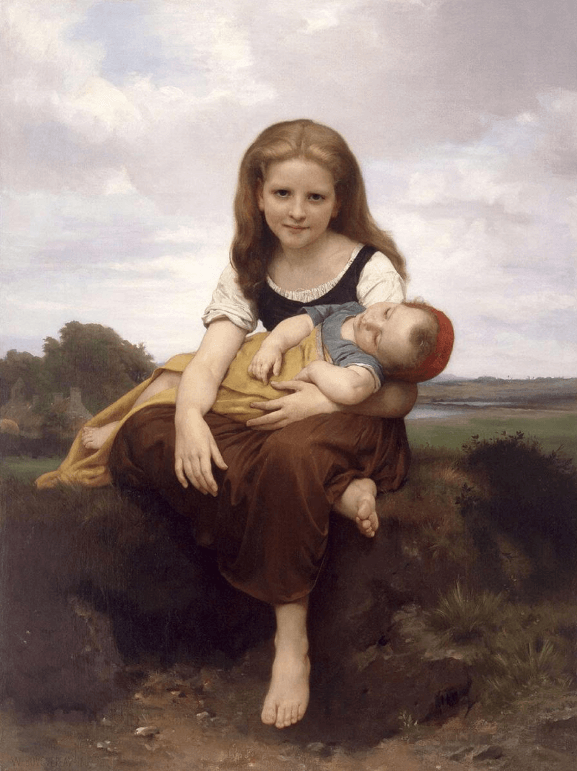
The painting depicts a young girl, perhaps no older than 10 or 12, gently cradling a sleeping infant in her lap.
They’re seated outdoors, in what appears to be a rustic, natural setting, bathed in a soft, ethereal light that seems to come from nowhere and everywhere at once.
The elder sister’s gaze is fixed on the baby, a look of profound affection and protectiveness etched on her face.
Her arm is wrapped around the baby, holding it securely, almost as if she’s shielding it from the world.
The infant, plump and rosy-cheeked, sleeps soundly, completely trusting in the gentle embrace of its older sibling.
The colors are muted yet rich, dominated by earthy tones and the soft blues and whites of their clothing, which make the vibrant skin tones of the children truly pop.
Bouguereau’s technique here is just *chef’s kiss*.
The brushstrokes are virtually invisible, creating a smooth, almost photographic realism that draws you into the scene.
Every detail, from the delicate folds of their simple garments to the tiny fingers of the baby, is rendered with meticulous care.
It’s clear that Bouguereau wasn’t just painting models; he was capturing a universal truth about family, care, and innocence.
The painting’s composition is incredibly balanced, drawing your eye from the elder sister’s face, down to the baby, and then subtly out to the serene landscape behind them.
It creates a sense of peaceful intimacy, making you feel like you’re witnessing a private, sacred moment.
And the lighting!
It’s soft, warm, and seems to perfectly illuminate the children, highlighting their purity and vulnerability.
This isn’t just natural light; it’s idealized light, enhancing the emotional resonance of the scene.
It’s like looking at a cherished photograph, but one that has been painstakingly crafted with layers of emotion and artistic intention.
The elder sister herself is portrayed with a maturity beyond her years, her expression a mix of innocence and profound responsibility.
Her large, dark eyes convey a depth of feeling that is truly captivating.
And the baby – oh, the baby!
Those rosy cheeks, the soft curls of hair, the perfectly rendered tiny fingers – it’s a testament to Bouguereau’s skill in capturing the delicate beauty of infancy.
It’s believed that the models for “The Elder Sister” were Bouguereau’s own children, Henriette and Paul, adding another layer of personal significance and tenderness to the work.
This personal connection likely infused the painting with an even greater degree of warmth and authenticity, making it more than just a depiction, but a heartfelt tribute to familial love.
This masterpiece now resides in the Museum of Fine Arts, Houston, where it continues to enchant visitors.
Symbolism, Emotion, and the Human Connection
Beyond just being a pretty picture, “The Elder Sister” is loaded with symbolism and emotional depth.
First, let’s talk about the symbolism of the elder sister herself.
She represents protection, maternal instinct even at a young age, and the blossoming of responsibility.
She’s the guardian, the nurturer, and the first teacher.
Her gaze isn’t just loving; it’s a profound commitment, a quiet promise to watch over and care for this tiny, vulnerable being.
The natural setting, too, isn’t just a backdrop.
It evokes a sense of purity, simplicity, and a return to fundamental human connections.
It’s untouched by the complexities of urban life, suggesting that this bond is as natural and essential as the earth itself.
The innocence of the children, their untainted beauty, is a powerful symbol of purity and hope.
In a world that was rapidly industrializing and undergoing significant social upheaval in 1869, Bouguereau’s focus on such pristine innocence might have been a deliberate artistic choice to offer solace and a reminder of timeless virtues.
But really, where this painting truly shines is in its emotional resonance.
It taps into universal feelings: the love between siblings, the tenderness of care, the quiet joy of watching someone you adore, even if they’re completely unaware of your presence.
It evokes a sense of nostalgia for simpler times, for bonds that are uncomplicated and pure.
It reminds us that even in a chaotic world, there are moments of profound peace and connection.
It’s the kind of painting that makes you think about your own family, your own siblings, or perhaps the moments you’ve witnessed such tenderness between children.
It’s a silent testament to the enduring power of unconditional love.
And that, my friends, is why it’s more than just a beautiful piece of art; it’s a profound human experience captured on canvas.
The juxtaposition of the elder sister’s knowing gaze with the infant’s blissful slumber creates a compelling narrative about the cycle of life and the inherent human need for connection and nurturing.
The way the elder sister’s hand delicately supports the baby’s head is a masterclass in conveying gentle strength.
It’s not just holding; it’s cherishing.
This painting speaks volumes about empathy and compassion without uttering a single word.
It teaches us, simply by observing, the beauty of selflessness and the quiet dedication of one soul to another.
It’s a universal story, understood across cultures and generations, making its appeal truly timeless.
Even the subtle interplay of light and shadow on their faces contributes to the emotional depth, emphasizing their rounded, innocent features and drawing the viewer’s attention to their expressions.
It’s a masterclass in using visual elements to tell an emotional story.
Its Cultural Impact and Enduring Appeal
You might be thinking, “Okay, a nice painting, but what’s its big deal culturally?”
Well, even though Bouguereau and the Academic style fell out of favor with the rise of modern art movements (Impressionism, Post-Impressionism, etc.), “The Elder Sister” – and many of his other works – never truly lost their grip on the public imagination.
During his lifetime, Bouguereau was incredibly popular and commercially successful.
His works were reproduced widely, appearing in homes across Europe and America, making art accessible to a broader audience than ever before.
“The Elder Sister” itself has been reproduced countless times, appearing on everything from greeting cards to calendars, becoming one of those iconic images that people instinctively recognize, even if they don’t know the artist or the title.
It’s become a symbol of sibling love and childhood innocence, transcending its origins as a fine art painting.
Why this enduring appeal?
I think it’s because it hits on something deeply fundamental about the human experience.
It’s comforting.
It’s beautiful.
It’s a reminder of the good in the world, of the simple, profound connections that ground us.
In a world that often celebrates the edgy, the controversial, and the abstract, there’s still a powerful longing for beauty and harmony.
And Bouguereau delivers that in spades.
This painting, like many of his others, has also played a significant role in shaping public perception of childhood in art – as a period of purity, innocence, and tender bonds.
It has influenced countless artists who sought to capture similar themes, demonstrating its pervasive impact on visual culture.
It resonates because, beneath all the layers of artistic theory and historical movements, it’s simply a beautiful depiction of love.
And who doesn’t want more of that in their life?
The fact that it can still move audiences over 150 years later is a testament to its timeless quality and Bouguereau’s profound understanding of the human heart.
It’s proof that sometimes, the most direct and honest expression of emotion is the most powerful.
Why “The Elder Sister” Still Matters Today
So, in our hyper-connected, often chaotic modern world, why should we still care about a painting from 1869?
Great question! And the answer is surprisingly simple: because it offers something we desperately need.
In an era dominated by screens, algorithms, and fleeting trends, “The Elder Sister” is a quiet anchor.
It reminds us of the profound beauty in human connection, in empathy, and in the simple act of caring for another.
It’s a visual balm for the soul, a gentle invitation to pause, breathe, and appreciate the tender moments that often pass us by unnoticed.
Think about it: how often do we truly stop to observe, to feel, to simply *be* in a moment of pure, unadulterated love?
This painting forces that pause.
It’s a masterclass in quiet storytelling, showing rather than telling the depth of human emotion.
Moreover, in a world that can sometimes feel fragmented and divisive, works like “The Elder Sister” offer a universal language.
The themes of care, protection, and innocence are understood by everyone, regardless of background or culture.
It serves as a timeless reminder of our shared humanity and the bonds that unite us.
It’s a powerful counter-narrative to the cynicism that sometimes pervades our public discourse.
It tells us, without a word, that tenderness and kindness are not only valuable but essential.
And who knows, maybe gazing upon it for a few minutes will inspire you to offer an extra hug to your own sibling, child, or loved one today.
That’s the true power of art – not just to adorn a wall, but to touch a heart and perhaps even change a small corner of the world, one tender moment at a time.
It also serves as a critical link to understanding the artistic landscape of the 19th century, a period often overshadowed by the more “revolutionary” movements.
Bouguereau’s work provides a necessary counterpoint, showing the continued relevance and masterful execution of traditional techniques, even as the art world shifted.
It’s a testament to the fact that beauty, expertly rendered, will always find an audience.
Beyond the Canvas: Bouguereau’s World
Stepping back from “The Elder Sister” for a moment, let’s consider the broader context of Bouguereau’s artistic life.
He wasn’t just a painter; he was an institution.
He taught at the Académie Julian, one of the most prestigious art schools in Paris, influencing generations of artists.
He was a firm believer in the rigorous academic training that had shaped his own career.
While he might have been seen as a traditionalist during the rise of modernism, his dedication to craftsmanship and beauty was unwavering.
His life, however, wasn’t without its share of personal tragedy.
He lost his wife and several of his children to illness, a sorrow that undoubtedly deepened the emotional resonance of his depictions of children.
Perhaps “The Elder Sister” is even more poignant when viewed through this lens – a father pouring his love and grief into images of innocence.
He also championed female artists, which was quite progressive for his time.
He opened the Académie Julian’s doors to women, a significant move in an era where formal art education was largely inaccessible to them.
His second wife, Elizabeth Jane Gardner, was herself a talented painter and his former student.
So, when you admire “The Elder Sister,” you’re not just appreciating a single work; you’re connecting with a complex artist who navigated a rapidly changing world while holding firm to his artistic principles, driven by a profound appreciation for beauty and the human spirit.
He was a bridge between the old masters and a new era, proving that classical ideals could still thrive amidst innovation.
His commitment to his craft was legendary.
He worked tirelessly, often twelve to fourteen hours a day, meticulously building up layers of paint to achieve the luminous effects for which he is renowned.
This dedication is evident in every detail of “The Elder Sister,” a testament to his belief that art should be a labor of love and precision.
A Personal Reflection on Art and Empathy
If I can get a bit personal for a moment (because what’s a blog post without a little human touch, right?), “The Elder Sister” always makes me think about the power of empathy.
It’s not just about two kids; it’s about the unspoken connection, the silent understanding that exists between people, especially those who share a deep bond.
In a world that often feels noisy and demanding, this painting reminds us of the profound importance of quiet moments, of simply being present for someone else.
It’s the kind of art that makes you feel, rather than just think.
It transcends mere aesthetics to become an experience.
And isn’t that what the best art does?
It moves us, challenges us, or simply gives us a moment of profound peace.
“The Elder Sister” falls squarely into that last category.
It’s a gentle whisper in a world full of shouts, a reminder that vulnerability and tenderness are not weaknesses but immense strengths.
It’s a painting that teaches without preaching, and that’s something truly special.
It encourages us to look closer, not just at the painting, but at the relationships in our own lives, to find those quiet, tender moments and cherish them.
It’s a subtle nudge towards a more empathetic way of seeing the world.
I recall once seeing a small child standing before this painting, absolutely mesmerized.
Their parent explained the scene, and you could see the understanding dawn on the child’s face.
That’s the magic – art bridging generations, conveying universal truths.
Visiting Bouguereau: Where to See the Magic
Feeling inspired to see “The Elder Sister” in person?
You’re in luck!
This iconic piece, painted in **1869**, is a highlight of the collection at the Museum of Fine Arts, Houston (MFAH).
It’s an absolute treat to see the brushwork up close and appreciate the scale and luminosity that reproductions simply can’t capture.
If you find yourself in Texas, make sure to add it to your itinerary.
But Bouguereau’s works are scattered across many prestigious museums worldwide.
You can find his masterpieces in institutions like the Orsay Museum in Paris, the Metropolitan Museum of Art in New York, and the Getty Center in Los Angeles, among many others.
Each viewing offers a unique perspective on his incredible talent and the enduring power of his art.
Seriously, there’s nothing like standing in front of an original.
The colors, the texture, the sheer presence of the artwork – it’s a completely different experience from seeing it on a screen.
It’s like listening to your favorite band live versus on Spotify.
Both are good, but one truly electrifies.
So, if you ever get the chance, go see “The Elder Sister” in the flesh.
You won’t regret it.
It’s an art pilgrimage worth making.
And while you’re there, take a moment to absorb the atmosphere, the quiet reverence of the other visitors, and the way the light truly seems to emanate from the canvas.
It’s an experience that transcends mere looking; it’s about feeling.
It’s also an opportunity to witness how different lighting conditions in a museum setting can subtly alter your perception of the painting, revealing new nuances you might not have noticed before.
A truly immersive experience for any art enthusiast.
Final Thoughts: The Unseen Power of Art
“The Elder Sister” by William-Adolphe Bouguereau is more than just a beautiful painting from 1869.
It’s a testament to the enduring power of art to capture the essence of human emotion and connection.
It speaks of innocence, protection, and the silent, profound love between siblings.
It’s a masterpiece that reminds us to cherish the tender moments in life, to appreciate the beauty of simple bonds, and to find solace in the timeless messages conveyed through art.
So next time you’re feeling overwhelmed by the modern world, perhaps take a virtual (or actual!) trip to Houston and spend a few quiet moments with “The Elder Sister.”
Let its gentle embrace remind you of the enduring good in the world.
You might just find yourself feeling a little more hopeful, a little more connected, and a lot more appreciative of the quiet miracles all around us.
It’s a painting that proves some things never go out of style, especially love and artistry.
And that, my friends, is a beautiful thing.
William-Adolphe Bouguereau, The Elder Sister, 1869, Painting, Sibling Love, Masterpiece
🎨 View Monet’s 1867 Masterpiece