
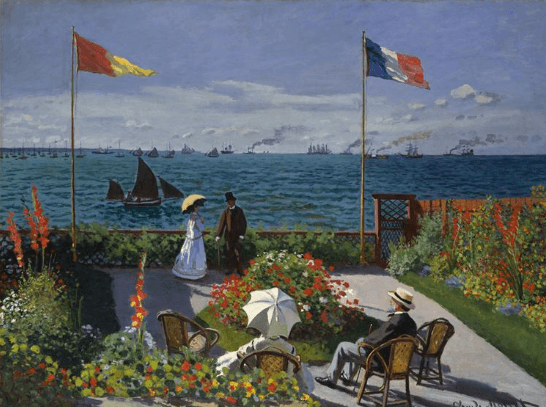
Monet’s 1867 Masterpiece: A Stolen Moment in Time!
Discover the vibrant world of Claude Monet’s “Garden at Sainte-Adresse” and why this 1867 painting continues to captivate art lovers worldwide.
Table of Contents
- Unveiling the 1867 Gem: More Than Just a Pretty Picture
- The Genesis of Genius: Monet’s Early Days and the Road to Impressionism
- Sainte-Adresse: The Canvas’s Unsung Muse
- A Symphony of Light and Life: Deconstructing the Composition
- Brushstrokes of Revolution: The Impressionist Soul of the Painting
- A Glimpse Into Monet’s World: Family, Friends, and the Familiar
- Beyond the Canvas: The Painting’s Enduring Legacy and Impact
- Experience the Magic: Where Can You Witness This 1867 Marvel?
- Final Thoughts: Why This 1867 Masterpiece Still Speaks to Us
- Dive Deeper: Explore More on Monet and Impressionism
Unveiling the 1867 Gem: More Than Just a Pretty Picture
Let’s be honest, how many times have you scrolled past a painting online, given it a quick nod, and moved on?
We’ve all done it.
But then there are those rare moments, those almost magical encounters, where a piece of art just… stops you dead in your tracks.
For me, one such moment happened with Claude Monet’s “Garden at Sainte-Adresse,” or as it was originally titled, “Terrace at the Seaside, Sainte-Adresse.”
And let me tell you, this isn’t just any painting.
This is a vibrant snapshot from 1867, a crucial year in the nascent stages of Impressionism, a year when Monet was truly hitting his stride.
It’s more than just a beautiful garden scene; it’s a portal back in time, offering us a window into the bustling bourgeois life of 19th-century France, infused with the revolutionary brushstrokes that would forever change the course of art history.
Imagine it: the salty air, the gentle hum of conversation, the rustling leaves, and the dazzling sunlight dancing on the water.
Monet didn’t just paint a scene; he captured an atmosphere, a feeling, a specific moment in 1867 that still feels incredibly alive today.
It’s this palpable sense of presence that makes the “Garden at Sainte-Adresse” so utterly compelling, an absolute must-see for anyone who appreciates art that truly breathes.
So, grab a cup of coffee – or maybe a glass of rosé, if you’re feeling fancy – and let’s dive deep into this incredible 1867 work.
We’re going to peel back the layers of paint, explore the genius behind the brush, and understand why this particular “Garden at Sainte-Adresse” continues to charm and inspire generations.
Trust me, by the end of this, you’ll see this 1867 masterpiece not just as a painting, but as a lively, breathing narrative of a pivotal era.
And who knows, you might even feel the sea breeze yourself.
The Genesis of Genius: Monet’s Early Days and the Road to Impressionism
Before we fully immerse ourselves in the “Garden at Sainte-Adresse,” it’s helpful to understand the man behind the easel, especially in the crucial years leading up to 1867.
Claude Monet wasn’t born with a paintbrush in his hand, though sometimes it feels like he was.
Born in Paris in 1840, he spent his formative years in Le Havre, a bustling port city in Normandy.
It was here that his artistic journey truly began, not with grand oil paintings, but with caricatures!
Yes, you read that right. He was quite good at them, too, earning a decent living sketching humorous portraits.
But fate, as it often does, had bigger plans for young Claude.
At 17, he met Eugène Boudin, a landscape painter who would become his first true mentor.
Boudin, a pioneer in painting en plein air (outdoors), encouraged Monet to step outside the studio, to observe light, atmosphere, and the ever-changing natural world.
This was a pivotal moment, shaping Monet’s entire artistic philosophy and setting him on the path to what would become Impressionism.
Imagine the scene: two artists, bundled up against the elements, sketching on the rugged Norman coast, battling gusts of wind and sudden shifts in light.
It wasn’t glamorous, but it was authentic, and it instilled in Monet a lifelong dedication to capturing fleeting moments.
By the 1860s, Monet was in Paris, grappling with the rigid academic traditions of the art establishment.
He studied at the Académie Suisse and later in the studio of Charles Gleyre, where he met fellow artistic rebels like Pierre-Auguste Renoir, Alfred Sisley, and Frédéric Bazille.
This group, dissatisfied with conventional art, shared a common vision: to paint modern life, to capture immediate impressions, and to break free from the dark, heavy palettes of their predecessors.
The mid-1860s were a period of intense experimentation for Monet.
He was financially struggling, often borrowing money and facing eviction, but his artistic output was prolific and increasingly bold.
He was exploring how light affected color, how shadows weren’t just black but contained a spectrum of hues, and how brushstrokes could convey movement and spontaneity.
It was in this crucible of creativity and hardship that the stage was set for masterpieces like the “Garden at Sainte-Adresse,” painted in that pivotal year of 1867.
He was honing his unique vision, preparing to unleash a revolution that would redefine how we see the world.
And this painting, this “Garden at Sainte-Adresse,” is one of the earliest, most vivid declarations of that coming revolution.
Sainte-Adresse: The Canvas’s Unsung Muse
So, where exactly is this magical garden, this “Terrace at the Seaside, Sainte-Adresse” that Monet captured so beautifully in 1867?
Sainte-Adresse is a charming commune located in Normandy, France, just north of Le Havre.
In the 19th century, it was a fashionable seaside resort, a popular destination for the bourgeoisie to escape the heat and grime of the city.
Think of it as the Hamptons of its day, but with more dramatic cliffs and a distinctly French flair.
Monet had a deep personal connection to Sainte-Adresse.
His father, Claude-Adolphe Monet, lived there, and the artist often visited him and other relatives.
It was a place of comfort, family, and familiarity, providing a steady backdrop for his artistic explorations.
The specific garden depicted in the 1867 painting is believed to be the garden of his aunt, Sophie Lecadre, a place he knew intimately.
This isn’t just some generic seaside view; it’s a personal landscape, imbued with the artist’s own memories and associations.
What made Sainte-Adresse so appealing to Monet as a subject, beyond his family ties?
Firstly, the light.
The Norman coast is famous for its ever-changing, often dramatic light conditions.
The interplay of sun, clouds, and sea created a dynamic canvas for Monet’s burgeoning Impressionist techniques.
He could experiment with how light transformed colors, how shadows shifted, and how the atmosphere imbued a scene with different moods.
Secondly, the juxtaposition of elements.
Sainte-Adresse offered a fascinating mix of natural beauty – the sea, the sky, the gardens – and human activity – the figures strolling, the boats sailing.
This allowed Monet to combine his love for landscape painting with his growing interest in capturing scenes of modern life.
In “Garden at Sainte-Adresse,” you can almost feel the fresh sea breeze, hear the gentle lapping of waves against the shore, and smell the blooming flowers.
It’s not just a place; it’s an experience.
Monet wasn’t simply recording what he saw; he was translating the sensory experience of being there in 1867 onto the canvas.
This intimate connection to the location, combined with his revolutionary artistic approach, is what makes the “Garden at Sainte-Adresse” such a compelling and enduring work.
It’s a testament to how a familiar place, viewed through the eyes of a genius, can become a timeless subject.
A Symphony of Light and Life: Deconstructing the Composition
Now, let’s get down to the nitty-gritty, the visual feast that is the 1867 “Garden at Sainte-Adresse.”
What makes this painting so visually captivating, so endlessly fascinating?
It’s not just the subject matter, but the masterful way Monet composed it, almost like a conductor orchestrating a symphony of color and form.
The painting is divided into distinct horizontal bands, creating a sense of depth and perspective.
At the bottom, we have the vibrant, meticulously rendered garden, bursting with an explosion of color.
The flowers, while not botanically precise, are rendered with dabs and strokes of pure color, creating a lively, shimmering effect.
This foreground is anchored by two figures seated in the garden – his father, Adolphe Monet, and his cousin, Jeanne-Marguerite Lecadre.
Their stillness provides a wonderful contrast to the dynamic elements of the sea and sky beyond.
Above the garden, a low fence acts as a visual divider, leading our eye to the middle ground: the terrace itself, with two more figures – perhaps his aunt, Sophie Lecadre, and another cousin, Georges Lecadre – standing and gazing out at the sea.
These figures, though small, are crucial.
They establish a human presence, a narrative element, and draw us deeper into the scene.
Beyond the terrace lies the expansive, shimmering sea, dotted with sailboats and framed by the distant coastline.
Monet masterfully captures the movement of the water, the way light plays on its surface, and the sense of vastness.
And finally, at the very top, the sky, a brilliant expanse of blue, punctuated by soft, wispy clouds.
The way Monet renders the sky and sea, with their shifting light and atmospheric effects, is a hallmark of his burgeoning Impressionist style.
One of the most striking aspects of the composition is the use of the high vantage point.
We, the viewers, are placed high above the scene, looking down and out, almost as if we are standing on a balcony ourselves.
This gives us a panoramic view, allowing us to take in the entire vista at once.
It also emphasizes the sense of openness and the vastness of the natural world.
Another compositional genius is the strategic placement of the figures.
They are not the central focus, yet they are indispensable.
They add a sense of scale, a human element that invites us to imagine ourselves in their place, enjoying the tranquil beauty of the “Garden at Sainte-Adresse.”
And let’s not forget the balance of color and light.
The vibrant greens of the garden, the deep blues of the sea and sky, and the warm tones of the human figures all work in harmony, creating a visually rich and harmonious scene.
This 1867 painting is a masterclass in how to combine meticulous observation with revolutionary artistic techniques to create a truly unforgettable image.
It’s a testament to Monet’s early prowess as a compositional wizard, setting the stage for decades of groundbreaking work.
Brushstrokes of Revolution: The Impressionist Soul of the Painting
Alright, let’s talk about the real magic trick in the “Garden at Sainte-Adresse,” the thing that truly sets it apart from the more traditional paintings of its time: the groundbreaking Impressionist techniques that Monet was so brilliantly experimenting with in 1867.
If you were an art critic in the mid-19th century, you’d likely be scratching your head, perhaps even scoffing, at what Monet was doing here.
Where were the meticulously blended brushstrokes? The smooth, almost photographic realism? The dark outlines?
Nowhere to be found!
Instead, Monet presents us with something entirely new and exhilarating.
Firstly, consider the brushwork itself.
It’s loose, visible, almost playful.
You can literally see the individual strokes of paint, especially in the foliage and the shimmering surface of the water.
This wasn’t about hiding the artist’s hand; it was about celebrating it, making the process of painting part of the experience.
It gives the painting a vibrant, energetic quality, a sense of immediacy that was revolutionary for its time.
Secondly, the treatment of light and color is nothing short of revolutionary.
Monet was obsessed with light – how it changed throughout the day, how it affected the colors of objects, how it created atmosphere.
In the “Garden at Sainte-Adresse,” he doesn’t use black for shadows; instead, he uses a range of blues, purples, and greens, reflecting the ambient light and the colors of the surrounding environment.
This was a radical departure from academic painting, where shadows were often simply darkened versions of the local color.
Look closely at the water – it’s not just blue, but a symphony of blues, greens, whites, and even hints of pink and gold, reflecting the sky and the sun.
This technique, known as broken color, involves applying small dabs of pure color next to each other, allowing the viewer’s eye to mix them optically.
The result is a more vibrant, luminous effect, a sense of light that truly seems to emanate from the canvas.
It’s like he’s telling us, “Hey, the world isn’t static! It’s constantly changing, and so should our depiction of it!”
Thirdly, the focus on capturing an “impression” – hence the name Impressionism!
Monet wasn’t aiming for a precise, detailed representation of every leaf or every wave.
Instead, he sought to capture the fleeting moment, the overall sensation, the immediate visual perception of the scene.
It’s less about what things “are” and more about how they “appear” in a specific moment of light and atmosphere.
This spontaneity, this sense of capturing a passing moment, gives the “Garden at Sainte-Adresse” its incredible freshness and vitality.
It feels alive, as if you could step right into that 1867 garden and feel the sun on your face.
While “Impression, Sunrise” (painted in 1872) famously gave the movement its name, this 1867 “Garden at Sainte-Adresse” is a crucial precursor, a bold declaration of the artistic revolution brewing in Monet’s mind.
It’s a powerful example of how he was pushing the boundaries, experimenting with light, color, and brushwork to create a new language of art.
And for that, we owe him a huge debt of gratitude.
A Glimpse Into Monet’s World: Family, Friends, and the Familiar
One of the most heartwarming aspects of the “Garden at Sainte-Adresse” from 1867 is the deeply personal connection Monet had to the scene and the people within it.
This isn’t just a generic landscape; it’s a family portrait, a slice of life from his own intimate world.
The figures populating this vibrant garden are not anonymous models; they are Monet’s own flesh and blood, people he knew and loved.
The man seated in the foreground, with his back to us, is none other than his father, Claude-Adolphe Monet.
Imagine painting your own dad, capturing his stillness and contemplation amidst the bustling beauty of the garden.
It adds a layer of tenderness and authenticity to the work.
Beside him, shaded by the parasol, is his cousin, Jeanne-Marguerite Lecadre.
Her pose, almost a quiet observation, perfectly complements the scene’s serene atmosphere.
These two figures anchor the foreground, providing a human scale to the expansive view.
Further back, on the terrace overlooking the sea, stand two more figures.
One is believed to be his aunt, Sophie Lecadre, and the other, likely another cousin, Georges Lecadre.
The fact that Monet chose to include his family members in this groundbreaking work speaks volumes.
It shows that even as he was pushing the boundaries of art and embracing radical new techniques, his subjects were rooted in his personal experience and immediate surroundings.
This isn’t a grand historical painting or a commissioned portrait of distant nobles.
It’s a moment of everyday life, elevated to art through the brilliance of his vision.
This choice of subject matter – ordinary people in an ordinary, albeit beautiful, setting – was itself revolutionary.
It mirrored the Impressionists’ broader aim to depict modern life, to find beauty and artistic merit in the mundane, the fleeting, and the personal.
When you look at “Garden at Sainte-Adresse,” you’re not just seeing a masterpiece of light and color from 1867; you’re getting a rare glimpse into Monet’s private world, his relationships, and the very fabric of his existence at that time.
It’s a reminder that even the greatest artists drew inspiration from the people and places closest to their hearts.
And that, perhaps, is why this painting feels so genuinely warm and inviting.
Beyond the Canvas: The Painting’s Enduring Legacy and Impact
So, we’ve dissected the brushstrokes, admired the composition, and peered into Monet’s personal connections within the “Garden at Sainte-Adresse.”
But what about its place in the grand tapestry of art history? Why does this 1867 painting still resonate so profoundly today?
Its impact, my friends, is nothing short of monumental.
Firstly, the “Garden at Sainte-Adresse” serves as a crucial early benchmark in the development of Impressionism.
While the term “Impressionism” wouldn’t be coined until a few years later, sparked by Monet’s “Impression, Sunrise” in 1872, this 1867 work clearly demonstrates many of the core tenets of the movement already in full swing.
The emphasis on light, the broken brushwork, the vibrant palette, and the capture of a fleeting moment – it’s all here, loud and clear.
It effectively heralded a shift from meticulously rendered, historically themed art to a more spontaneous, observational approach focused on modern life and natural phenomena.
This painting was a quiet rebellion, a subtle but powerful rejection of the rigid academic standards that dominated the art world at the time.
It showed that everyday scenes, even a family gathering in a garden, could be subjects for profound artistic expression.
Secondly, its influence can be seen in the subsequent works of Monet himself and his Impressionist contemporaries.
The techniques he refined in this period, particularly his mastery of capturing atmospheric effects and the play of light on surfaces, became his signature.
You can trace a direct line from the shimmering sea in Sainte-Adresse to his iconic water lilies series, decades later.
This painting was a proving ground, a laboratory for his artistic ideas that would ripen into some of the most beloved works in art history.
Thirdly, and perhaps most importantly for us, the viewers, the “Garden at Sainte-Adresse” paved the way for a more accessible and relatable form of art.
It invited viewers to engage with art not just intellectually, but emotionally and sensorially.
It was art that spoke to the experience of being alive, of seeing and feeling the world around us.
This shift made art less intimidating, more human, and ultimately, more popular.
It helped democratize art, making it something that could be appreciated by a wider audience, not just a select few.
Today, the “Garden at Sainte-Adresse” is celebrated as a jewel in the crown of Impressionism, a testament to Monet’s genius and his unwavering commitment to his artistic vision.
It’s a painting that reminds us of the power of observation, the beauty of the everyday, and the revolutionary spirit that can be found in a single, well-placed brushstroke from 1867.
Its legacy is etched not just in art books, but in the countless hearts it has touched and inspired over the decades.
Experience the Magic: Where Can You Witness This 1867 Marvel?
Alright, by now, I bet you’re itching to see this glorious 1867 masterpiece, “Garden at Sainte-Adresse,” with your own eyes.
And I don’t blame you one bit!
There’s simply no substitute for standing before an original work of art, allowing the colors to wash over you and the brushstrokes to tell their story.
So, where can you go to have this unforgettable experience?
The “Garden at Sainte-Adresse” holds a prominent place in one of the most prestigious art museums in the world: the Metropolitan Museum of Art in New York City, USA.
Yes, that’s right, the Met!
Nestled among countless other treasures, this 1867 Monet gem shines brightly, drawing admirers from all corners of the globe.
When you visit the Met, make sure to seek out the European Paintings galleries, specifically the ones dedicated to 19th-century art and Impressionism.
You’ll find it there, patiently waiting to reveal its layers of beauty and history.
A word of advice from someone who’s been there: give yourself time.
Don’t just rush past it with a quick glance.
Step back and take in the whole scene.
Then, move closer, examining the individual brushstrokes, the way Monet built up the colors, and how he captured the light.
Notice the details: the small flags on the boats, the varied greens in the garden, the subtle expressions on the faces of his family members.
You’ll be amazed at how much more you discover when you allow yourself to truly engage with the painting.
And if you can’t make it to New York City right away, don’t despair!
Many reputable museum websites offer high-resolution digital images and even virtual tours of their collections.
While it’s no substitute for the real thing, it’s a fantastic way to get a closer look and deepen your appreciation for this particular 1867 masterpiece.
But seriously, if you ever find yourself in the Big Apple, a visit to the Met to see “Garden at Sainte-Adresse” should be at the top of your list.
It’s a pilgrimage worth making for any art lover.
You’ll walk away with a fresh perspective and a newfound appreciation for Monet’s early genius, captured perfectly in that single, glorious 1867 painting.
Final Thoughts: Why This 1867 Masterpiece Still Speaks to Us
We’ve journeyed through the vibrant garden, explored the mind of a revolutionary artist, and examined the very fabric of an artwork that defied convention.
So, why does “Garden at Sainte-Adresse,” painted all the way back in 1867, continue to hold such a powerful grip on our imaginations?
It’s more than just a painting; it’s a testament to the power of observation, the beauty of the ordinary, and the sheer audacity of an artist willing to break all the rules.
This 1867 masterpiece isn’t just about a garden or a seaside terrace.
It’s about light. It’s about movement. It’s about the fleeting nature of time and the desire to capture it before it slips away.
Monet, with his bold brushstrokes and revolutionary use of color, invites us to slow down, to truly look at the world around us, and to appreciate the subtle dance of light and shadow that plays out every single day.
In a world that often feels chaotic and overwhelming, there’s something incredibly soothing and timeless about this painting.
It offers a moment of tranquility, a gentle reminder of the simple pleasures: a sunny day, a beautiful garden, the company of loved ones, and the calming expanse of the sea.
It connects us to a past era, yet feels entirely contemporary in its spirit.
It reminds us that innovation often comes from looking at familiar things in a completely new way.
So, the next time you see “Garden at Sainte-Adresse,” take a moment.
Imagine yourself there, standing on that terrace in 1867, feeling the breeze, hearing the gulls, and perhaps, just for a moment, seeing the world through Monet’s revolutionary eyes.
It’s a profound experience, and one that reminds us why art, especially masterpieces like this one from 1867, continues to be such an essential part of the human experience.
It’s not just paint on canvas; it’s a living, breathing piece of history, beauty, and pure artistic genius.
Dive Deeper: Explore More on Monet and Impressionism
Want to learn even more about Claude Monet and the incredible Impressionist movement? Here are some trusted resources that can take your knowledge to the next level:
Explore “Garden at Sainte-Adresse” at The Met
Learn More About Claude Monet at the National Gallery of Art
Discover Impressionism at MoMA
Read About Impressionism on Britannica
Monet, Impressionism, 1867, Sainte-Adresse, Art History