
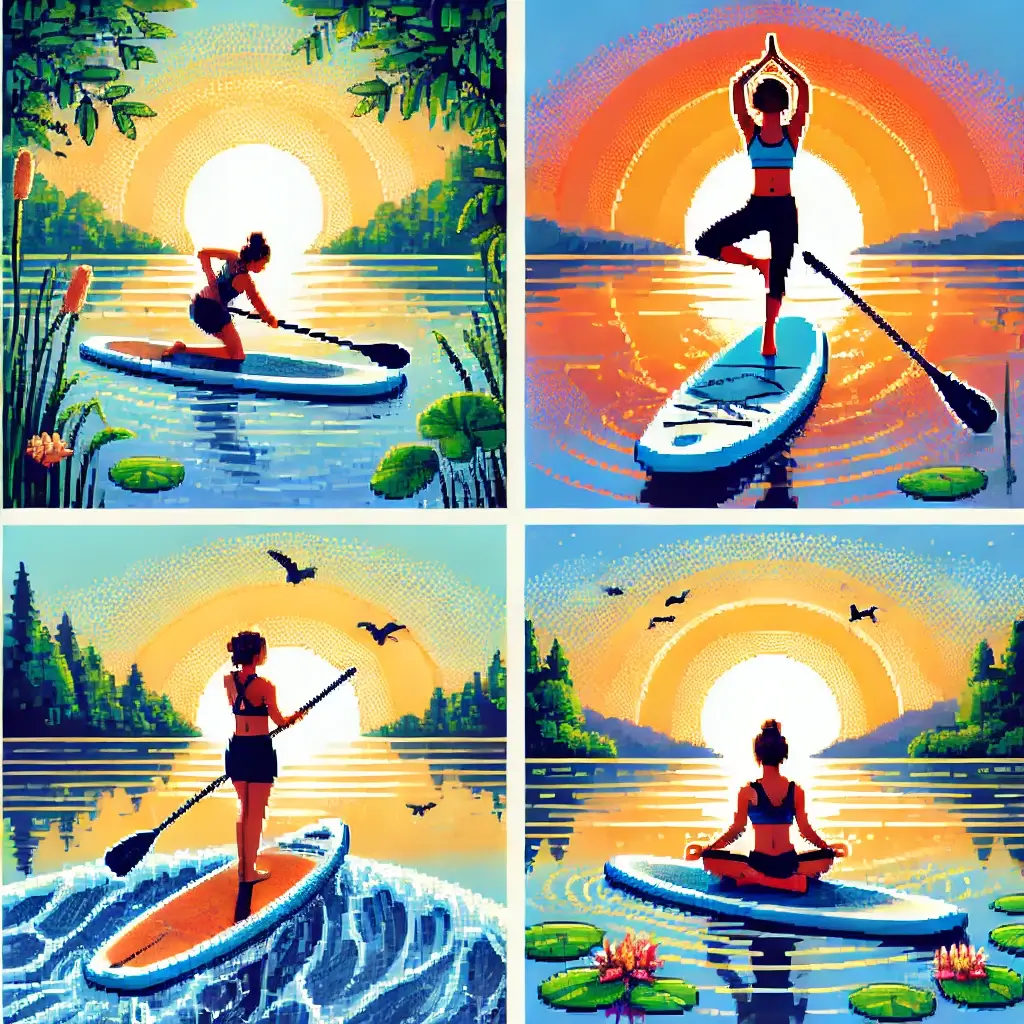
5 Mind-Blowing Stand-Up Paddleboard Yoga Poses to Master Now!
Have you ever tried to hold a downward-facing dog while the world gently sways beneath you?
It’s a game-changer, I tell you.
Stand-Up Paddleboarding, or SUP, is more than just gliding across the water.
It’s a full-body workout, a meditation session, and an adventure all rolled into one.
But when you add yoga to the mix, things get really interesting.
SUP Yoga is like taking your mat out of the studio and placing it on a living, breathing canvas of water.
It’s challenging, calming, and surprisingly accessible, even if you’re a total beginner.
I remember my first time.
I was so nervous, imagining myself toppling over with every tiny ripple.
And yeah, I did fall.
More than once.
But instead of feeling embarrassed, I just burst out laughing.
The cool water felt amazing, and it taught me a valuable lesson: falling is part of the fun.
It’s a chance to let go of perfectionism and just be in the moment.
That’s the beauty of SUP Yoga.
The water holds you, supports you, and also keeps you humble.
Every tiny movement, every shift in your weight, is magnified.
This means you have to engage your core like never before.
Your balance improves exponentially, and your mind gets a forced vacation from all the noise.
Think about it.
No phones, no emails, just you, your board, and the gentle lapping of the water.
The world feels miles away, and for a little while, all that matters is your breath and the feel of the sun on your skin.
It’s a truly unique kind of bliss.
In this guide, we’re going to dive deep into the world of SUP Yoga.
I’ll share some of my favorite techniques and poses, from the simple and stable to the more advanced.
We’ll cover everything from how to choose the right gear to the best ways to get started without a single worry.
Get ready to trade the studio lights for sunlight and the hard floor for a soft, watery embrace.
Ready?
Let’s paddle out and get our zen on. —
Table of Contents
Getting Started with SUP Yoga: The Absolute Basics
So, you’re thinking about giving SUP Yoga a try.
That’s awesome!
The first thing you need to do is get your feet wet—literally.
The most common mistake beginners make is overthinking it.
They worry about their balance, their form, and looking silly.
The key is to start simple.
Don’t jump straight into a headstand.
Your first session should be all about getting comfortable with your board and the water.
Think of your paddleboard as your new yoga mat, but one that moves and sways.
Before you even attempt a pose, spend some time just kneeling on the board.
Feel how it responds to your weight.
Shift your body from side to side.
Notice how the board tilts.
This is your first lesson in finding your center of gravity.
Once you’re comfortable kneeling, try a simple seated pose like Sukhasana (Easy Pose).
Sit cross-legged, close your eyes, and just breathe.
Feel the gentle rocking of the water.
This is your introduction to the meditative side of SUP Yoga.
The water provides a constant, gentle reminder to stay present.
When you’re ready, slowly move into a standing position.
Place your hands on the board for support, and carefully bring one foot up, then the other.
Keep your feet hip-width apart, knees slightly bent.
This is your mountain pose on the water.
It might feel wobbly at first, and that’s perfectly normal.
The wobbly feeling is your body’s way of telling you that you’re engaging muscles you don’t normally use on solid ground.
It’s a great sign!
Start with simple, stable poses.
A simple forward fold, a gentle twist, or even just standing and breathing.
The goal is not to perform a perfect pose, but to connect with your body and the environment.
Remember, the water is an excellent teacher.
It teaches you to be less rigid and more fluid.
So if you fall, just laugh it off, climb back on, and try again.
It’s all part of the journey.
I’ll never forget one student who was terrified of falling.
She was so stiff and tense, and it made her even more unstable.
I told her, “The water is your friend, not your enemy. Let it hold you.”
Once she relaxed and allowed herself to sway with the board, she found her balance almost instantly.
The lesson here is simple: trust the board, trust the water, and most importantly, trust yourself.
It’s a fantastic way to build both physical and mental resilience.
Trust me, there’s nothing quite like the feeling of finding your balance on a wobbly board in the middle of a peaceful lake.
It’s a little victory that feels huge.
So, go ahead and get started.
Mastering the Paddleboard: Your Floating Mat
Your paddleboard isn’t just a vehicle to get you from point A to point B; it’s your sacred yoga space.
Think of it as a giant, buoyant mat that challenges you in all the best ways.
The first thing to understand is the sweet spot.
Every board has one.
This is the area where you have the most stability.
Typically, it’s right in the center, over the handle.
Position your body here, and your poses will feel much more stable.
A common mistake is to place your feet too close to the edges, which makes you incredibly wobbly.
I always tell my students to use the handle as a guide.
For most poses, having your feet on either side of the handle is a great starting point.
This ensures your weight is evenly distributed and you’re centered on the board.
Another pro tip?
Drop your center of gravity.
On solid ground, you can get away with standing tall and a little stiff.
On the water, that’s a recipe for an unplanned swim.
Instead, bend your knees slightly, engage your core, and imagine a string pulling you down towards the water.
This lowers your center of gravity, making you more stable.
It’s the same principle a tightrope walker uses.
The more you hug the ground—or in this case, the water—the less likely you are to fall.
Your feet are your foundation.
Keep them active and engaged.
Spread your toes and press down through all four corners of your feet.
This creates a wider base of support and helps you feel more connected to the board.
If you’re a seasoned yogi, you’ll know this is a key principle on land, too.
But on the water, it’s non-negotiable.
It’s amazing how much more aware you become of your feet when you’re standing on a moving surface.
Finally, befriend the paddle.
Your paddle isn’t just for getting around; it’s a prop.
You can use it for support in standing poses, like a walking stick.
Placing it horizontally across your lap during seated poses can also help you feel more grounded.
It’s a versatile tool that can make your practice much easier and more enjoyable.
Just don’t forget to secure it with a leash so it doesn’t float away!
Remember, every board is different.
Spend some time getting to know yours before you try anything too ambitious.
Just like a relationship, a little time and attention will help you build a strong connection with your board.
And trust me, a good relationship with your paddleboard is the foundation for an incredible SUP Yoga experience.
This is where the magic happens.
The board becomes an extension of you, and you learn to move with it, not against it.
It’s a beautiful dance of push and pull, strength and surrender.
And once you get that feeling, you’ll be hooked. —
Building a Strong Foundation: Core-Engaging Poses
The core is the epicenter of all your movements, and in SUP Yoga, it’s your best friend.
On a wobbly surface, your core muscles are constantly firing to keep you upright.
This means that even the simplest poses become powerful core workouts.
Let’s start with some foundational poses that will help you build that rock-solid center.
First up: Plank Pose.
You know it, you love it (or love to hate it).
On the water, Plank is an absolute beast.
Start on all fours, with your hands directly under your shoulders and knees under your hips.
Then, extend your legs back one at a time, coming into a full Plank.
The water will try to rock you from side to side, and your core will have to work overtime to stabilize you.
You’ll feel a deep burn almost instantly.
This is not about holding it for five minutes; it’s about control.
Hold it for a few breaths, release, and then try again.
Next, let’s try Cat-Cow Pose.
This is a gentle, flowing movement that’s perfect for the water.
Start on all fours again, and as you inhale, drop your belly and lift your gaze (Cow).
As you exhale, round your spine and tuck your chin (Cat).
The beauty of doing this on a board is that the movement of the water adds an extra layer of challenge.
It’s like your spine is moving in three dimensions, not just two.
It feels incredible and helps you find a deeper connection to your breath and body.
Another must-do is Downward-Facing Dog.
Ah, a classic.
From your Plank, push your hips up and back, forming an inverted V.
Keep a soft bend in your knees, and really push through your hands.
The water will make this feel completely different.
You’ll have to constantly micro-adjust to stay stable, which works all those tiny stabilizer muscles you didn’t even know you had.
I remember one time, the wind picked up a little bit while I was in Downward Dog.
The board started to bounce and sway, and I had to laugh.
It felt like I was riding a wild horse, and it was a fantastic reminder that you can’t control everything.
You just have to go with the flow.
Finally, let’s talk about Boat Pose.
On solid ground, this can be tough.
On the water, it’s a whole new ballgame.
Sit on your board, lean back slightly, and lift your feet off the board, keeping your legs bent.
Try to balance here, with your hands extended forward.
This pose will challenge your core, your balance, and your sense of humor.
You’ll be wobbling, shaking, and maybe even laughing as you try to hold it.
But with each attempt, you’ll get a little stronger, a little more stable.
These core poses are the building blocks for everything else you’ll do on the water.
So take your time with them, and don’t be afraid to take a dip.
The water is there to catch you.
It’s a beautiful dance of strength and surrender.
You’re not just building muscle; you’re building trust in your body’s ability to adapt and find stability in an ever-changing environment.
And that’s a lesson that extends far beyond the water. —
The Art of Balance: Poses for Stability and Grace
Now that your core is engaged and you’re feeling more stable, it’s time to play with some balance poses.
These are the poses that will truly challenge you and show you just how powerful your body is.
Let’s start with a classic: Warrior II.
This pose is a fantastic foundation for all standing poses.
From a standing position, step one foot back, keeping your front knee bent at a 90-degree angle.
Extend your arms out to the sides, parallel to the water.
The key here is to keep your core engaged and your gaze steady.
You’ll feel the board trying to pull you, but you’ll resist with your strength.
It’s a beautiful battle of wills between you and the water.
Next, let’s try Tree Pose.
This one might seem intimidating on the water, but it’s totally doable.
Start in a standing position, with your feet hip-width apart.
Find a point on the horizon to focus on.
Slowly lift one foot and place it on the inside of your opposite calf or thigh.
Avoid placing your foot directly on your knee.
Bring your hands to your heart center or extend them overhead.
This is where that deep core engagement we talked about earlier comes into play.
You’ll be shaking, you’ll be wobbling, and you’ll be laughing.
But that’s the point.
You’re not trying to be a statue; you’re trying to find a dynamic balance.
I had a student who was convinced she could never do Tree Pose on the water.
She kept saying, “I can’t even do it on land!”
I told her to stop thinking and just try.
She fell a few times, but on the fifth try, she held it for a full breath.
The look on her face was pure joy.
It’s moments like that that make SUP Yoga so rewarding.
For a more advanced challenge, try Warrior III.
From a standing position, lift one leg back, keeping it parallel to the water.
Hinge at your hips and extend your arms forward.
Your body should form a T-shape.
This pose is a true test of your core, balance, and mental focus.
The wind will try to push you, the water will try to sway you, and your body will have to work as one to keep you stable.
It’s a powerful and humbling experience.
The key to all these poses is to breathe.
When you feel yourself starting to wobble, don’t hold your breath.
Breathe deeply, slowly, and deliberately.
Your breath is your anchor.
It connects you to your body and to the moment.
And when you’re connected to your breath, you can find a sense of peace even in the most unstable of circumstances.
It’s a powerful metaphor for life, isn’t it?
Embrace the wobble, embrace the challenge, and find your own beautiful, wobbly balance. —
Advanced SUP Yoga: Taking Your Practice to the Next Level
Alright, you’ve mastered the basics and you’re feeling confident.
Now it’s time to turn up the heat.
Advanced SUP Yoga isn’t about being a gymnast on a board; it’s about deepening your connection and pushing your boundaries in a safe, fun way.
One of my favorite advanced poses is Crow Pose.
Yes, you heard me right.
Crow Pose on a paddleboard.
It sounds crazy, but it’s actually a fantastic way to build incredible upper body and core strength.
Start from a squatting position on the board.
Place your hands on the board, a little wider than shoulder-width apart.
Bring your knees to the back of your upper arms, and slowly shift your weight forward.
Lift one foot, then the other, and balance.
The water beneath you will amplify every tiny shift in your weight, forcing you to find a perfect, centered balance.
And if you fall, well, you’re already low to the ground, and the splash is a reward, not a punishment.
Another great advanced pose is Dancer’s Pose.
From a standing position, lift one foot and grab it with the same-side hand.
Extend the other arm forward and begin to hinge at your hips, lifting your chest and leg.
This pose requires immense focus, flexibility, and balance.
On the water, you’ll have to use your core to prevent your body from swaying side to side.
It’s an incredibly graceful pose that feels even more magical with the wind in your hair and the sun on your face.
Let’s not forget about inversions.
Handstands and headstands on a paddleboard are not for the faint of heart, but they are an exhilarating challenge.
The key is to start in shallow water and use your core, not momentum, to get into the pose.
I had a student who was a professional gymnast, and she was so surprised at how much harder a simple handstand was on the water.
The instability forced her to slow down, to be more deliberate, and to use her core in a way she never had before.
The best part?
When you fall, it’s a soft landing.
It’s a fantastic way to practice without the fear of hitting a hard floor.
So, if you’re ready to take your practice to the next level, don’t be afraid to try some of these more advanced poses.
Just remember to listen to your body, and never push yourself to the point of injury.
The goal is to grow, not to get hurt.
And when you finally nail that advanced pose on the water, you’ll feel an incredible sense of accomplishment.
It’s a powerful reminder that with a little courage and a lot of practice, you can do anything.
It’s a beautiful dance of strength and surrender.
You’re not just building muscle; you’re building trust in your body’s ability to adapt and find stability in an ever-changing environment.
And that’s a lesson that extends far beyond the water. —
Mindfulness on the Water: More Than Just Poses
While the poses are a big part of SUP Yoga, the true magic lies in the mindfulness aspect.
Being on the water forces you to be fully present.
There are no distractions.
You can’t check your phone, and you can’t worry about what you have to do later.
All that matters is the here and now.
The gentle rocking of the board is a constant reminder to stay in the moment.
Every time your mind wanders, the subtle shift in the water brings you back.
It’s a natural form of meditation.
I often end my SUP Yoga sessions with Savasana, or Corpse Pose.
I lie flat on my back on the board, close my eyes, and let my hands and feet hang slightly off the sides.
The board becomes a floating cocoon.
The sun warms my skin, the water gently laps against the board, and the sounds of nature fill the air.
It is, without a doubt, the most peaceful Savasana I have ever experienced.
You feel a deep connection to the elements—the water, the sun, the air.
It’s a feeling of being a part of something much bigger than yourself.
Another way to practice mindfulness is to pay attention to your breath.
The breath is your anchor in any yoga practice, but on the water, it becomes even more crucial.
When you inhale, feel your chest expand.
When you exhale, feel your body sink a little deeper into the board.
Use your breath to guide your movements and to find a sense of calm when things get wobbly.
I always tell my students, “Don’t just do the pose; be the pose.”
And on the water, this takes on a whole new meaning.
You’re not just a person doing yoga; you’re a part of the water, the wind, and the sun.
It’s a beautiful, holistic experience that nourishes your body, mind, and soul.
So, when you’re on the water, don’t just focus on the physical.
Take a moment to close your eyes, feel the sun on your skin, and listen to the sounds of nature.
Let the water hold you, and let go of all your worries.
That’s the true essence of SUP Yoga.
It’s a beautiful dance of strength and surrender.
You’re not just building muscle; you’re building trust in your body’s ability to adapt and find stability in an ever-changing environment.
And that’s a lesson that extends far beyond the water. —
Safety First: Crucial Tips Before You Start
Before you rush out onto the water, let’s talk about safety.
This is super important, so pay attention.
First and foremost, wear a life vest.
Even if you’re a strong swimmer, you never know what could happen.
A life vest is a non-negotiable safety item.
Next, be aware of the weather and water conditions.
Don’t go out if it’s windy or if there’s a strong current.
SUP Yoga is best practiced on calm, flat water.
Check the forecast before you head out, and if in doubt, stay on land.
Always tell someone where you’re going and when you plan to be back.
This is a simple but crucial safety tip.
And if you’re going out alone, make sure you have a way to call for help if you need it.
Another key piece of advice is to attach your board to your ankle with a leash.
If you fall off, you don’t want your board to float away from you.
The leash keeps your board close and acts as a flotation device if you need it.
And, of course, wear sunscreen.
The sun’s reflection off the water can be intense, and you’ll burn much faster than you would on land.
Wear a hat and sunglasses, too, to protect your face and eyes.
Finally, be mindful of your surroundings.
Paddle away from other boats, swimmers, and anything that could cause a collision.
Find a peaceful, secluded spot where you can practice without worrying about getting in someone’s way.
These safety tips might sound obvious, but they are easy to forget when you’re excited to get on the water.
Taking a few moments to prepare and plan can make all the difference.
Your safety is the most important thing, so never take risks.
Now, go have some fun and be safe out there!
It’s a beautiful dance of strength and surrender.
You’re not just building muscle; you’re building trust in your body’s ability to adapt and find stability in an ever-changing environment.
And that’s a lesson that extends far beyond the water. —
Essential Gear for Your SUP Yoga Journey
To have the best SUP Yoga experience, you need the right gear.
It doesn’t have to be expensive or fancy, but a few key items will make a world of difference.
First, the board.
Look for a wide, stable board.
The wider the board, the more stable you’ll be.
Inflatable boards are a great option because they’re easy to transport and store.
Plus, they’re softer to land on when you fall.
A good board should have a full-length deck pad, which provides grip and comfort.
Next, the paddle.
You’ll need a paddle that’s the right size for you.
A good rule of thumb is that the paddle should be about 6 to 8 inches taller than you are.
And, as I mentioned before, a leash is essential.
It will keep your board from drifting away while you’re in a pose.
You’ll also need appropriate clothing.
Wear something that is comfortable, quick-drying, and allows for a full range of motion.
Swimsuits, board shorts, or leggings are all great options.
Avoid cotton, as it stays wet and can make you cold.
And don’t forget the sunscreen, a hat, and sunglasses.
A waterproof bag is also a great idea for keeping your keys, phone, and other valuables safe and dry.
Finally, a good attitude is the most important piece of gear you can have.
Be open to the experience, be willing to fall, and be ready to have some fun.
With the right gear and the right mindset, you’re all set for an incredible SUP Yoga journey.
It’s a beautiful dance of strength and surrender.
You’re not just building muscle; you’re building trust in your body’s ability to adapt and find stability in an ever-changing environment.
And that’s a lesson that extends far beyond the water. —
Finding Your Flow: The Ultimate SUP Yoga Experience
The ultimate goal of SUP Yoga isn’t to nail the perfect pose.
It’s about finding your flow.
It’s about moving with the water, not against it.
It’s about letting go of all your expectations and just being in the moment.
The water provides a constant, gentle reminder to stay present.
Every time your mind wanders, the subtle shift in the water brings you back.
It’s a natural form of meditation.
This practice teaches you to find your balance not just on the board, but in your life.
It teaches you to be resilient, to adapt to change, and to find your center even when the world feels wobbly.
So, go out there, get on a board, and give it a try.
You might fall, you might laugh, and you might even discover a part of yourself you never knew existed.
The water is waiting to be your teacher, your playground, and your sanctuary.
Are you ready to dive in?
For more information and inspiration, check out these amazing resources:
Active.com: SUP Yoga for Beginners
SUP Connect: The Ultimate SUP Yoga Guide
SUPboarder Mag: SUP Yoga Benefits
SUP Yoga, Paddleboard, Balance, Core Strength, Mindfulness