
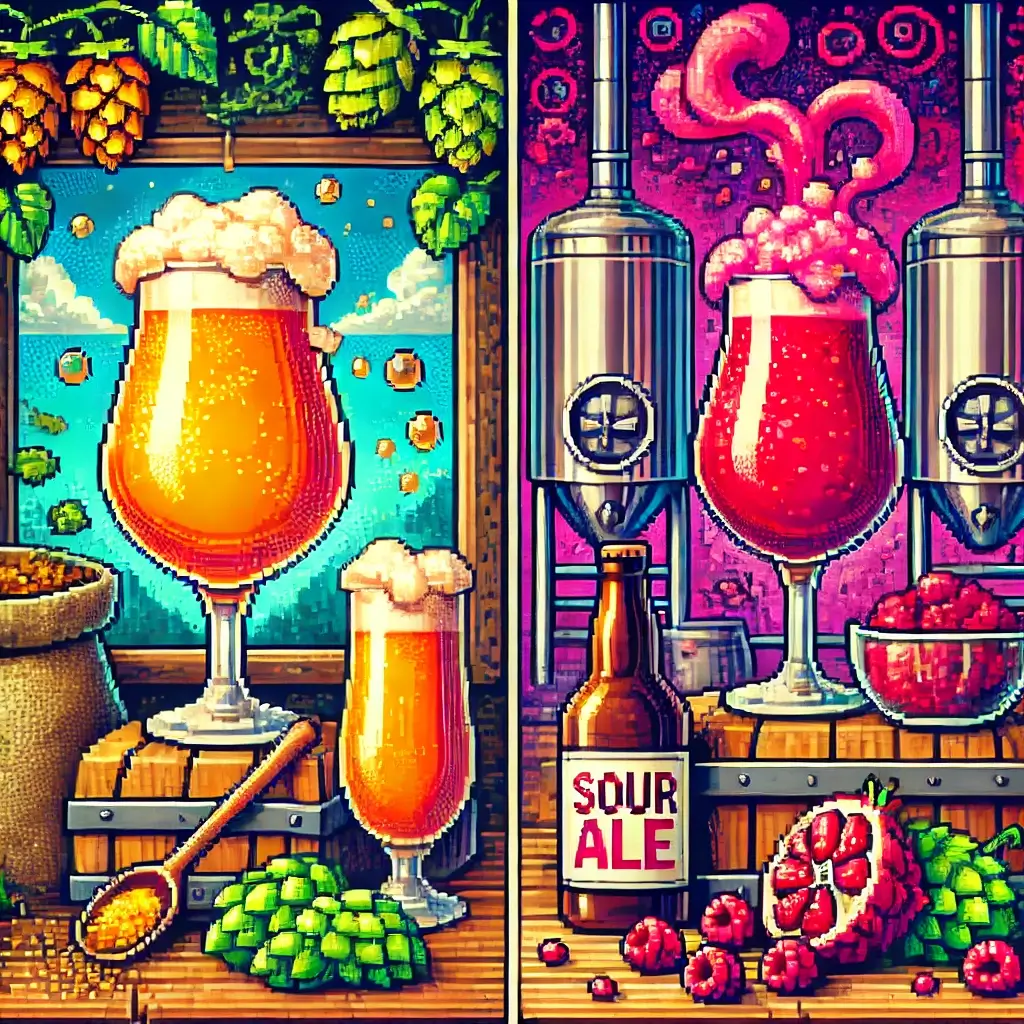
How to Master 2 Insanely Complex Micro-Brewing Styles and Impress Everyone You Know
Ever walked into a brewery and seen a list of beers that read like a wizard’s spellbook?
Belgian Trippel.
Sour Ales.
They sound intimidating, right?
Like something only a bearded, monastic brewer with decades of experience could possibly concoct.
Well, I’m here to tell you that’s a beautiful, wonderful lie.
I’ve been in your shoes.
I remember staring at a beer menu, completely baffled by the descriptions.
“Notes of banana and clove?”
“Tart, funky, with a hint of barnyard?”
I thought, “Who on earth drinks this stuff?”
And then, I tried one.
A perfectly poured, effervescent Belgian Trippel.
It was a revelation.
The complex spice, the high alcohol content sneakily hidden behind a clean, crisp finish.
It was like sipping on sunshine, but with a kick.
Then, I dipped my toe into the wild world of Sour Ales.
A raspberry sour that tasted like summer berries and a perfectly puckering lemonade had a beautiful, delicious baby.
From that moment on, I was obsessed.
My quest to recreate these legendary brews in my own garage began.
And let me tell you, it was a journey filled with explosive fermenters, questionable odors, and a few batches that were, let’s say, better left to the drain.
But through it all, I learned.
I talked to professional brewers, read countless books, and experimented with every ingredient I could get my hands on.
Now, I want to share that hard-won knowledge with you.
Because brewing these specialized styles isn’t about being a brewing god.
It’s about understanding the core principles, being meticulous, and having a whole lot of patience.
And a little bit of luck never hurts.
We’re going to dive deep into two of the most rewarding and challenging styles you can tackle as a homebrewer or a small-scale micro-brewer: the classic, powerful Belgian Trippel and the wonderfully weird Sour Ale.
Ready to get your hands sticky and your palate educated?
Let’s get brewing!
Table of Contents
The Heart and Soul of Belgian Trippel Brewing: 3 Things You Must Know
Belgian Trippel.
Just saying it makes me think of ancient monasteries, thick stone walls, and the quiet devotion of monks perfecting their craft.
This beer is not just a beverage; it’s a piece of history.
And it’s a total blast to brew.
The first thing you need to know about a Belgian Trippel is that its name, “Trippel,” often refers to the fact that it’s brewed with roughly three times the amount of malt as a simple, standard Trappist table beer.
This isn’t a hard and fast rule, but it gives you a clue about its character: it’s big, it’s bold, and it’s surprisingly complex for its pale color.
The classic example, Westmalle Tripel, is a benchmark for a reason.
It’s a masterclass in balance.
The second thing is that the flavor profile of a Trippel is all about the yeast.
I cannot stress this enough.
The yeast is the star of the show.
Belgian yeasts are famous for their spicy, fruity esters and phenolic compounds.
They can give you everything from banana and bubblegum to pepper and clove.
It’s like they have their own little flavor orchestra inside the fermenter, and you, the brewer, are the conductor.
The third thing is that brewing a great Trippel is all about taming the beast.
With a high ABV (typically 8-10% or even higher), you’re dealing with a lot of sugar.
A lot of potential for disaster.
You need to manage the fermentation temperature like a hawk, or you’ll end up with a boozy, solvent-like mess.
But when you get it right, oh man, the reward is so worth it.
It’s a beer that fills you with a quiet, confident pride.
It’s not for slamming down; it’s for sipping, contemplating, and sharing with people who truly appreciate the craft.
Brewing Belgian Trippel: Step-by-Step Magic
Alright, let’s get into the nitty-gritty.
This isn’t a simple recipe you can follow blindly.
It’s a framework, a set of principles you need to internalize to brew a world-class Belgian Trippel.
### 1. The Grain Bill: Keep it Simple, Stupid (KISS)
Unlike some other styles, the Trippel’s grain bill is surprisingly straightforward.
The base is usually high-quality Pilsner malt.
This gives you a pale color and a clean, malty backbone.
You can add a small amount of specialty grains for color or head retention, but a classic Trippel is often 90-95% Pilsner malt.
The real secret weapon, however, is the sugar.
Don’t be afraid of sugar!
This is what gives the beer its high alcohol content without making it cloyingly sweet or overly malty.
Candi sugar, especially clear Candi sugar, is your best friend here.
It ferments completely, drying out the beer and creating that signature clean finish.
Without it, your Trippel would be thick and heavy.
Think of the sugar as the hidden muscle of your beer.
It does all the heavy lifting in the background, allowing the yeast and hops to shine.
### 2. The Mash: Hit Your Numbers
A single infusion mash at around 149-152°F (65-67°C) is a great starting point.
This temperature range is perfect for producing a fermentable wort, which is exactly what you need for a high-gravity beer like a Trippel.
You want the yeast to have a buffet of simple sugars to feast on, leaving very little behind.
### 3. The Boil: Hops and Sugar
Your boil will likely be longer than a standard brew—60 to 90 minutes.
Hops for a Trippel are all about balance, not bitterness.
You’re not making an IPA here.
Noble hops like Saaz or Hallertau are traditional.
Add a bittering hop addition early in the boil to get your IBU (International Bitterness Units) where you want them, and maybe a small flavor addition late in the boil.
This is also when you’ll add your Candi sugar.
Don’t just dump it in!
Dissolve it in a small amount of hot wort first to prevent scorching.
It’s a little extra step, but it’s crucial.
### 4. The Fermentation: The Conductor’s Baton
This is where a good Trippel becomes a great Trippel.
Pitch a healthy amount of a high-quality Belgian yeast strain.
Wyeast 3787 (Trappist High Gravity) or White Labs WLP530 (Abbey Ale) are fantastic choices.
And here’s the key: control your temperature.
Start on the cooler side of the yeast’s recommended range (e.g., 68°F or 20°C) and let it free-rise naturally as fermentation takes off.
You can even let it get up to 75-80°F (24-27°C) for a few days to really coax out those classic Belgian esters.
But don’t let it get out of control!
The last thing you want is a fusel alcohol bomb that tastes like paint thinner.
It’s a delicate dance, but when you nail it, the result is pure liquid poetry.
### 5. Conditioning and Carbonation: Patience is a Virtue
A Trippel is not a beer you want to rush.
It needs time to mature.
After primary fermentation is complete, let it sit for a few more weeks to clean up any off-flavors.
Bottle or keg it, and then let it condition for at least a month, preferably longer.
This is where the magic really happens.
The flavors will meld, the high alcohol heat will mellow out, and the carbonation will become that beautiful, champagne-like effervescence that is a hallmark of the style.
Trust me, the wait is the hardest part, but it’s essential for that “aha!” moment when you finally pour that first perfect glass.
Mastering the Pucker: Your Guide to Sour Ale Micro-Brewing
Now, let’s talk about the complete opposite of a clean, structured Trippel: the gloriously chaotic, beautifully wild world of Sour Ales.
If the Trippel is a monk in a library, a Sour Ale is a punk rocker in a garage.
There’s a beautiful, raw energy to them.
For a long time, “sour beer” was a sign of a spoiled batch.
A mistake.
But brewers in places like Belgium, and later the US, realized that with a little bit of control, these “off-flavors” could be a source of incredible complexity and deliciousness.
The key to a good sour is not just “making it sour.”
It’s about making it deliciously sour.
It’s the difference between a lemon and a tart, perfectly balanced lemonade.
The sourness should complement the other flavors, not overwhelm them.
And the organisms responsible for this are not our friendly saccharomyces cerevisiae (the standard brewer’s yeast).
We’re talking about a whole new crew: Lactobacillus, Pediococcus, and a whole host of other wild yeasts like Brettanomyces.
Lactobacillus is what gives you that clean, yogurt-like acidity.
Pediococcus gives you a deeper, more complex kind of sourness, often with a buttery, diacetyl character that needs a secondary organism (like Brettanomyces) to clean it up.
And Brettanomyces, or “Brett,” is the wild card.
It’s what gives many sours that signature “funk” — aromas of leather, horse blanket, and hay.
It sounds gross, I know.
But trust me, in the right context, it’s absolutely magical.
It adds a rustic, earthy dimension that you just can’t get with standard yeast.
Micro-brewing a Sour Ale is less about following a recipe and more about embracing a process.
It’s about being patient and letting the organisms do their thing, like a farmer tending to a wild garden.
Sour Ale Secrets: The 6 Rules for Funky Success
So, you want to dive into the deep end?
Here’s what I’ve learned about brewing sours that don’t taste like a science experiment gone wrong.
### 1. Separate Your Gear. Seriously.
This is the number one rule of sour brewing.
Lactobacillus and Brettanomyces are tenacious little buggers.
They will get into every scratch, every plastic surface, every nook and cranny of your equipment.
And they will infect your next beer.
If you don’t want your beautiful, clean Trippel to suddenly taste like a barnyard, you absolutely must have a separate set of brewing equipment for your sours.
Separate fermenters, separate tubing, separate spoons.
Think of it like keeping a clean kitchen from a messy one.
### 2. Choose Your Method: Kettle Sour vs. Long-Term Fermentation
There are two main ways to make a sour ale, and they are wildly different.
Kettle Souring: This is the fast and furious method.
You mash and lauter as usual, then cool the wort to about 95-100°F (35-38°C).
You then pitch a pure culture of Lactobacillus (or use a sour mash) and let it ferment for 12-48 hours.
Once it reaches your desired level of sourness, you boil the wort again to kill the lacto, then cool and pitch your regular brewer’s yeast.
This method gives you a clean, lactic acid sourness without the funk.
It’s perfect for styles like Gose or Berliner Weisse.
Long-Term Fermentation: This is the patient, traditional method for styles like Lambics or Flanders Red Ales.
Here, you co-pitch multiple organisms (Saccharomyces, Brettanomyces, Lactobacillus, Pediococcus) and let them all duke it out over months, sometimes years.
This is where the magic, and the funk, really happen.
It’s a commitment, but the complexity and depth you get from this method are unparalleled.
### 3. Control Your Oxygen
For a long time, brewers believed that sours needed oxygen to develop.
While some wild yeasts can benefit from it, most modern sour brewing techniques actually focus on limiting oxygen exposure after pitching your souring organisms.
Too much oxygen can lead to off-flavors like ethyl acetate (nail polish remover).
This is especially true for Brettanomyces, which can produce acetic acid in the presence of oxygen.
So, once your fermentation is off and running, seal that fermenter tight and let it do its thing.
### 4. Consider Fruit!
Sours and fruit are a match made in heaven.
The tartness of the beer cuts through the sweetness of the fruit, creating a beautifully balanced, refreshing beverage.
Add fruit in the secondary fermentation stage to avoid the sugars from the fruit fermenting out completely.
This allows the fruit character to really shine through.
Just be careful!
The sugars from the fruit can reignite fermentation, so be sure to use a blow-off tube and keep an eye on your airlock.
I once had a raspberry sour blow its lid off and redecorate my entire closet.
The smell was divine, the cleanup was… not.
### 5. Blend, Blend, Blend
Many of the best sour ales in the world are not from a single batch.
They are a blend of multiple batches of different ages and characteristics.
This is where the real artistry comes in.
You can blend a young, aggressively sour beer with a more mature, funky beer to create something with incredible depth and complexity.
Don’t be afraid to experiment with different ratios until you find something that sings to you.
It’s like being a chef, but your ingredients are beer.
### 6. Sanitize, Then Sanitize Again
This might sound contradictory after I just told you to embrace the wild, but it’s not.
You want to introduce the specific organisms you choose, not some random wild yeast or bacteria that’s floating around in the air.
A good sour is a controlled wild fermentation.
Sanitation is still your best friend, even in the funky beer world.
Pro-Tips from the Trenches: Making Your Specialized Beers Shine
Brewing is a journey, not a destination.
These styles, in particular, are a masterclass in patience, attention to detail, and a willingness to embrace the unexpected.
Here are a few more nuggets of wisdom I’ve picked up along the way.
### 1. Water Chemistry Matters. A Lot.
The water you use is the foundation of your beer.
For a Belgian Trippel, you want soft water that doesn’t have a lot of mineral character.
This allows the malt and yeast character to shine through.
For sours, a little more mineral content, particularly calcium, can help with the souring process and overall mouthfeel.
Invest in a water report or a good water profile calculator.
It’s one of those things that seems complicated at first but can have a massive impact on the quality of your beer.
### 2. Temperature Control is Non-Negotiable
I’ve said it before, and I’ll say it again: you can’t make great specialized beers without great temperature control.
A simple fermentation chamber, like an old fridge with a temperature controller, is the single best investment you can make as a homebrewer.
It’s the difference between an “okay” beer and a truly great one.
It allows you to hit the exact temperature you need for the yeast to produce the flavors you want, not the flavors it produces when it’s too hot or too cold.
### 3. Document Everything!
Keep a brewing log.
Seriously.
Write down every detail: the grain bill, the hop schedule, the yeast strain, the fermentation temperatures, how long you conditioned it, what the final gravity was.
This is how you learn.
When you brew a truly amazing beer, you’ll be able to go back and see exactly what you did.
And when a batch goes wrong, you can look at your notes and figure out what went south.
It’s a treasure map for future greatness.
### 4. Don’t Be Afraid to Fail
You will brew a bad batch.
You will.
It’s an inevitable part of the process, especially with these complex styles.
But here’s the secret: every “bad” batch is a learning opportunity.
It’s a chance to figure out what went wrong and how to fix it next time.
Don’t get discouraged.
Just dump it, clean up, and start again.
The journey is the fun part, and the community of brewers out there is incredibly supportive.
Essential Gear and Resources for Micro-Brewing Specialized Beer Styles
You’ve got the knowledge, now let’s make sure you have the right tools.
You don’t need a fancy, million-dollar setup, but a few key pieces of equipment can make all the difference.
I’ve linked some fantastic resources below that I’ve used and trusted over the years.
They have everything from detailed brewing calculators to advice forums and ingredient suppliers.
Join the Homebrewers Association!
This is a great community to join for resources, forums, and a wealth of information from experienced brewers.
An incredible resource for recipes, techniques, and in-depth articles on every aspect of brewing.
Shop for High-Quality Ingredients!
A trusted supplier for all your brewing needs, from malt and hops to yeast and specialized equipment.
Brewing these specialized beer styles is an act of love.
It’s a journey into history, chemistry, and pure sensory pleasure.
It’s about creating something unique, something that tells a story, and something you’re truly proud of.
So, what are you waiting for?
Grab your mash tun, your wild yeast, and your sense of adventure.
Your next favorite beer is waiting for you to brew it.
What’s the first specialized style you’re going to tackle, and what are you most excited (or nervous) about?
Micro-Brewing, Belgian Trippel, Sour Ales, Homebrewing, Specialized Beer Styles