
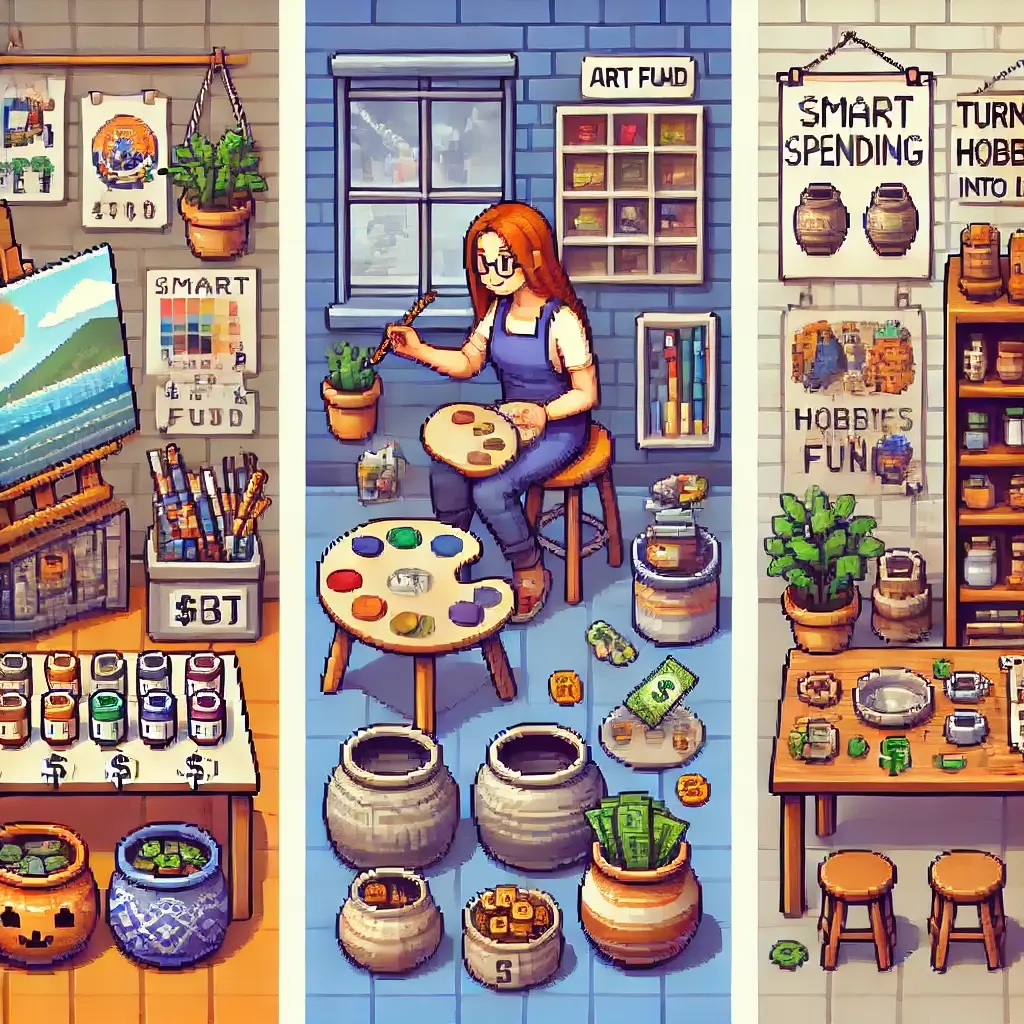
How I Saved $1,500 in 6 Months on My Creative Hobbies (And You Can Too!)
You’re in a happy place.
The world outside melts away as your hands, covered in clay, shape a bowl on the pottery wheel.
Or maybe you’re in front of a canvas, the scent of turpentine in the air, a kaleidoscope of colors waiting to be transformed into a masterpiece.
That feeling?
That’s pure joy.
The kind of joy that makes you feel alive, connected to something deeper than the daily grind.
But then, reality hits.
You look at your bank account, and a knot forms in your stomach.
That beautiful feeling of creation is quickly replaced by the cold, hard facts of your finances.
The cost of pottery classes, the price of a new set of paints, the kiln fees… it all adds up.
It’s a tale as old as time, a battle between passion and practicality.
I’ve been there.
For years, my love for creative hobbies felt like a guilty pleasure, a luxury I couldn’t truly afford.
I would find myself cutting corners in other parts of my life just to buy a new brush or a bag of clay.
It was a constant cycle of creative highs and financial lows.
One day, I decided enough was enough.
I wasn’t going to let my financial stress get in the way of my passion anymore.
I was going to learn how to budget for creative hobbies.
And you know what?
It worked.
I didn’t just survive; I thrived.
In just six months, I managed to save over $1,500 on my creative pursuits without sacrificing a single ounce of joy.
I learned that being an artist on a budget isn’t about giving up what you love.
It’s about being smart, resourceful, and a little bit creative with your money, too.
Think of your budget not as a cage but as a canvas.
You’re the artist, and the rules of the canvas are there to help you create something beautiful, not to hold you back.
This post isn’t just a list of tips.
It’s a roadmap from one creative soul to another, a guide to help you find that perfect balance between your artistic dreams and your financial reality.
So, let’s roll up our sleeves and get started.
It’s time to stop worrying about money and start creating.
—
Table of Contents
The Truth About Your Creative Hobby Budget
Before we dive into the nitty-gritty of numbers, let’s get one thing straight.
Your creative hobby isn’t a frivolous expense.
It’s an investment in your well-being.
It’s a way to de-stress, to express yourself, to find purpose and meaning.
Don’t ever let anyone, especially that little voice in your head, tell you that it’s a waste of money.
The key is to integrate it into your life without it becoming a source of stress itself.
For a long time, I thought that budgeting meant saying “no” to everything fun.
I imagined myself living a life of beige, where every penny was accounted for and there was no room for spontaneity or creativity.
But that’s not what a good budget is about.
A good budget is about saying “yes” to the things that truly matter.
It’s a tool that gives you permission to spend money on your passion, because you’ve planned for it.
My journey started with a simple, yet brutal, realization.
I had no idea where my money was going.
I’d buy a new set of brushes here, a ticket to a workshop there, and before I knew it, my ‘small’ purchases had turned into a gaping hole in my wallet.
It was like trying to fill a bucket with a leaky faucet.
The first step to fixing the leak isn’t to buy more water; it’s to find the hole.
—
Step 1: The ‘Broke Artist’ Mindset Shift
Let’s be real for a second.
The “broke artist” trope is romanticized, but in reality, it’s just a lot of stress and ramen noodles.
We need to ditch that idea completely.
The first step in budgeting for your creative hobbies isn’t about spreadsheets; it’s about changing how you think about your money and your art.
Your creativity isn’t a luxury; it’s a necessity.
It’s the air you breathe, the food for your soul.
When you start seeing your creative pursuits as essential to your well-being, you begin to treat the expenses associated with them with the respect they deserve.
Instead of a guilt-ridden splurge, buying that new canvas becomes a planned investment in your mental health.
I started by reframing my thoughts.
Instead of thinking, “I can’t afford that,” I started asking, “How can I make this work?”
This simple shift opened up a world of possibilities.
I began to see every purchase not as a one-off transaction, but as a long-term part of my creative journey.
This mindset shift is like a foundation for a house.
Without a solid foundation, all the fancy budgeting techniques in the world won’t matter.
You’ll just fall back into old habits.
So, take a moment and genuinely reflect on why your creative hobby matters to you.
Write it down.
Put it somewhere you can see it.
This will be your anchor when things get tough.
—
Step 2: Tracking Your Creative Spending (No Judgment!)
This is where the rubber meets the road.
It’s also the part where most people want to run and hide.
Don’t worry, I’m not going to tell you to stop buying lattes.
I’m just going to ask you to look at your spending with an honest, non-judgmental eye.
For one month, I want you to track every single penny you spend on your creative hobby.
This includes materials, classes, studio fees, tools, subscriptions, even that fancy coffee you buy on your way to the pottery studio.
Use a notebook, a spreadsheet, or a budgeting app like Mint or YNAB.
The tool doesn’t matter; the act of tracking does.
The first time I did this, I was shocked.
I thought I was spending maybe $50 a month on painting supplies.
The reality was closer to $200.
I’d forgotten about the new easel, the workshop I signed up for, and all the small impulse buys that added up over time.
This step isn’t about shaming yourself.
It’s about gaining clarity.
It’s like turning on the lights in a dark room.
You can’t organize a room you can’t see, right?
Once you have this data, you’ll be able to see exactly where your money is going and where you can make smarter choices.
Maybe you’re spending a fortune on pre-made canvases when you could be buying canvas by the roll and stretching your own for a fraction of the price.
Maybe you’re paying for a monthly pottery studio membership you only use twice a month.
This is your baseline.
It’s the starting point from which we will build your new, smarter budget for creative hobbies.
Don’t skip this step.
It’s the most important part of the entire process.
—
Step 3: Finding Your Financial Flow with the 50/30/20 Rule
Now that you know where your money is going, it’s time to create a plan.
There are a million different budgeting methods out there, but I’ve found the 50/30/20 rule to be the most flexible and easy to follow, especially for those of us with creative, sometimes unpredictable, incomes.
The rule is simple:
- 50% of your after-tax income goes to Needs: This is your rent/mortgage, utilities, groceries, and transportation. The non-negotiables.
- 30% goes to Wants: This is where your creative hobby budget lives! It also includes things like dining out, entertainment, and that new pair of shoes you’ve been eyeing.
- 20% goes to Savings & Debt Repayment: This is your future fund. It’s for an emergency fund, retirement, or paying off credit card debt.
The beauty of this method is the flexibility of that 30% “Wants” category.
You get to decide how much of that 30% you dedicate to your creative pursuits.
Want to take a pottery class that costs $300?
You can pull from your “Wants” budget for a few months to save up for it.
No guilt.
No stress.
It’s all part of the plan.
This is where my personal breakthrough happened.
I realized I could consciously allocate a portion of my income to my creative hobbies, making it a legitimate part of my budget, not just a side thought.
I created a separate savings account for my “Art Fund.”
Every payday, I’d automatically transfer a small amount into that account.
This made it feel less like I was “spending” money and more like I was “saving” for my passion.
It was a powerful psychological trick.
—
Step 4: Smart Shopping for Your Supplies
This is the fun part!
It’s where you get to be a creative problem-solver, not just in your art, but in your shopping, too.
Think of it like a treasure hunt.
You’re on a mission to find the best materials for the best price.
Here are some of my go-to strategies that helped me save hundreds of dollars.
Buy Used (No, Really!)
I know, I know.
The thought of buying used art supplies might seem a little odd.
But trust me, it’s a game-changer.
I’ve found incredible deals on barely used easels, pottery wheels, and even whole sets of watercolor paints on Facebook Marketplace and Craigslist.
Someone’s creative dream might have fizzled out, and you can be the one to give their supplies a second life.
For ceramics, I’ve found that local pottery studios often sell used equipment or even give away old tools they no longer need.
It’s a win-win: you get what you need for cheap, and they get to declutter.
Bulk Buying and Group Orders
Are you part of a local art group or a pottery studio?
If so, you have a secret weapon: collective buying power.
Instead of each person buying a single bag of clay or a set of paint tubes, try organizing a group order.
Many suppliers offer significant discounts for bulk purchases.
You can split the cost, get more for your money, and build a stronger creative community at the same time.
DIY or Find Alternatives
Get creative with your materials!
For painters, you can make your own gesso or even your own paints using natural pigments.
For potters, you can use found objects as stamps or textures instead of buying expensive tools.
I once saw an artist use a simple kitchen fork to create an incredible texture on a ceramic piece.
The possibilities are endless, and they’re often right under your nose.
Sign Up for Newsletters and Loyalty Programs
This is a simple one, but it works wonders.
Most art supply stores have loyalty programs and send out emails with coupons and sale alerts.
I’ve snagged some incredible deals on my favorite paint brands just by being on the mailing list.
It might clutter your inbox a bit, but the savings are worth it.
—
Step 5: From Hobbyist to Hustler (Making Money from Your Art)
Now, this step isn’t for everyone, and that’s okay.
But if you’ve been dreaming of turning your passion into a small side hustle, now might be the time.
Making a little money from your art can completely change your creative budget.
It transforms your hobby from an expense into an investment.
I started by selling a few small pottery pieces at a local craft fair.
The first few sales were exhilarating, not just for the money, but for the validation.
Someone actually wanted to pay for something I created!
The money I made went straight back into my “Art Fund” account, which allowed me to buy a new kiln and a better set of tools.
It created a self-sustaining cycle of creativity and income.
You don’t have to quit your day job and become a full-time artist overnight.
Start small.
Sell a few prints of your paintings on Etsy.
Offer to do a custom piece for a friend.
Teach a small workshop at a local community center.
These small steps can make a huge difference in your creative budget and your confidence as an artist.
Remember, this isn’t about becoming a millionaire.
It’s about creating a little bit of breathing room in your budget, allowing you to invest more in your passion without any of the guilt.
—
More Resources for Your Creative Budget
Budgeting can feel like a lonely journey, but it doesn’t have to be.
There are tons of resources out there to help you on your way.
Here are some of my favorites that have been a game-changer for me.
Learn More About the 50/30/20 Rule
Creative Ways to Save on Art Supplies (YouTube)
These links aren’t just for reading; they’re for doing.
Take some time to explore them.
Your journey to a stress-free creative life starts now.
It all comes down to this: your passion is priceless, but the tools to pursue it don’t have to be.
By taking control of your creative budget, you’re not just saving money; you’re giving yourself the gift of peace of mind.
You’re creating a sustainable, joyful, and guilt-free artistic life.
Now, go create something beautiful.
Creative Hobbies, Budgeting, Pottery, Painting, Art Supplies