
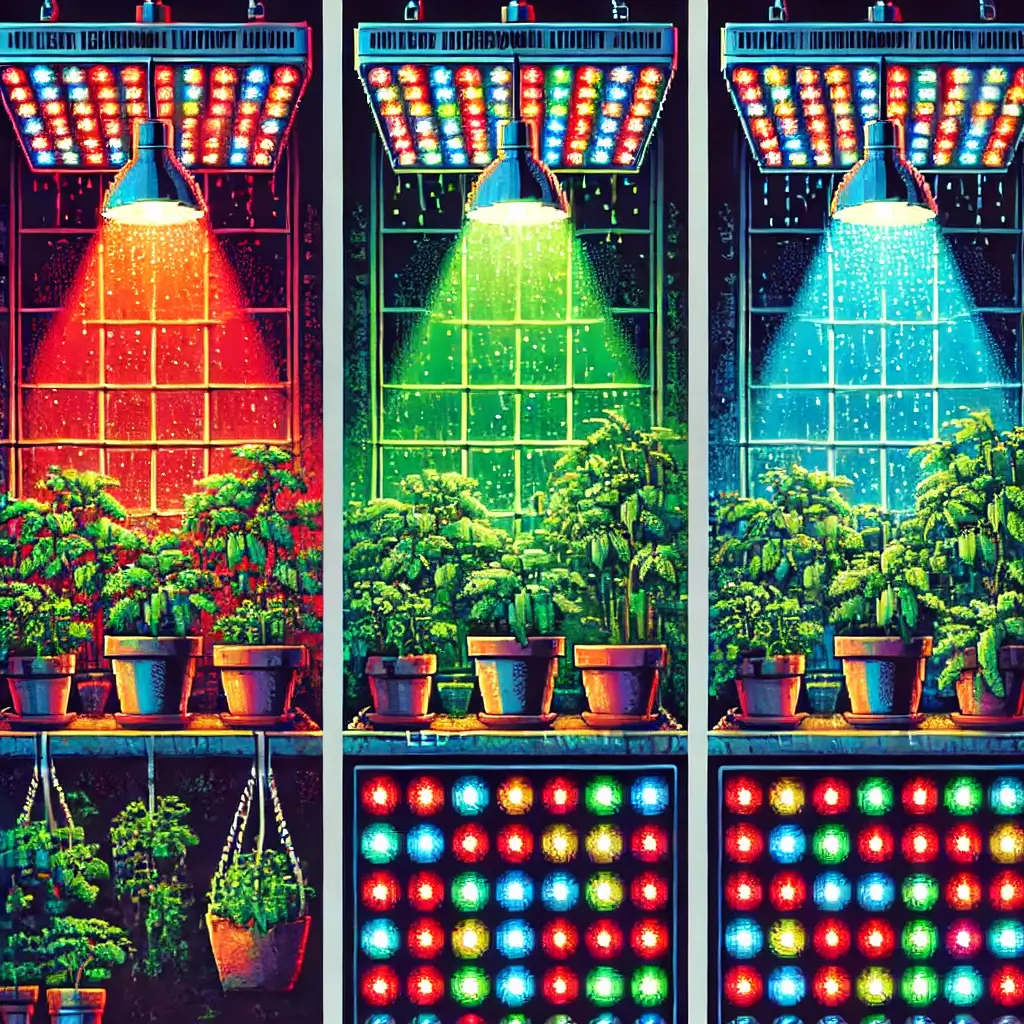
Crushing It! 7 Mind-Blowing LED Grow Light Secrets for Explosive Plant Growth
Hey there, fellow green thumbs!
Ever feel like you’re just throwing spaghetti at the wall with your indoor garden?
You’ve got your pots, your soil, your seeds, and a whole lot of hope, but the plants just aren’t… thriving?
Trust me, I’ve been there.
I’ve killed more succulents than I care to admit and watched my tomato seedlings stretch out like gangly teenagers reaching for a light that wasn’t there.
But then, I discovered the magic of LED grow lights, and my entire world changed.
It’s not just about turning on a light and walking away.
It’s about unlocking the true potential of your plants, giving them exactly what they need, when they need it.
And let me tell you, when you get it right, the results are nothing short of spectacular.
Imagine luscious, vibrant green leaves and bountiful harvests, all from the comfort of your living room.
That’s what this guide is all about.
I’m going to share some game-changing secrets that will transform your indoor gardening from a hopeful hobby into a jaw-dropping success story.
No more guessing, no more wasted effort.
Just pure, unadulterated plant power.
Ready to level up?
Let’s dive in!
Table of Contents
The Epic Battle of Light: Why LED Grow Lights Dominate
Let’s get one thing straight from the start.
If you’re still using old-school incandescent bulbs or even those curly CFLs, you’re fighting a losing battle.
It’s like bringing a knife to a gunfight, or a flip phone to a space mission.
LED grow lights are the future, and for good reason.
I remember my early days, lugging around heavy, noisy HID lights that cranked out so much heat I thought I was going to melt my house down.
I was constantly worried about my plants getting fried and my electricity bill giving me a heart attack.
LEDs, on the other hand, are a total game-changer.
They are incredibly energy-efficient, using a fraction of the power of traditional lights.
This means your wallet stays happy and you can grow a lot more without worrying about the electric company sending you a nasty surprise.
They also produce very little heat, which is a massive bonus.
You can place them closer to your plants without scorching the leaves, which is crucial for maximizing light intensity.
This also simplifies your whole setup, as you don’t need a huge, noisy ventilation system just to keep things cool.
Think of it this way:
An LED grow light is a precision tool, tailor-made for plants.
It’s not just a bulb that makes light; it’s a finely-tuned instrument that delivers the exact wavelengths of light plants need for photosynthesis, and nothing they don’t.
It’s the difference between a sledgehammer and a scalpel.
With LEDs, you’re operating with surgical precision, which leads to healthier plants and bigger yields.
And let’s not forget the longevity.
A good LED grow light can last for over 50,000 hours.
That’s more than five years of continuous use!
You can literally set it and forget it, while your old lights would have needed replacing a dozen times over.
The upfront cost might be a bit higher, but trust me, it’s an investment that pays for itself in energy savings, longevity, and, most importantly, results.
Decoding the Light Spectrum: More Than Just ‘On’ or ‘Off’ for Your LED Grow Light
Okay, let’s get a little nerdy for a second, but I promise it’s worth it.
Imagine you’re trying to feed a baby.
You wouldn’t just give them a bowl of spaghetti and say “eat up,” right?
You’d give them a balanced meal with all the necessary nutrients for their growth.
The light spectrum is like that balanced meal for your plants.
Plants don’t use the full spectrum of visible light equally.
They primarily use blue and red light for photosynthesis.
Blue light is like the espresso shot for your plant; it’s essential for vegetative growth, building strong stems and leaves.
Red light, on the other hand, is the fuel for flowering and fruiting.
It signals to the plant that it’s time to start producing flowers and, eventually, delicious fruits or vegetables.
When you’re looking at an LED grow light, you’ll see a bunch of different colored diodes, often with some white ones mixed in.
This is what’s known as the “full spectrum” and it’s what makes modern LEDs so effective.
They’re not just blasting your plants with bright light; they’re delivering a specific recipe of wavelengths, perfectly calibrated for each stage of growth.
This is a huge advantage over traditional lights, which often have a very limited, and often inefficient, spectrum.
Some advanced LED lights even allow you to adjust the spectrum, dimming or boosting the blue and red channels to mimic the changing seasons or to push your plants for a specific growth outcome.
This level of control is simply impossible with older technology.
The key takeaway here is that you’re not just buying a light; you’re buying a nutrient delivery system in the form of photons.
Pay attention to the spectrum details on the packaging, especially if you have specific plants in mind.
For leafy greens, a light with a higher blue component is great.
For flowering plants, you’ll want to make sure there’s a strong red component.
Choosing Your Champion: Selecting the Perfect LED Grow Light
Alright, now for the fun part: shopping!
Walking into a hydroponics store or Browse online for an LED grow light can feel like walking into a spaceship.
There are so many numbers and acronyms: PPF, PPFD, PAR, wattage, efficacy… it’s enough to make your head spin.
But don’t panic.
We’re going to break it down into simple, manageable pieces.
First, let’s talk about the two most important factors: **wattage and coverage area**.
Forget the old incandescent rule of “higher wattage equals brighter light.”
LEDs are all about efficiency.
What you really want to pay attention to is the **PAR (Photosynthetically Active Radiation)** and **PPFD (Photosynthetic Photon Flux Density)** values.
Think of PAR as the range of light that plants can actually use for photosynthesis.
It’s the buffet of photons for your plants.
PPFD is the number of those photons that hit a specific square meter of your plant canopy per second.
This is the metric you truly care about.
It’s the density of that buffet.
A seedling needs much less PPFD than a mature, flowering plant.
I’d recommend looking for a light that can produce at least 200-400 µmol/m²/s for vegetative growth and 400-800 µmol/m²/s for flowering.
Next, consider the **form factor**.
Are you growing in a small tent, a big closet, or an open room?
There are bar-style lights, quantum boards, and traditional panel lights.
Quantum boards are my personal favorite for their excellent light distribution and passive cooling.
They spread the light out evenly, reducing hot spots and ensuring all your plants get a fair shake.
Bar-style lights are fantastic for large-scale operations or for supplementing light from other sources.
Lastly, don’t skimp on quality.
You’ll see a massive range in prices for LED grow lights.
While a cheap light might seem like a good deal, it often comes with a poor spectrum, low-quality diodes, and shoddy construction that will fail on you faster than a New Year’s resolution.
Investing in a reputable brand with quality components like Samsung or Osram diodes is a wise move.
It’s the difference between a rusty old tricycle and a high-performance sports car—they both get you somewhere, but one of them is going to get you there a lot better and without breaking down.
Ready to start your search?
Here are a few places to get you started with top-tier brands and expert reviews:
Check Out a Comprehensive Grow Light Guide!
Find Quality LED Grow Lights Here!
Learn More from Gardening Experts!
Installation Secrets: The Right Distance is Everything for Your LED Grow Light
You’ve chosen your magnificent LED grow light, and you’re ready to hang it up.
You might be tempted to just slap it up high and call it a day, but this is one of the biggest rookie mistakes you can make.
The distance between your light and your plant canopy is absolutely critical.
It’s a delicate dance of give and take.
Too close, and you risk “light burn,” which looks like bleached or yellowing leaves and is basically your plant screaming “HELP, I’M GETTING SUNBURNED!”
Too far, and your plants will get “leggy,” stretching and growing thin in a desperate attempt to reach the light.
This is a surefire way to get weak, spindly plants that will never produce a good harvest.
The sweet spot for your **LED grow light** depends on a few things: the power of your light, the stage of your plant’s growth, and the manufacturer’s recommendations.
As a general rule, a more powerful light needs to be hung higher than a less powerful one.
Seedlings are the most sensitive little babies and need a much gentler light intensity.
I usually start my seedlings with the light about 24-36 inches away, and then as they get stronger, I’ll move the light closer.
For vegetative growth, you’ll be in the 18-24 inch range.
During the flowering stage, your plants are at their hungriest for light, so you can often drop the light to 12-18 inches, depending on the intensity of your fixture.
The best way to know for sure is to check the manufacturer’s guide.
Most reputable brands will provide a hanging height chart for each growth stage.
If you don’t have that, a great rule of thumb is the “hand test.”
Hold your hand at the canopy level for 30 seconds.
If it feels uncomfortably hot, it’s too hot for your plants.
Raise the light until the heat is just a gentle warmth.
One more pro tip: reflective material is your best friend!
My first setup was in a regular white-walled room, and I was losing a ton of light to absorption.
Once I lined the walls with Mylar, I was blown away by the difference.
It’s like giving your plants a surround-sound light show.
This simple trick can increase the efficiency of your setup dramatically and get you more bang for your buck.
The Rhythm of Light: Timing Your LED Grow Light for Success
Plants aren’t robots; they need a rhythm.
This is where your timer comes in.
It’s one of the most powerful tools in your arsenal, and setting it correctly is absolutely crucial for your plants’ health and success.
Just like we need sleep to recharge and grow, plants need a period of darkness to perform essential biological processes, like respiration.
And let’s be real, you’re not going to stand there all day and night flipping a switch.
So let’s break down the perfect schedule for each stage.
For seedlings, you want to give them a long day to encourage robust, fast growth.
A common schedule is **18 hours on and 6 hours off**.
This gives them plenty of light to fuel their rapid development while still providing a short period of rest.
Once your plants are in the vegetative stage, the same **18/6** schedule works like a charm.
This long light period ensures they are building a strong, leafy structure, preparing them for the main event.
Now, here’s where it gets exciting.
When you’re ready to flip your plants into the flowering stage (for photoperiod plants, that is), you need to change their mindset.
You do this by mimicking the shorter days of late summer and early autumn.
The standard schedule here is **12 hours on and 12 hours off**.
This extended period of uninterrupted darkness tells the plant that it’s time to stop focusing on leaves and start focusing on flowers and fruits.
Getting this timing right is a non-negotiable step.
An inconsistent dark period can stress the plant and even cause it to revert back to the vegetative stage.
A good digital timer is a very small investment that pays off huge dividends.
I have a dozen of them, and they are the unsung heroes of my grow room, silently making sure my plants get their beauty rest and their full dose of photons every single day.
This is where the magic happens, folks.
This is where you go from a plant grower to a plant conductor, orchestrating the perfect symphony of light and darkness to get the best performance from your green superstars.
Troubleshooting Your LED Grow Light: Common Problems, Easy Fixes
Even with the best equipment and a solid plan, things can sometimes go wrong.
Don’t sweat it.
The key is to know what to look for and how to fix it before it becomes a bigger problem.
One common issue is **light burn**, which we touched on earlier.
This often appears as white or yellow patches on the leaves closest to the light.
My first thought when I see this is to blame my plants for being too sensitive, but the reality is, I’m just being a bad parent.
The fix is simple: raise the LED grow light a few inches and see if the new growth looks healthier.
Another problem I’ve seen is my plants getting too tall and “stretching.”
They’re growing long, spindly stems with large gaps between the leaves.
This is a clear sign that they aren’t getting enough light intensity.
It’s like they’re a tiny plant on a crowded bus, trying to peek over everyone else’s heads to see the scenery.
The solution is to lower the light closer to the canopy, but be careful not to cause light burn.
A lot of times, with an adjustable light, I’ll just increase the light intensity by turning up the dimmer switch a notch.
Another thing to watch out for is a funny, patchy growth pattern or leaves that look like they’re being “shadowed” by other leaves.
This usually means your light isn’t a good fit for your grow area or isn’t providing an even spread.
This is where those quantum boards I mentioned earlier really shine.
They spread light evenly, reducing the number of these “shadow spots.”
If you’re using a panel-style light, you might need to adjust its position, or even add another one, to ensure full coverage.
Lastly, keep an eye on your plants’ color.
Pale green or yellowing leaves can sometimes be a sign of a nutrient deficiency, but with a new light, it can also be a sign of light stress.
Always check the light distance and intensity before you start dumping more nutrients on your plants.
Sometimes the simplest solution is the right one.
Your plants are excellent communicators; you just have to learn how to listen to them.
They’ll tell you what they need if you pay close enough attention.
Final Words of Wisdom: The Takeaway to Transform Your Grow
If there’s one thing I want you to take away from this guide, it’s that indoor gardening doesn’t have to be a guessing game.
With the right tools and a little know-how, you can achieve incredible results that will make all your friends and family jealous.
LED grow lights are the single most important piece of that puzzle.
They are not just a simple light bulb; they are a high-tech tool that puts you in the driver’s seat of your plants’ growth.
By understanding the science behind the spectrum, selecting the right fixture for your space, and meticulously setting your hanging height and timer, you’re giving your plants the best chance to flourish.
So go out there, get that light, and start growing!
The lush, vibrant garden of your dreams is just a few clicks and a little setup away.
Happy growing, my friends!
And remember, if at first you don’t succeed, try, try again… and maybe adjust your light a bit.
Good luck!
LED grow light, plant growth, light spectrum, indoor gardening, grow light timer