
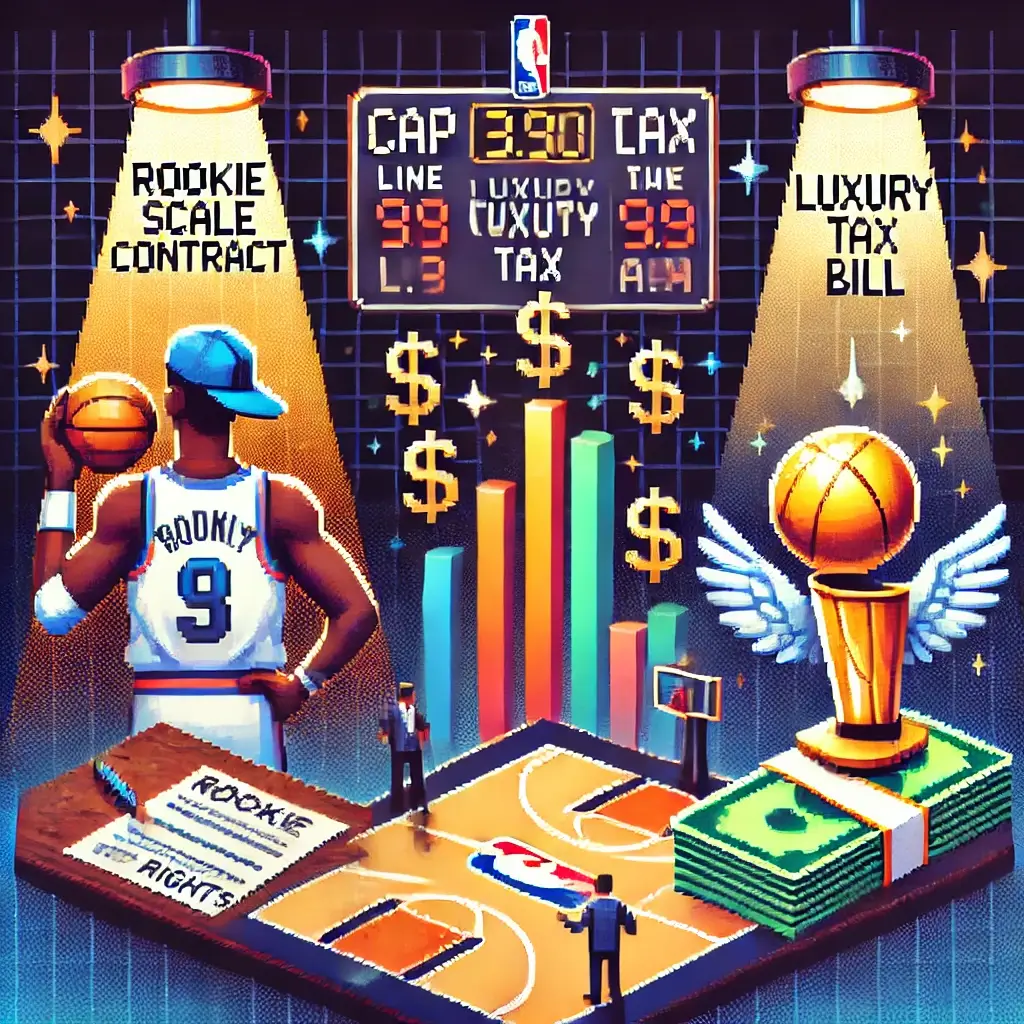
The $100 Million Gamble: How NBA Contracts Exploded and Changed Basketball Forever
Remember that mind-blowing moment when you saw a massive free-agent contract announced on your phone?
A player you barely knew signed for $150 million over five years, and your jaw just hit the floor.
We see these colossal numbers thrown around every summer, and it’s easy to get lost in the sheer scale of it all.
We think, “Wow, this guy is set for life,” and that’s about the end of the thought process for most people.
But what if I told you that those numbers are just the tip of a financial iceberg, a swirling vortex of strategy, rules, and mind-bending math that makes or breaks an NBA franchise?
This isn’t just about paying a superstar.
This is about the intricate, high-stakes game of player contracts and cap space that every team has to play to have even a snowball’s chance at winning a championship.
It’s a game of chess played with dollar signs, and it’s a million times more fascinating than you think.
So, let’s pull back the curtain and peek inside the bizarre, brilliant, and sometimes bewildering business of basketball.
It’s time to understand where the money goes and, more importantly, why.
This isn’t a dry economics lesson, I promise.
Think of me as your guide through the labyrinth, a veteran of countless late nights spent pouring over CBA summaries and salary charts, a true believer that understanding this stuff makes watching the game even better.
Trust me, once you get it, you’ll see every trade and free-agent signing in a whole new light.
You’ll be the person at the sports bar who casually explains why a sign-and-trade was the only move for a team, while everyone else is still arguing about who had a better college career.
You’ll feel like a true insider, and that’s the real reward.
So let’s get into it, shall we?
—
Table of Contents
—
Contracts Aren’t Created Equal: From Rookies to Max Money
When we hear the word “contract,” we usually just think of the total value and the years.
But in the NBA, it’s not that simple.
Just like a restaurant menu, there are different categories, each with its own specific rules and restrictions.
The first and most straightforward is the **Rookie Scale Contract**.
If you’re a fresh-faced college phenom hearing your name called on draft night, this is your first step into the financial big leagues.
The salary for a first-round pick is pre-determined by the CBA, based on their draft position.
The top pick gets the most, and it scales down from there.
It’s a fixed, four-year deal with team options for the third and fourth years.
This is the league’s way of keeping things fair and predictable for young talent and preventing bidding wars for unproven players right out of the gate.
The next level up is the holy grail for a star player: the **Max Contract**.
This isn’t a specific dollar amount; it’s a percentage of the salary cap.
The max depends on a player’s years of experience in the league.
A player with 0-6 years of experience can sign for a maximum of 25% of the cap.
A veteran with 7-9 years gets up to 30%, and a true elder statesman with 10+ years can command up to 35%.
This structure is designed to reward loyalty and experience, allowing teams to pay their homegrown superstars more than they could in free agency.
It’s the reason why a player often takes a slight discount to stay with the team that drafted them—they can get a bigger piece of the pie.
It’s also why a young star’s contract extension is a huge deal.
Speaking of which, we have the **Designated Veteran Extension**, better known as the “supermax.”
This is a rare, special category for a select few superstars.
If a player has been in the league for 7-9 years, meets specific performance criteria (like winning MVP or Defensive Player of the Year), and has been with their current team for their entire career, they are eligible for a contract that starts at 35% of the salary cap.
This was created to help small-market teams retain their franchise players and prevent them from leaving for bigger markets.
Did it work? Well, that’s a debate for another day, but it certainly made a splash.
Then there are the smaller, but equally important, contracts like the **Two-Way Contract**.
This is for players who split time between an NBA team and its G-League affiliate.
It’s a pathway for developing talent without committing a full roster spot or a big salary.
It’s a fantastic innovation that has given countless players a real shot at making it to the big time.
Finally, we have the **Minimum Contracts**.
These are exactly what they sound like: the league minimum salary for a veteran, which depends on their years of experience.
These contracts are crucial for filling out a roster, adding veteran leadership, and finding diamonds in the rough.
They are also a key element in many complex trades and signings.
So, you see? A contract isn’t just a number.
It’s a roadmap, a rulebook, and a strategic tool all rolled into one.
—
The Salary Cap: The Budget Every Team Must Master
If contracts are the puzzle pieces, the **salary cap** is the size of the puzzle box.
It’s a hard limit on how much a team can spend on its players’ salaries each year.
Well, sort of.
Unlike other sports with a “hard cap” (looking at you, NFL), the NBA has a “soft cap.”
This means there are a bunch of complex, often mind-boggling exceptions that allow teams to exceed the cap under certain circumstances.
Think of it like a family budget, but with a secret, magic credit card that you can only use for very specific things.
The main purpose of the salary cap is **competitive balance**.
Without it, a handful of wealthy owners in big markets could just outspend everyone else and hoard all the best players, making the league a snooze-fest.
The cap ensures that even smaller market teams have a shot at building a contender if they draft well and manage their finances smartly.
Each season, the salary cap is set based on the league’s basketball-related income (BRI) from the previous year.
So when the NBA TV ratings are up and merchandise sales are booming, the cap goes up, and everyone gets a raise.
It’s all connected, and it’s why those TV deals are so unbelievably important.
A few other key terms you need to know are the **luxury tax** and the **apron**.
The luxury tax line is a separate threshold, usually about $20 million above the cap.
If a team’s total payroll exceeds this line, they have to pay a steep tax to the league.
The deeper into the tax you go, the more you have to pay, and it’s a progressive tax, so the bill can get astronomical.
This money is then redistributed to the non-taxpaying teams, which is a great incentive for everyone to stay frugal.
The apron is another, even higher line.
If a team is over the apron, they lose access to certain cap exceptions, making it even harder to sign players or make trades.
It’s the league’s way of saying, “You’ve spent enough; now you have to live with the consequences.”
Managing the cap is a delicate balancing act for every General Manager.
It’s about knowing when to spend and when to be patient.
It’s a game of chicken, and the stakes are massive.
—
Navigating the NBA’s Rulebook: The Collective Bargaining Agreement
If the salary cap is the budget, the **Collective Bargaining Agreement (CBA)** is the entire constitution of the league.
It’s a massive, hundreds-of-pages-long legal document that governs every single aspect of the relationship between the NBA and its players’ union.
It’s a living, breathing document that gets renegotiated every few years, and every change in it has seismic ripple effects throughout the league.
The CBA dictates everything from player salaries and contracts to the rules of free agency, the draft, and even things like drug testing and the length of the season.
When you hear a sports analyst talking about how “the CBA allows for this type of deal,” they’re talking about a specific clause in this massive document.
Understanding the CBA is like having a secret key to unlock the true meaning of every move a front office makes.
For example, the CBA sets the rules for how and when a player can be extended.
A star on a rookie-scale deal is eligible for a **rookie extension** after their third season.
If they sign it, they secure their future before even hitting free agency.
For the team, it’s a way to lock up a key piece of their core for years to come without worrying about a bidding war.
But wait, there’s more!
The CBA also includes the now-famous **Designated Player Extension** rule, which allows teams to sign their homegrown stars to a “supermax” deal.
The player must meet certain criteria (like being on an All-NBA team) to qualify.
It’s designed to help small-market teams keep their best players and avoid the dreaded situation of a superstar leaving in free agency.
Whether it’s worked perfectly is a matter of fierce debate among basketball fans, but it certainly changed the landscape.
Think of the CBA as the ultimate rulebook for the ultimate game.
You can’t just play the game; you have to know the rules, and you have to know how to bend them just enough to get an advantage.
—
Bird Rights and the Luxury Tax: The Ultimate Superpower and Its Price
If the salary cap is the budget, and the CBA is the rulebook, then **Bird Rights** are the secret cheat code.
Named after the legendary Larry Bird, they are an exception to the salary cap rules.
Basically, if a team has a player who has been with them for three years, they gain the ability to re-sign that player for a max contract, even if it puts them over the salary cap.
This is a superpower, a crucial tool for teams to retain their talent without sacrificing their financial flexibility.
It’s why you see so many stars stay with their teams for life, like Stephen Curry or Damian Lillard.
There are a few different types of Bird Rights.
There are **Full Bird Rights** (after three seasons with the same team), **Early Bird Rights** (after two seasons), and **Non-Bird Rights** (after one season).
Each type allows a team to offer a slightly different, progressively more valuable contract, but the basic idea is the same: they let you keep your own guys, even when you’re “out of money” by traditional cap standards.
It’s the reason a player will often re-sign with their current team even if another team offers them a slightly higher salary in free agency.
The current team can just offer them a longer deal with bigger raises, and that’s often a game-changer.
But with great power comes a great price, and that’s where the **luxury tax** comes in.
Just because you can use your Bird Rights to keep a player and go over the cap doesn’t mean you should.
Exceeding the luxury tax line can be an incredibly expensive proposition for a team owner.
The tax is punitive, designed to discourage teams from just buying championships.
The more you go over the tax line, the more you pay per dollar.
For example, for every dollar you spend between the tax line and the first tax bracket, you pay a certain amount back to the league.
If you’re a repeat offender, the tax bill can be even higher.
This is why you see so many teams desperately try to shed salary to get under the tax line, especially at the trade deadline.
They’ll give away a pick or a solid role player just to save a few million in salary and avoid a massive luxury tax bill.
It’s the constant tug-of-war between winning on the court and managing the books off the court.
It’s the hidden battle that decides so much of the league’s landscape.
—
How GMs Play Chess: Using Cap Space as a Weapon
At the end of the day, basketball is a game of strategy, but so is the front office.
General Managers and team presidents are not just scouting talent and watching film.
They are financial strategists, constantly looking at the cap sheet, a spreadsheet that shows every player’s salary, contract length, and other details.
Their job is to turn this dry data into a championship contender.
A team with a lot of cap space is like a rich person with a full wallet on Black Friday.
They can go out and try to sign a top-tier free agent.
This is a huge advantage, but it’s not a guarantee of success.
Often, a team will sacrifice future flexibility to sign a big star, only to find themselves stuck with a less-than-ideal roster afterward.
Another key strategy is the **sign-and-trade**.
This happens when a team is about to lose a free agent but wants to get something in return.
They can sign the player to a new contract and then immediately trade him to another team, often one that doesn’t have the cap space to sign the player outright.
It’s a tricky, often complicated maneuver, but it allows teams to get some value back instead of losing an asset for nothing.
Think of it as a win-win for both teams, allowing a player to get to their desired destination while providing their old team with a little bit of compensation.
Then there’s the risky but often rewarding strategy of taking on a “bad contract.”
A team with cap space can trade for a player with a huge, multi-year contract that his current team desperately wants to get rid of.
In exchange, the cap-space team usually gets a valuable asset, like a draft pick or a young player, as a sweetener.
It’s a way for a rebuilding team to acquire assets for the future, while the other team gets the financial freedom to make another move.
It’s the ultimate financial arbitrage, and it’s a huge part of the NBA’s offseason.
So, the next time you hear a rumor about a trade, don’t just think about the players involved.
Think about the cap sheets, the exceptions, the Bird Rights, and the luxury tax.
Think about the financial chess match happening behind the scenes, and you’ll start to see the whole picture.
Check the Latest NBA Free Agents & Contracts on Spotrac
Explore NBA Player Salaries on HoopsHype
—
A Visual Guide to the Cap: An HTML Infographic
Now, I know all this talk about contracts and cap space can feel a bit abstract.
So, I thought it would be helpful to show you a simple visual representation of the key financial concepts.
Think of this as your cheat sheet, a quick reference guide to remember what’s what.
It’s not a perfect scale, but it gives you a good idea of the relationships between the cap, the tax, and the different types of contracts.
NBA Salary Cap & Contract Breakdown
Team’s Total Payroll
Team is Under the Cap
(Flexibility to sign Free Agents)
Team is Over the Cap, But Under the Tax
(Can use Exceptions like Bird Rights)
Team is Over the Luxury Tax
(Pays a Heavy Penalty)
Key Contract Types
Rookie Scale
Veteran Minimum
Mid-Level Exception
Max Contract
—
The Human Element: Why The Numbers Matter
It’s easy to get lost in the jargon, the numbers, and the endless spreadsheets.
It’s easy to see these players as just assets, pieces on a chessboard to be moved and traded at will.
But we have to remember the human element.
These contracts, these cap numbers, they represent people’s lives and careers.
For a young player signing his first rookie deal, it’s not just a contract; it’s a dream come true, the culmination of a lifetime of hard work and sacrifice.
It’s a way to provide for their family, to set up their future, and to gain a foothold in the most competitive sports league in the world.
For a veteran, a new contract can be about cementing their legacy, securing their place in the history books, or finding a home where they can chase a championship ring.
The contracts are a reflection of a player’s value, their worth to the franchise and to the league as a whole.
When a team extends a player on a max deal, it’s a huge vote of confidence, a statement that they are the face of the franchise.
It’s a declaration of a long-term commitment, a promise of loyalty from both sides.
And when a team trades a player away, even if it’s for a sound financial reason, it has a real impact on that person’s life.
They have to move their families, change their routines, and adapt to a new city and a new system.
It’s the harsh, cold reality of the business of basketball.
So the next time you hear about a complex sign-and-trade or a team desperately trying to shed salary to get under the tax line, don’t just see the numbers.
See the strategy, the struggle, and the human ambition behind it all.
It’s a game of inches, both on the court and in the front office.
The business of basketball is a complex, fascinating, and sometimes brutal world, but understanding it makes the game itself all the more compelling.
It adds another layer of intrigue and drama to every pass, every shot, and every buzzer-beater.
It’s a testament to how far the sport has come, from a simple game of hoops to a multi-billion dollar industry where every decision, no matter how small, has massive repercussions.
And now, you’re not just a fan; you’re an insider, a financial guru who understands the real business of basketball.
Welcome to the club.
NBA Contracts, Cap Space, Collective Bargaining Agreement, Luxury Tax, Bird Rights
🔗 Post-Retirement Tycoons Posted 2025-08-18 09:40 UTC 🔗 Minimalist Parenting in Urban Apartments Posted 2025-08-18 09:18 UTC 🔗 Your Dream JDM Car Posted 2025-08-18 07:55 UTC 🔗 Australian Outback Motorcycle Tour Posted 2025-08-18 07:24 UTC 🔗 Independent Jazz Musicians Posted (Date not provided) 🔗 The Alley-Oop: 3 Rules to Master Posted 2025-08 (Exact date not specified)