
Gallery Insurance 101: 27 Caffeine-Fueled Secrets Behind Liability, Property & Business Interruption
Table of Contents
Gallery Insurance 101 — art gallery insurance cost per year and why it matters on a Tuesday at 2 a.m.
Close your eyes for a second, unless you are holding a latte and an expensive sculpture, in which case please do not.
Imagine your white walls glowing like a calm lake at sunrise, a few red dots on labels whispering that rent will, in fact, be paid.
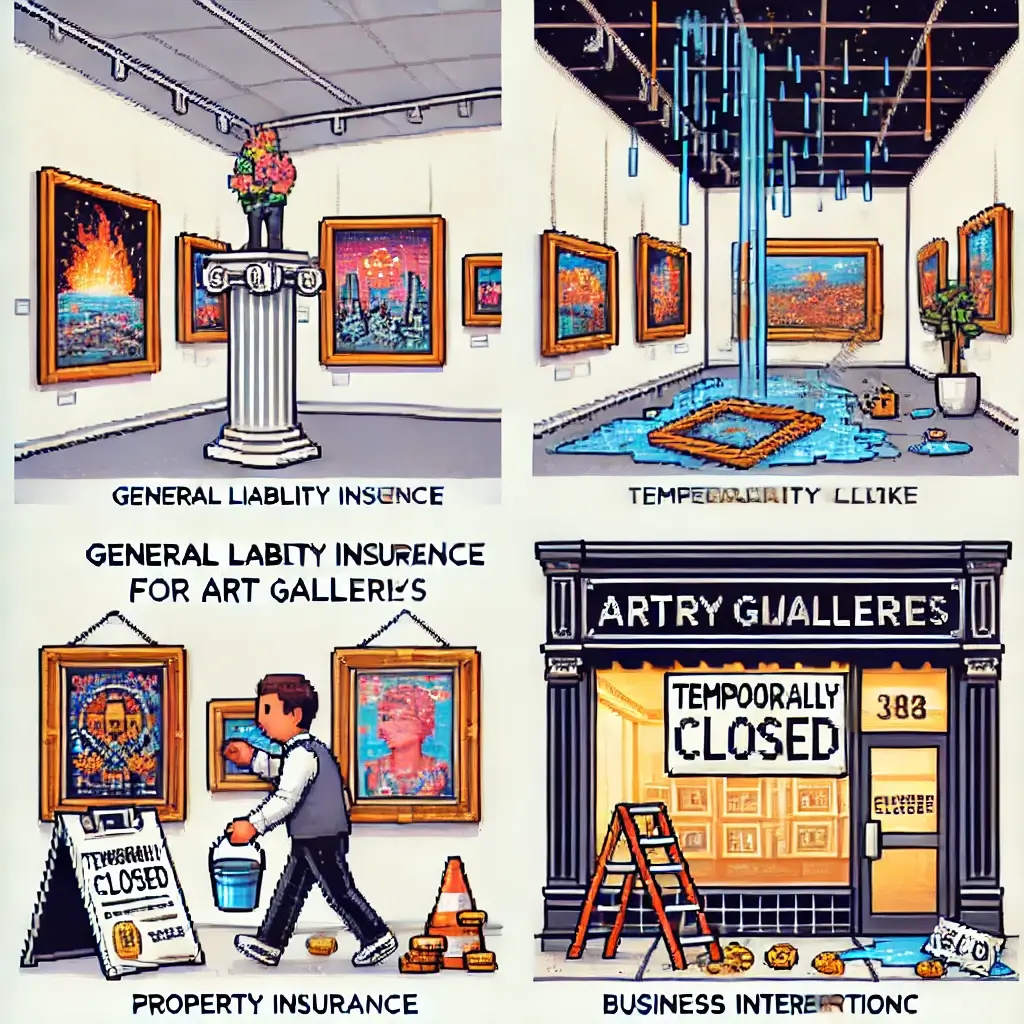
Now imagine a guest with a very energetic scarf spinning into a pedestal like a joyful tornado, and your calm lake suddenly becomes a dishwasher on spin cycle.
That, my friend, is when gallery insurance stops being abstract and becomes oxygen.
Gallery insurance is the grown-up name for a bundle of coverages that protect your space, your art, your people, and your business rhythm when the universe does its awkward pratfall act.
It is less about fear and more about choreography, so you can keep doors open and the lights gentle and warm even when something fragile meets gravity.
It includes liability for the “oops,” property for the “crack,” and business interruption for the “we have to close for six weeks and still make payroll.”
It also includes tiny extras you forget about until they save your week, like spoilage for climate incidents or debris removal after a ceiling leak.
Maybe I am being dramatic, but I have seen curators Google deductibles with a shaking hand while mopping a floor at midnight, so forgive the theater.
This guide is your flashlight under that stage.
Beginner Level — Gallery Insurance with crayons, plus art gallery insurance cost per year in plain English
Let us pretend insurance is a gallery opening with three rooms and too much hummus.
Room one is General Liability, which says if a visitor trips on a cable and does a swan dive, the policy will help with medical bills and legal defense.
Room two is Property, which protects the things you own, from track lighting to the front desk iMac to that rolling pedestal you swear was straight yesterday.
Room three is Business Interruption, which keeps the cash flow humming when a covered loss forces you to close or slow down, paying for lost income and ongoing expenses like rent, utilities, and employee wages.
There are side rooms, and they are fun in a responsible way.
Fine art on consignment can be covered under your policy, but the terms matter, and we will talk about them the way a careful framer talks about corners.
Inland marine handles art in transit or at temporary locations, such as fairs and pop-ups, because art likes to travel more than your accountant does.
There is also Cyber for the modern heartbreak of phishing, ransomware, and that one staffer who clicks everything with reckless optimism.
What does art gallery insurance cost per year for beginners.
It depends on location, limits, the replacement cost of what you own, your security measures, your claims history, and whether your neighbor runs a flamenco studio with an enthusiastic fog machine.
A small storefront with modest equipment and careful risk control might see premiums that feel like a nice dinner each month.
A larger urban space hosting big openings, high visitor volume, pricey consignments, and regular shipping might budget like it is feeding a polite dragon.
We will unpack numbers later with a napkin and a calculator made of metaphors.
Intermediate Level — How to act like you have done this before, and how a gallery liability insurance quote is a map not a maze
This is where you tie your hair back and read the policy like it is a mystery novel where the murderer is the exclusion you did not notice.
When you request a gallery liability insurance quote, you will see lines for general liability, products and completed ops, personal and advertising injury, and medical payments.
You will also see limits, which are the polite way of saying the most the policy will pay when life happens loudly.
Common limits are one million per occurrence and two million aggregate, but your event schedule, foot traffic, and landlord requirements may push those numbers higher.
Ask for endorsements that match your reality, such as additional insured status for landlords and event spaces, waiver of subrogation for key partners, and primary and noncontributory wording so your coverage leads the dance when certificate juggling begins.
Get property coverage on a replacement cost basis if you can, not actual cash value, because depreciation is a heartbreak ballad and you deserve better.
Schedule fine art with agreed value when appropriate, especially for high-value pieces, and be clear who owns what, because ownership is the compass of claims.
For business interruption, confirm that the waiting period is not a week of poetic silence, and confirm that coverage triggers align with your biggest realistic risks, like water damage from the unit above or a neighborhood transformer that enjoys dramatic exits.
Ask for coverage for dependent properties if your revenue relies on a nearby museum or a partner venue that could go dark and drag your foot traffic with it.
Review deductibles with the maturity of a person reading a menu for the prices, not the adjectives.
Yes, sometimes a higher deductible lowers premium in a way that actually makes sense, as long as you keep an emergency fund that is not a shoebox of gallery postcards.
Expert Level — Underwriting anthropology, loss modeling, and stubborn realities behind art gallery insurance cost per year
Underwriters are not villains or saints, but weather forecasters with calculators and a fondness for granular questionnaires.
They read your website, your lease, your event calendar, your consignment agreements, your security plan, your HVAC logs, and your history of claims with the patience of someone untangling a headset cord from 2007.
They price on probability, severity, and uncertainty, which means your job is to reduce uncertainty with documentation and predictable habits.
Premium is not a moral judgment, it is a probability poem written in dollars.
For art gallery insurance cost per year, underwriters weigh neighborhood crime data, fire protection class, proximity to water lines and older roofs, value and fragility of inventory, staff count, visitor volume, event frequency, alcohol service, and the logistics of transit and installation.
They consider alarm systems, cameras, off-site storage relationships, and whether you have a humidity strategy that is not just “the air feels nice today.”
They browse loss runs for patterns like “ceiling leaks every June,” or “two slip-and-falls near the same threshold,” and they ask what changed since then.
They assign credits for sprinklers, central station alarms, UL-rated safes, key control, and staff training, and they apply debits for cluttered storage, overloaded outlets, unanchored pedestals, and doors that do not quite latch with conviction.
You can talk to them like a partner, because the story you tell is part of the math they do.
Bring data on attendance, sales distribution, event headcounts, and seasonal patterns, and bring a map of your risk controls the way you bring a floor plan to a designer.
Offer a two-year improvement plan for anything squishy, and ask for a mid-term review when milestones are hit, because pricing responds to fresh facts faster than it responds to wishful thinking.
Infographic #1 — Gallery Insurance Coverage Matrix
Use this quick matrix to map common gallery risks to the primary coverage that normally responds.
| Risk Scenario | General Liability | Property | Transit / Inland Marine | Business Interruption | Cyber |
|---|---|---|---|---|---|
| Slip & fall during opening night | ✓ | — | — | — | — |
| Owned pedestal and walls damaged by burst pipe | — | ✓ | — | ✓ | — |
| Consigned artwork scratched during installation | — | ✓* | — | — | — |
| Theft with visible forced entry | — | ✓ | — | ✓* | — |
| Artwork lost or damaged in transit | — | — | ✓ | ✓* | — |
| Funds diverted by fraudulent email | — | — | — | — | ✓ |
| Street closure by civil authority limits access | — | — | — | ✓* | — |
*Often requires an endorsement, sublimit, or specific policy wording.
Infographic #2 — Cost Driver Heatmap
See which operational and environmental factors typically push premiums for liability, property, and business interruption.
| Cost Driver | Liability | Property | Business Interruption |
|---|---|---|---|
| Foot traffic & event frequency | High | Medium | Medium |
| Building age & roof condition | Low | High | Medium |
| Alarm, cameras, key control | Low | Medium | Low |
| Water sensors & maintenance logs | Low | Low | Medium |
| Transit frequency & crate quality | Low | Medium | High |
| Alcohol service at openings | High | Low | Low |
| Consigned value volatility | Medium | High | Medium |
| Recent claims history | High | High | High |
Legend: High = stronger impact on premium; Medium = moderate impact; Low = lighter impact.
Infographic #3 — Claims Response Timeline
Follow this sequence to reduce loss severity and speed up recovery after an incident.
T0
Safety first.
Stop water, secure area, assist guests.
+10–30 min
Document.
Photos, videos, notes, item list.
+30–60 min
Notify.
Broker/carrier, landlord, vendors.
Same Day
Mitigate.
Board-up, dry-out, move pieces, dehumidify.
48–72 hrs
Adjuster visit.
Share logs, receipts, condition reports.
1–2 weeks
Estimate & approval.
Work orders, restoration plan.
Repair period
Track costs & downtime.
Use extra expense to speed reopening.
Reopen
Announce safely.
Monitor humidity & foot traffic.
+30 days
Post-mortem.
Fix root causes, update checklists.
Prepare template emails, vendor contacts, and a photo checklist in advance to save precious minutes.
Infographic #4 — Premium Optimization Scorecard
Visualize how common controls typically influence pricing. Longer bars suggest stronger potential for credits or favorable underwriting.
Water leak detection & auto-shutoff
Central-station alarm & camera coverage
Anchored pedestals & cord management
Daily walkthrough logs with photos
Vendor COIs + Additional Insured & Waiver of Subrogation
Professional art shippers & climate-controlled transit
Cyber controls: MFA, backups, staff phishing drills
Combine multiple controls for compounding benefits at renewal.
Infographic #5 — Business Interruption Builder
Use this visual to set a realistic indemnity period and anticipate cash-flow needs during recovery.
Waiting Period
Typical deductible measured in hours or days before coverage starts.
Repair & Restoration
Primary indemnity period; track revenue trends and extra expense.
Extended Period
Optional extension to rebuild foot traffic and sales after reopening.
Stabilization
Marketing push, events calendar reset, inventory normalization.
Budgeting Pointers
Estimate normal monthly net income and fixed expenses, then select an indemnity period that reflects realistic build-back timelines for your location and trade partners.
Infographic #6 — COI (Certificate of Insurance) Requirements Checklist
Standard language galleries request from vendors, caterers, and pop-up venues.
General Liability — $1M per occurrence / $2M aggregate or higher per contract.
Additional Insured — Gallery entity and landlord listed, form acceptable to contract.
Primary & Noncontributory — Vendor policy primary for operations at premises.
Waiver of Subrogation — In favor of gallery and landlord.
Liquor Liability — If serving alcohol, proof of coverage for caterer or bar service.
Auto & Workers’ Comp — Required for movers, riggers, and shippers.
Policy Dates — Must be current for the full event or project period.
Store COIs in a dated folder and match them to invoices to avoid last-minute scrambles.
The Big Three — Liability, Property, and Business Interruption in Gallery Insurance, plus a gallery liability insurance quote decoding
General Liability is your legal seatbelt when people and things collide in socially complicated ways.
It covers bodily injury and property damage to others, plus personal and advertising injury if your marketing accidentally steps on someone’s toes with more enthusiasm than intended.
Liquor liability may be needed if you serve alcohol, because prosecco is fun until it is suddenly physics.
Certificates of insurance become social currency here, so build a simple process to issue them fast without typos that make landlords sigh.
Property covers your owned stuff, and sometimes the walls depending on your lease, but always read the lease like a detective novel where the landlord’s lawyer is the plot twist.
Choose limits with inventory spreadsheets, not vibes, and remember improvements and betterments if you paid to make the space behave like a gallery instead of a charming shoebox.
Pay attention to water damage, because buildings are basically aquariums pretending to be architecture.
Confirm theft coverage terms, alarm requirements, and if mysterious disappearance is covered or just a phrase that haunts you like an unfinished label.
Business Interruption is the musician who keeps the vibe alive when the power flickers.
It replaces income and covers necessary continuing expenses after a covered loss, sometimes including extra expense to speed reopening, like renting a temporary space or paying overtime for repairs.
Pick an indemnity period that matches reality, not optimism, because artisan plaster is slow and permitting is slower.
Pricing Map — How to ballpark art gallery insurance cost per year without calling your ex who works in actuarial
Premium modeling is a mosaic built from five tiles that never sit still.
Tile one is size and scope, meaning square footage, revenue, event count, and staff.
Tile two is location, meaning fire protection class, building age, flood exposure, crime statistics, and proximity to riskier neighbors.
Tile three is contents and consignment, meaning the value and volatility of what is inside and who owns it on any given day.
Tile four is operations, meaning transit frequency, installation methods, contractors, alcohol service, and visitor management.
Tile five is history and controls, meaning past losses and the story of how you fixed the root causes.
If you want a practical budgeting ritual, start by listing your replacement cost for owned contents and improvements, then add your estimated twelve-month lost profit at a normal cadence, then pick liability limits that satisfy your scariest event and your grumpiest landlord.
Now divide by months and ask whether the number makes your left eyelid twitch.
If it does, identify credits you can earn in the next ninety days, because those move the needle more than threatening to become a pottery studio.
Remember that art gallery insurance cost per year usually falls when your controls move from “we intend to” to “here is the logbook and here is the camera screenshot.”
Documentation is premium poetry.
How To Read a gallery liability insurance quote like you read a wall label you secretly love
Start with the declarations page, which is like the exhibition checklist of your policy.
Confirm named insureds, locations, and operations descriptions, because names and verbs are legally expensive when wrong.
Check the limits, aggregates, products and completed operations, personal and advertising injury, and medical payments, and make sure your landlord’s required wording appears on the certificate the way they wrote it in your lease with profound intensity.
Flip to endorsements, which are the quiet pages where your favorite coverage either shines or goes on break.
Look for the additional insured endorsement forms and whether they are scheduled or blanket, primary and noncontributory language, and waiver of subrogation for relationships where the insurer promises not to be weird later.
Review exclusions with curiosity and snacks.
If an exclusion removes a risk you actually have, ask for a buyback or an alternative carrier, and do it before you sign, not after your opening night stilt walker meets a skylight.
For property quotes, hunt for valuation method, coinsurance clauses, deductible structures, water damage sublimits, fine art treatment, and transit language that sounds like a grown-up wrote it.
For business interruption, study waiting periods, measurement of loss, extended period of indemnity, and any civil authority coverage if street closures would break your foot traffic for a while.
Mind the Gaps — The awkward places in Gallery Insurance where art gets shy, plus art gallery insurance cost per year implications
Certain risks like flood, quake, and named storm may require separate policies or endorsements, so do not assume the big policy loves all kinds of water and wind.
Transit coverage can be a mirage if not scheduled, so map your shipping routes and fairs and ask for evidence that those lanes are truly covered and not just implied by optimism.
Consigned art is emotional and contractual, so cross-reference your consignment agreements with your policy language about care, custody, and control.
Use agreed value where appropriate so a claim pays the number you both understood, not the number a half-awake appraiser invents after coffee.
Mysterious disappearance will test your relationship with documentation, so build intake and release checklists with photos, signatures, and more timestamps than a teenage group chat.
Cyber incidents might not be glamorous, but ransomware could freeze your POS and CRM during a fair week and turn a great month into a historical footnote.
Ask whether your cyber rider includes social engineering, funds transfer fraud, and breach response with actual humans you can call who do not answer like distant robots.
Operations That Actually Lower Gallery Insurance, and how they touch the gallery liability insurance quote
Anchor the pedestals, because physics is undefeated and visitors are curious.
Train the team on guest flow, lifting, ladder safety, and incident reporting, and sign the attendance sheet like a band at a merch table.
Install water sensors near skylights, bathrooms, and mechanical rooms, and connect them to someone who still checks email after 6 p.m.
Maintain HVAC and dehumidifiers, and keep logs like a ship’s captain, because humidity loves to audition for the role of silent killer.
Document intake and release photos with condition reports, and store them in a folder structure that makes sense even to future you who forgot where anything is.
Use vendor agreements with indemnification, additional insured status, and COIs kept in a cheerful spreadsheet that does not lie.
Practice a claim once a year like a fire drill for adults, and include who calls whom, where the shutoff valves live, and which passwords are not a mystery.
Share the plan with your broker and underwriter, because a clean process is a discount with better lighting.
Claims Triage — The midnight manual for Gallery Insurance people who would rather be hanging art
Step one is safety, always, even if the art whispers “save me first.”
Step two is photos, so many photos, and then more photos of the photos like you are trying to win a contest.
Step three is mitigation, which means covering broken windows, shutting off water, moving pieces away from hazards, and documenting every minute like your future self will be grading you.
Step four is notification, tell your broker and carrier early, not after you have had three existential espressos and considered moving to a meadow.
Step five is evidence, including invoices, maintenance logs, alarm records, and condition reports that make adjusters weep with gratitude.
Step six is communication, steady and unemotional, with a timeline and a single point of contact who can speak both art and claims without switching fonts mid-sentence.
Step seven is review, because every claim is a rehearsal for the next near-miss where your prevention plan becomes a little more real.
Contracts & COIs — Why your landlord’s lawyer secretly loves Gallery Insurance, and what your gallery liability insurance quote must promise
Leases demand specifics, so compare their insurance clause to your quote line by line like you compare Pantone chips in afternoon light.
Confirm additional insured forms match the exact wording requested, and confirm primary and noncontributory status when required, because this is grown-up algebra and you do not want to redo it at the door.
Certificates of insurance are snapshots, not the whole movie, so keep the policy and endorsement forms handy for real questions.
For loan agreements on expensive acquisitions, ask whether the lender wants loss payee status or a security interest noted, and have your broker translate their demands into endorsements rather than interpretive dance.
For fairs and pop-ups, each contract has its own weather, so pre-read every clause and treat unknown requirements like a special exhibition, not a casual afternoon.
Cyber, Transit, and Pop-Ups — The traveling circus of Gallery Insurance, with a quiet nod to art gallery insurance cost per year
Transit is romance until the crate breathes wrong, so treat logistics like choreography.
Use professional art shippers with climate control and actual paperwork, not a cousin with a van and confidence.
Request certificates from vendors the way you request artist statements, gently but persistently.
For cyber, enforce MFA, phishing drills, backups you actually test, and vendor access rules that do not feel like an honor system from camp.
If you sell online, make sure your policy contemplates the revenue you might lose if the checkout dies during a drop, because that is not a hypothetical, it is a schedule conflict with fate.
For pop-ups, update your policy with temporary locations so coverage follows you like a loyal dog, not like a partner who forgot the keys.
Ask your broker how temporary locations are handled, and put dates and addresses in writing with more clarity than your phone notes from the airport.
Infographic — The Coverage Triangle of Gallery Insurance that even your sleep-deprived brain will remember
Below is a simple HTML infographic you can paste into your post or deck.
It explains how Liability, Property, and Business Interruption support each other, with a quick risk-to-coverage map.
The Coverage Triangle
Liability
Who it protects.
Visitors, partners, and the world outside your walls.
What it covers.
Bodily injury, property damage to others, and advertising injury.
Common add-ons.
Additional insured, waiver of subrogation, primary & noncontributory.
Property
Who it protects.
Your stuff, improvements, and sometimes consigned art.
What it covers.
Fire, theft, water damage, and a list of named perils or special form.
Common add-ons.
Agreed value, transit, mysterious disappearance, water damage sublimits.
Business Interruption
Who it protects.
Your cash flow and payroll during repairs.
What it covers.
Lost income, continuing expenses, and extra expense.
Common add-ons.
Dependent properties, civil authority, extended indemnity period.
Risk → Coverage Map
Slip & Fall at Opening
Coverage Target.
General Liability and medical payments.
Ceiling Leak on Saturday
Coverage Target.
Property for damage and Business Interruption for lost income.
Lost Piece in Transit
Coverage Target.
Inland marine transit endorsement with agreed value.
Phishing Drains Deposit
Coverage Target.
Cyber with social engineering and funds transfer fraud.
Bookmark that little triangle in your mind, because it is the cheat sheet when conversations get complicated.
Mid-Article Pause — A humble ad break to keep the lights museum-soft
Below is a standard responsive ad slot, placed politely so it does not bulldoze your reading flow.
Thank you for tolerating the capitalism that gently funds the art talk.
Trusted Resources — Big Friendly Buttons about Gallery Insurance and safer choices
Sometimes you want to click a thing that feels like a cushion and lands on something useful.
These are not random blogs but institutions and guides with a long memory for risk and small business sanity.
Insurance Information Institute — Small Business Insurance Basics
U.S. Small Business Administration — Compliance & Risk Pointers
Art Dealers Association of America — Professional Resources
Open these after you finish your tea so you do not fall into an educational rabbit hole mid-paragraph.
Mini Case Files — Three true-ish tales from the claims side of Gallery Insurance
The Sprinkler Waltz.
A sprinkler head in a building built when disco was new decides to cough at 1 a.m., because of course it does.
The gallery’s water sensors scream, the shutoff is executed in six minutes, and plastic sheeting from a neatly labeled bin saves three pieces like a tiny superhero cape.
Property pays for restoration and Business Interruption covers five days of closure, while General Liability is politely uninvolved because the puddle never met the crowd.
The premium renewal includes a happy credit noted by an underwriter who loves logs and sensors and neat bins.
The Pop-Up Shuffle.
A traveling show hits three cities in nine days and the third elevator hates crates.
The inland marine endorsement handles the scuffed crate and the restorer invoice, and the show opens one hour late to a surprisingly forgiving line.
The team updates their pop-up checklist with elevator specs and an extra crew on load-in, because growth is a series of better checklists.
The Email That Looked Real.
An invoice rerouting arrives with excellent grammar and believable urgency.
Cyber coverage with social engineering kicks in after the finance lead recognizes the trap two hours and one wire later.
Backups, MFA, and a Thursday drill limit the damage to a story they now tell new hires, complete with snacks and a mild sense of triumph.
Risk Controls That Read Like Love Letters To Your Future Self, and the effect on art gallery insurance cost per year
Daily Walkthroughs.
Assign someone to walk the space before opening and after closing with a short checklist that fits on one phone screen.
Look for leaks, tripping hazards, cords, unlocked cases, and temperature quirks the way a barista checks a steam wand.
Event Geometry.
Adjust layout for openings so guest flow is gentle and pedestals are not at elbow height for the exuberant.
Post one staffer near the riskiest piece with a charming smile and a quiet mission.
Contractor Rules.
Mandate COIs and vendor agreements before installation day, because emails sent in caps the night before are not a process.
Key Control and Alarm Rituals.
Use a sign-in for keys and train three people on alarm arming so vacations do not break your force field.
Humidity Logs.
Set alerts and actually read them, because air is sneaky and paper notices everything.
Numbers Without Nausea — A back-of-napkin approach to budgeting gallery insurance cost per year
List replacement cost for owned contents and improvements like track lighting, the desk, shelving, tools, and furniture, and do not forget the label printer you would miss in an hour.
Estimate twelve months of normal net income plus ongoing fixed expenses you would still pay if you had to close for eight weeks after a covered loss.
Choose liability limits to satisfy the loudest contract in your pile and the biggest event you throw without breaking into hives.
Now call that total your “sleep budget,” and compare it to the quotes you receive in the wild.
If the numbers are far apart, do not panic or assume the worst, just ask what assumptions drive each quote and which controls would earn meaningful credits by next quarter.
Meet underwriters with receipts, not vibes, and watch how quickly cost per year becomes a puzzle you can solve instead of a riddle you resent.
People, Culture, and the Soft Skills Side of Gallery Insurance, plus why your gallery liability insurance quote likes calm emails
Claims are easier when people on both sides can use their inside voices even when the roof is wet.
Your broker is your translator, so pick one who answers like a human and draws pictures with words.
Your team is your risk engine, so thank them out loud for boring things like checking cords and refilling silica gel.
Your vendors are your extended family, so feed them clear expectations and warm beverages, and they will bring you COIs and better workmanship.
🎨 Ready to Protect Your Gallery?
Use these fun interactive tools to take real action — right now.
✅ My Gallery Insurance Readiness Checklist
Every box you tick = one less thing to panic about at midnight 🌙
FAQ
Q1.
What is the fastest way to lower my art gallery insurance cost per year without cutting coverage.
A1.
Install water sensors, document daily walkthroughs, anchor pedestals, tighten intake and release photos, and send your underwriter a one-page summary with proof that these exist in the real world and not only in your Pinterest soul.
Q2.
Does my gallery liability insurance quote include liquor liability for openings with bubbly.
A2.
Not always, so ask explicitly, and if you hire a caterer require their COI with liquor liability and additional insured status for your entity and landlord.
Q3.
How do I cover art on consignment when ownership is a philosophical question.
A3.
Use a property form that includes care, custody, and control with agreed value scheduling where needed, and align your consignment agreement with the policy wording so claims do not become a debate club.
Q4.
Is cyber insurance really necessary for a small gallery that mostly uses email and a card reader.
A4.
Yes, because funds transfer fraud, vendor email compromise, and ransomware love small businesses with kind eyes and busy weeks, and a modest cyber rider buys you a hotline and a response team at 3 a.m.
Q5.
How long should my business interruption indemnity period be if contractors move at a glacial but artistic pace.
A5.
Consider twelve months if your build-back is complex and your city issues permits like rare stamps, and add extended period of indemnity to capture lagging revenue after reopening when foot traffic has to remember you exist again.
Q6.
What certificates do I need for a pop-up in a building that calls itself “creative campus.”
A6.
Expect general liability with additional insured status for the venue and landlord, primary and noncontributory wording, waiver of subrogation, and sometimes evidence of property and transit coverage if your crates plan to visit elevators with opinions.
A Tiny Field Guide To Reading Fine Print Without Weeping, and why it changes the gallery insurance cost per year
Make a ritual of reading five clauses per day with a highlighter, not five hours in one day with despair.
Ask your broker the difference between special form and named peril, coinsurance and margin clause, agreed value and scheduled property, and do not pretend you already know.
It is better to ask a “silly” question in January than a very expensive question in June after water meets canvas in the wrong mood.
Good questions lower premiums because they signal a partner who will not surprise the carrier with theater at renewal.
The Human Side — Stories, mistakes, and the time the pedestal rolled like a tiny moon
I once saw a curator stop a tumble with one finger the way a superhero stops a train in a movie, and I also saw the same curator forget to save the photos of intake condition reports because the cloud sign-in was grumpy.
We are all contradictions with lanyards.
Let your systems carry the weight so your people can make the magic.
And when you mess up, which you will because you are alive, write it down and fix the system, not just the mood.
Templates You Can Steal With Pride and tweak for your gallery liability insurance quote
Daily Walkthrough Checklist.
Floors clear, cords taped, pedestals anchored, cases locked, drains quiet, dehumidifiers humming, thermostat noted, doors armed, cameras alive, and the bathroom not flooding because buildings are mysteries.
Event Plan.
Max capacity noted, flow arrows taped discreetly, volunteers briefed, caterer COI collected, exit paths clear, and one person on “cord patrol” like a lifeguard in the sea of shoes.
Intake Packet.
Condition photos, ownership confirmation, agreed value or valuation method, handling notes, and a cheerful place to sign with a pen that works.
Claim Packet.
Incident notes, photos, mitigation receipts, alarm logs, vendor contacts, and a timeline with more facts than adjectives.
Futureproofing — Trends shaping art gallery insurance cost per year and your next renewal conversation
Climate volatility nudges water claims upward and may make underwriters ask deeper questions about your building and roof like they are writing a dating profile for it.
Cyber threats keep learning new dance moves, so MFA becomes non-negotiable and backup tests become a monthly holiday in your calendar.
Transit gets pricier and more selective, so professional handlers with paper trails become less a luxury and more a lifeline.
Documentation becomes the new charisma.
The galleries that renew well are the ones that send before and after photos of improvements like proud parents, not the ones that promise to try harder next semester.
Conclusion — The slightly inaccurate but honest pep talk you needed about Gallery Insurance
Maybe I am wrong, but I think you are closer to “dialed” than you feel.
Insurance will never be as fun as a perfect opening night, but it can be as satisfying as a level frame and a label that sits exactly where the light kisses it.
Pick limits that let you breathe, run the checklists that let you sleep, and treat your underwriter like a collaborator who enjoys evidence more than adjectives.
Ask better questions, save PDFs like a squirrel saves nuts, and celebrate boring rituals that make emergencies shorter.
If today’s action is just one email asking your broker for a cleaner gallery liability insurance quote and confirmation on water damage sublimits, that is a win your future self will high-five from a quieter Tuesday.
Now go protect the walls so the art can do what art does, which is to remind everyone why we keep telling stories even when the roof occasionally drips on us.
🎥 Watch: How Business Insurance Works for Small Galleries
This short video explains liability, property, and business interruption insurance in a clear and visual way.
Tip: Save this video to share with your staff during training — visuals stick better than policy PDFs.
Keywords
gallery insurance, art gallery insurance cost per year, gallery liability insurance quote, business interruption insurance, fine art transit coverage
🔗 Decoding Art Therapy Billing Codes Posted 2025-08-26 02:25 UTC 🔗 Fine Art Shipping Insurance 2025 Posted 2025-08-25 04:18 UTC 🔗 Fine Art Shipping Insurance Posted 2025-08-25 04:01 UTC 🔗 Shade Tolerant Container Plants Posted 2025-08-23 15:24 UTC 🔗 Minimalist Packing Digital Nomads Posted 2025-08-23