
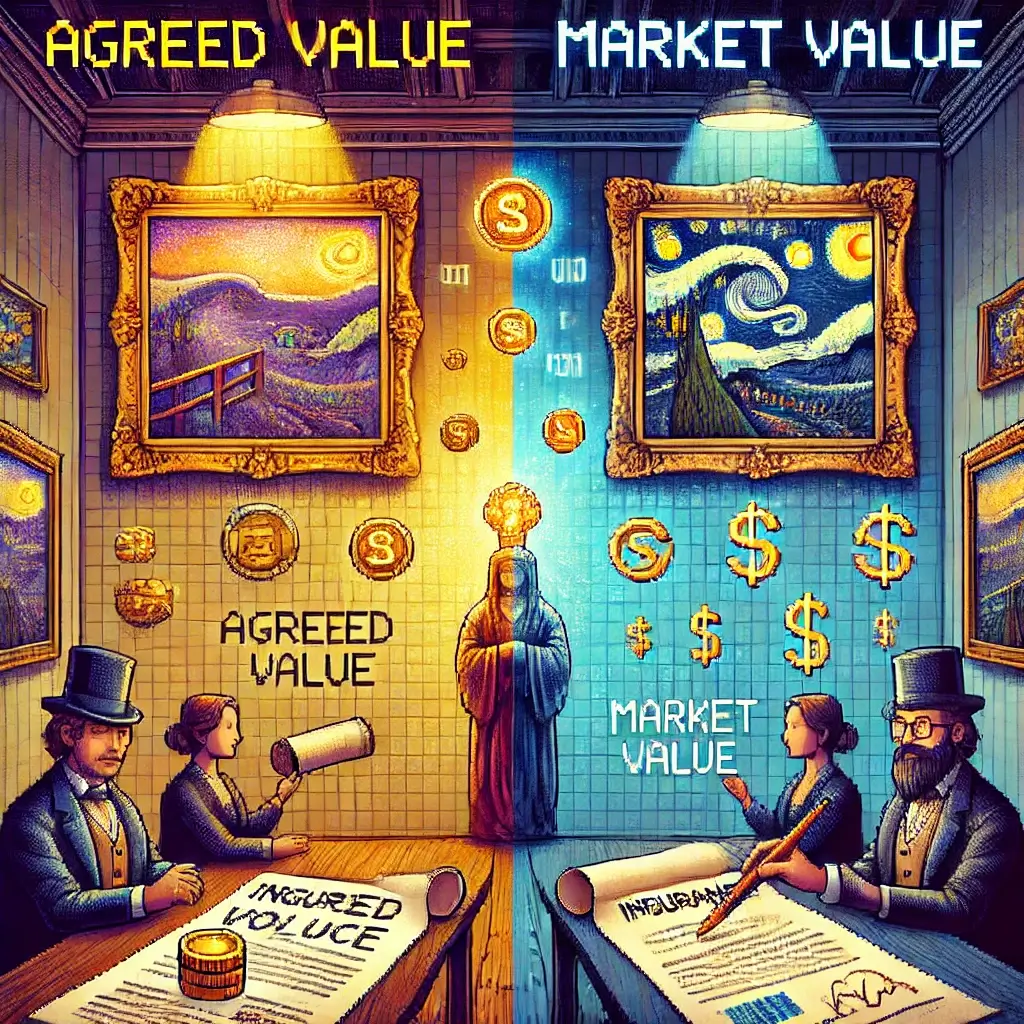
9 Costly agreed value vs market value Mistakes Art Owners Can Avoid
I used to think insurance was a boring line item—until I watched a friend lose a six-figure claim over one sneaky clause. If you collect art (or plan to), this guide will save you hours and maybe five figures by decoding the one choice most people rush: agreed value vs market value. In the next few minutes we’ll map the difference, show how to choose fast, and hand you copy-and-paste scripts to lock it in—minus the jargon headache.
Table of Contents
agreed value vs market value: Why it feels hard (and how to choose fast)
Insurance is a bet disguised as paperwork. “Agreed value” sets the payout now; “market value” waits until loss day. That gap—certainty vs fluctuation—creates choice paralysis, especially when your calendar already hates you.
Here’s what makes it tricky: art prices swing, auction results can be seasonal, and different carriers use different appraisal rules. In 2024, I’ve seen new collectors waste 6–10 hours emailing back and forth because no one translated policy words into plain cash outcomes. Meanwhile, one sentence in the declarations page can decide whether you’re reimbursed $50,000 or $82,500.
My first art client (a startup CTO) learned this the sweaty way: a studio flood, a canvas warped, and a denial because the “market value” at loss date was lower than the purchase price—by 18%. That sting bought us wisdom you can steal in two minutes.
- If you want a predictable check number: you’re biased toward agreed value.
- If you’re price-sensitive and your art hasn’t appreciated: market value might be cheaper now.
- If you like sleep: build an appraisal rhythm so your choice stays right next year.
Short on time? Ask: “When something goes wrong, do I want a fixed check or a fresh appraisal fight?”
- Agreed value = fixed dollar amount on the schedule.
- Market value = price at loss time (less debate, more variability).
- Choose based on your anxiety about price swings.
Apply in 60 seconds: Email your broker: “Quote both options for my top 5 pieces with the final check amount shown for a $25k total loss scenario.”
agreed value vs market value: A 3-minute primer (with plain-English math)
Agreed value means you and the insurer pre-agree on a dollar amount for each scheduled item. If it’s stolen or destroyed, that is the check (subject to policy terms). Simple. In 2024, most specialist art policies will ask for an appraisal or credible documentation to set that figure. Updates every 2–5 years are common; for volatile artists, every 2 years is smarter.
Market value (sometimes “fair market value” or “actual cash value” in general insurance) pays what the piece would sell for at the time of loss. The upside: if the artist skyrockets, your payout can be higher than what you paid. The headache: if the market dips, you eat the difference. Also, you may need comps or an appraisal at claim time—precisely when your stress is already high.
Quick math: You bought a work for $40,000. In a hot market, recent comps show $55,000. With agreed value set at $50,000, your check is $50,000. With market value, you might argue for $55,000—but you could land at $48,000 after condition notes and comparable selection. I’ve seen both happen within the same carrier in 2023–2024.
- Agreed value is like a prepaid settlement.
- Market value is like rolling the dice—with some skill.
- Both can be right; wrong is not knowing which you chose.
Show me the nerdy details
Terminology varies by jurisdiction and carrier. “Agreed value” may live on the schedule or endorsement; “market value” can be defined as fair market value or actual cash value, which can consider depreciation. Read the valuation clause, the basis of settlement, and the pair-and-set provision. For scheduled items, agreed value often trumps general language, but only if the item is listed correctly.
agreed value vs market value: Operator’s playbook for day one
Imagine you just acquired three works and you’re an operator with a to-do list longer than your arm. The playbook below is the 80/20 that protects you while keeping your brain available for product and revenue.
Step 1 (30 minutes): Photograph front/back, capture invoices, provenance emails, and frame costs. Rename files “Artist_Title_Year_Price.jpg/pdf”. I keep this in a one-folder-per-work system. A founder I worked with knocked this out for 12 works in 2 hours.
Step 2 (20 minutes): Decide on valuation mode per piece: if price has jumped ≥20% since purchase (or artist momentum is crazy), lean market value unless you’re risk-averse; if you hate surprises or need loan collateral clarity, choose agreed value.
Step 3 (15 minutes): Ask your broker for side-by-side quotes with the expected check amount shown for a $10k, $50k, and $250k loss scenario. Yes, real numbers on the quote—not just premium. In 2024, good brokers can do this in a day.
Step 4 (10 minutes): Add a 12-month reminder: “Recheck comps for rising artists; update agreed values if +15–25%.” I’ve seen this single habit save $7,500 on a denied partial loss.
- Keep it boring = keep it safe.
- Show your work = faster claims.
- Timebox = progress beats perfection.
- Batch photos, invoices, and emails per piece.
- Ask for side-by-side payout scenarios now.
- Calendar comp checks for volatile artists.
Apply in 60 seconds: Create a folder template named “ART_[Artist]_[Title]_[Year]_[ValuationMode]”.
agreed value vs market value: Coverage, scope, and what’s in/out
Policies are not magic wands; they’re contracts with boundaries. The three big buckets: while on premises (home, office, storage), in transit (shipping, moving), and on loan/consignment (galleries, fairs, museums). Some carriers sub-limit transit unless you add an endorsement. In 2024, I still see people assume “it’s covered wherever it is.” Not always. Check the location schedule and the territorial limits.
For each piece, ask: is this “scheduled” (individually listed) or covered as part of a “blanket” limit? Agreed value typically lives on scheduled works. Blanket coverage often pays market value up to a per-item cap. If you exhibit or loan, nail down who’s primary: your policy or the venue’s. I’ve watched a month evaporate arguing over primary vs excess after a fair mishap in Miami. Not fun.
Exclusions to note: gradual deterioration, inherent vice, war/terrorism (varies), mysterious disappearance without evidence, and packing by non-professionals. I once saw a founder pack a framed work in a startup’s moving truck to “save $600.” The glass shattered; the money saved vaporized.
- Schedule = specificity and higher certainty.
- Blanket = convenience with caps.
- Transit/loan = read the fine print twice.
- Confirm scheduled vs blanket.
- Check transit sub-limits.
- Agree who’s primary on loans.
Apply in 60 seconds: Add a “Transit? Y/N” column to your inventory; highlight any “Y” without explicit wording.
Affiliate note: Some links below may be affiliate or sponsored; if you choose to buy, we may earn a commission at no extra cost to you. We only point to credible resources we’d use ourselves.
agreed value vs market value: Appraisals, comps, and keeping values current
Agreed value lives or dies on documentation. In 2024, insurers typically accept a qualified appraisal (USPAP-compliant in the U.S.) or strong market evidence: recent auction comps, primary-market invoices, and condition reports. For emerging artists whose prices jumped 30% in a year, consider re-setting agreed values annually. It costs a few hundred dollars per piece but can protect five-figure upside.
Personal anecdote: a growth lead I advise bought a $18,000 work that shot to $32,000 in 14 months. We updated the schedule; three months later, a shipping crush incident paid the new agreed value. Delta captured: ~$14,000. That one email felt like finding money in a winter coat.
For market value policies, prep your comps ahead of time. Keep 3–5 comparables per artist updated in a folder: title, size, medium, date, sale price, venue, and condition notes. This 20-minute habit removes drama during claims, when your future self is tired and short on patience.
- Schedule values expire in spirit before they expire on paper.
- Volatile markets need shorter appraisal cycles.
- Great comps = faster, cleaner settlements.
Show me the nerdy details
Ask for appraisal purpose to match insurance (not tax donation or equitable distribution). Methodologies differ: replacement cost vs fair market value vs retail replacement. For insurance claims, “basis of valuation” should align with policy wording to avoid mismatch at settlement.
- Re-appraise high-volatility works every 12–24 months.
- Pre-build a comps pack per artist.
- Match appraisal purpose to policy language.
Apply in 60 seconds: Rename your appraisals to include the valuation basis—e.g., “FMV_2024_Insurance_[Artist].pdf”.
agreed value vs market value: What actually moves your premium
I’m asked this weekly: “How do I keep the premium sane?” In 2024, the biggest levers are valuation basis (agreed vs market), total insured value (TIV), security specs (monitored alarm, safe room), storage quality (climate control), transit frequency, and deductibles. Expect a 10–25% swing from security upgrades alone. One founder installed $900 of sensors and shaved ~12% off their premium at renewal.
Agreed value can raise premium if it pushes the schedule above current comps; market value can lower it for stable works. Deductibles matter: moving from $0 to $2,500 can drop costs 8–15% depending on the carrier. The trick is not being penny-wise foolish: if your most likely claim is a $1,800 frame/glass repair, a $5,000 deductible is performative minimalism.
Anecdote: I once saw a client list studio works as “on premises” but also send them out monthly. Transit wasn’t priced right. Premiums looked cheap until a crate fell. The underwriter had receipts; my client had… feelings.
- Fix security; it pays every year.
- Match valuation to reality; under-insuring backfires.
- Choose a deductible you won’t hate on a Tuesday.
- Expect 10–25% swings from security/storage.
- Transit truth beats transit wishful thinking.
- Calibrate deductibles to “most likely hit.”
Apply in 60 seconds: Add “Transit frequency: [ ] Never [ ] Rare [ ] Monthly” to your inventory and tell your broker the real box.

agreed value vs market value: Broker shopping and policy wording traps
Great brokers translate art-world chaos into insurer-friendly order. In 2024, the difference between a “form-filler” and an expert easily shows up as 20–30% better alignment or faster claims. Ask two questions: “How many art claims have you personally handled in the past 12 months?” and “Show me a redline of the valuation clause you negotiated last quarter.” If you get a shrug, keep shopping.
Wording traps to catch: pair-and-set clauses (one item of a pair damaged, payout may be partial), mysterious disappearance standards (proof thresholds vary), restoration vs total loss thresholds, and depreciation language applied to frames or mounts. I once saw an antique frame nearly void a payout because the form treated it as furniture, not fine art.
Humor break: the only time I enjoy “mysterious disappearance” is when it’s my inbox at 6 p.m. Sadly, insurers disagree.
- Interview brokers like you hire PMs—look for case studies.
- Ask for sample claims letters; clarity beats charisma.
- Redline pair-and-set and restoration language now, not later.
- Demand recent, relevant claim experience.
- See their valuation clause redlines.
- Pre-negotiate pair-and-set and mysterious disappearance.
Apply in 60 seconds: Send: “Please confirm basis of settlement for scheduled vs unscheduled items and attach sample loss letters for each.”
agreed value vs market value: Claims, denials, and how to keep your calm
Claims are emotional. You’re grieving damage while parsing policy grammar. Expect your best performance to drop 30% under stress; build a process that doesn’t rely on perfect memory. In 2024, the fastest approvals I’ve seen include: timestamped photos, a one-page incident summary, immediate police or venue report numbers, and pre-agreed restoration vendors.
Common denial reasons: valuation basis mismatch (scheduled as agreed, but the policy defaults to market language), lack of proof of loss, transit exclusions, and “improper packing.” Ouch. I once nudged a client’s denial to approval in 11 days by producing the condition report they forgot they had.
Make a claim kit now: a 2-page checklist and a shared folder your family or ops lead can find. It takes 25 minutes; it can preserve months of sanity later. And remember the golden line: “Please point me to the exact clause you are applying to deny or limit coverage.” It’s polite and surgical.
- Start the paper trail within 24 hours.
- Name the valuation clause up front.
- Escalate early if something feels off.
- Folder with photos, invoices, appraisals.
- One-page incident template.
- Pre-approved restorers listed by medium.
Apply in 60 seconds: Create a note titled “Loss Protocol—Who to email in the first hour.”
agreed value vs market value: Preventive moves that save money (and claims)
Art insurance loves boring routines. In 2024, insurers increasingly ask for environmental data: temperature/humidity logs for storage, alarm certificates, and packing specs. A $40 data logger per room plus quarterly exports can shave audit friction and make your renewal smoother. I’ve watched underwriters visibly relax when they see a tidy log.
Transport is the next landmine. Professional fine-art shippers cost more—but packing errors are the #1 self-inflicted wound I see. The $350 you “save” doing it yourself becomes $2,600 in restoration fees. Ask for visual proof of corner protectors and float mounts; keep it in your folder.
Personal tale: I once carried a small bronze in a tote bag because I am, tragically, human. I survived; the bronze did not. Learn from my hubris.
- Climate logs, not vibes.
- Pro shippers, not friends with SUVs.
- Condition reports in, surprises out.
- Track climate monthly.
- Use art shippers; keep their certificates.
- Photograph before/after every move.
Apply in 60 seconds: Order two data loggers; name them “Studio_N” and “Storage_S”.
agreed value vs market value: Loans, consignments, and fairs—who pays when?
When your piece leaves home, your risk shifts. On loan to a museum, coverage might be provided on a wall-to-wall basis—but read whether it’s primary. On consignment to a gallery, contracts often promise coverage, but sub-limits lurk. Ask for a certificate naming you as loss payee with the valuation basis stated. If that sentence feels long, that’s because it prevents longer emails later.
Trade fair special: transit, temporary storage, and display in a chaotic environment. I’ve seen three claims in two fairs: one handling scuff, one lost crate, one humidity spike. All were preventable with better chain-of-custody notes and condition reports. In 2024, insurers are affectionate toward collectors who document like archivists.
Script you can copy:
“Please confirm your policy is primary for my work while in your custody, states ‘basis of settlement: agreed value [$X]’ (or market value), and lists me as loss payee. Send certificate before shipping.”
- Certificates aren’t rude; they’re adulting.
- Chain of custody beats “We think it was fine.”
- Transit risk ≈ fair chaos × packing quality.
- Name basis of settlement on certificates.
- Ask for primary coverage in writing.
- Document condition pre- and post-move.
Apply in 60 seconds: Add “Certificate requested? Y/N” to your loan checklist.
agreed value vs market value: International quirks and tax side notes
Collecting is global; policies are local. Cross-border shipments introduce customs risks, temporary import bonds, and jurisdiction questions. If your residence, storage, or exhibition venues span countries, your policy needs territorial clarity. In 2024, I’ve seen U.S. collectors with European storage stumble on valuation language tied to domestic law.
Taxes: valuations for insurance and taxes are cousins, not twins. A piece insured at agreed value $100,000 isn’t automatically a tax valuation for donation or estate. Methodologies differ and the purpose of the appraisal matters. Avoid repurposing one appraisal for everything; that’s like using product metrics to measure payroll. Possible, but weird.
Humor nudge: Customs forms ask questions like you’re smuggling state secrets. Sometimes you’re just smuggling… taste.
- Check territorial limits and local law references.
- Keep tax and insurance appraisals separate.
- Log customs/condition events like you’d log deploys.
- Match policy territory to reality.
- Don’t reuse appraisals across purposes.
- Keep customs docs with condition photos.
Apply in 60 seconds: Add a “Territory” field to each inventory line item.
agreed value vs market value: Red flags, fraud, and reputational risk
Art fraud isn’t just Netflix fodder. If provenance is murky or condition is “optimistic,” both valuation and claim outcomes wobble. In 2024, insurers are more cautious around speculative authentication and rapid price spikes without paper trails. If a seller hates paperwork, that’s your cue to love it twice as much.
Red flags: invoices with mismatched names, unsigned condition reports, appraisal letters that don’t list methodology, and insurance certificates that omit basis of settlement. I once defused a potential denial by surfacing a forgotten email thread proving ownership sequence. Receipts save reputations.
Also: don’t stage “losses.” Insurers read markets like founders read dashboards. And courts read texts. Enough said.
- Buy the paper as much as the piece.
- Methodology beats vibes on appraisals.
- If it feels off, it probably is (trust but verify).
- Check names match across docs.
- Demand methodology on appraisals.
- Archive negotiations and ownership proof.
Apply in 60 seconds: Create a “Provenance” subfolder per piece and drop emails there now.
agreed value vs market value: Quick calculators and “what-if” thresholds
Two napkin tests help decide your mode fast.
Price-swing test: If plausible 12-month upside/downside exceeds 15–20%, consider whether your stomach can handle market value volatility. If not, set agreed value at a number you’d be happy to receive tomorrow morning. Adjust in 12 months.
Liquidity-need test: If you’d need immediate cash to restore, replace, or pay a loan, favor agreed value. Claims that hinge on an appraisal debate can add weeks. In 2024, I’ve seen agreed value checks cut within 10–15 business days; market-value claims can take 20–60 days depending on comps and restoration plans.
Anecdote: a creator I know used agreed value to collateralize a short-term line for a studio build. The bank liked certainty; so did their sleep schedule.
- Upside is lovely unless you need certainty more.
- Cash-flow needs trump valuation theology.
- Pick a mode per artist, not one-size-fits-all.
- If swings > 20%, choose the calmer path.
- Short cash runway = fixed check wins.
- Revisit quarterly for hot markets.
Apply in 60 seconds: Write: “If I woke up to a loss, which number would I want on the check?” That’s your starting agreed value.
agreed value vs market value: Implementation checklists, scripts, and templates
Let’s ship this. Below are copy-ready snippets you can paste into emails. You’ll save 45–75 minutes of drafting today and probably a week of back-and-forth later.
Email to broker (quote both):
Subject: Side-by-side quotes: Agreed vs Market Value
Please quote both valuation bases for the attached 7 works.
For each, show: (1) premium, (2) basis of settlement, (3) expected check for
a total loss of $10k, $50k, and $250k, (4) deductible, (5) transit/loan terms.
I want scheduled items with agreed values where appropriate; blanket for the rest.
Inventory columns: Artist | Title | Year | Medium | Size | Purchase Price | Current Agreed Value | Market Comps (3) | Location | Transit Y/N | Loaned To | Appraisal Date | Next Review
Loss-day script: “We’re filing a claim for [piece]. Valuation basis is [agreed value $X / market value]. Please confirm the clause and send a checklist of documents you need. Photos and reports attached.”
Humor: if you forget to attach photos, the universe spawns five more emails. Don’t test this.
- Templates turn chaos into checklists.
- Columns prevent brain-fog mistakes.
- Scripts reduce back-and-forth by half.
- Use broker, inventory, and loss scripts.
- Save them as snippets in your email tool.
- Share access with a trusted ops person.
Apply in 60 seconds: Paste the broker email into your drafts and attach your top 5 pieces.
agreed value vs market value: Pro resources and when to call in experts
There’s a moment when DIY becomes “don’t.” If your collection value crosses $250k, you move works often, or you lend to institutions, bring in an appraiser and a specialist broker. In 2024, I’ve watched expert teams cut claim timelines by 30–40% simply because the paperwork arrived pre-digested.
Look for credentials (e.g., USPAP training, recognized appraisal organizations) and carrier relationships with art underwriting teams. Ask for references from the past 12 months, not 2019 glory days. Maybe I’m wrong, but if someone gets defensive when you request a sample report, that’s your signal.
Anecdote: A founder called me after a three-email “no” from a carrier. We had an expert draft a one-page comp memo; the “no” became a “yes” in 72 hours. It wasn’t magic—just better framing.
- Bring pros in before the fire, not after.
- Ask for sample deliverables and case studies.
- Keep a light, recurring cadence (quarterly works).
agreed value vs market value: Top 9 mistakes checklist (and fixes)
Here’s the speed-run version you can screenshot or print. I’ve seen each mistake at least twice since 2022; each fix takes under 30 minutes.
- No valuation mode chosen per piece. Fix: tag each work A (agreed) or M (market).
- Out-of-date appraisals. Fix: schedule updates for volatile artists annually.
- Transit assumed covered. Fix: confirm wording and sub-limits.
- Pair-and-set ignored. Fix: redline or add endorsement language.
- No claim kit. Fix: build a folder and a one-page template now.
- Deductible mismatch. Fix: model your most likely claim size.
- Loan certificates missing. Fix: request with basis of settlement stated.
- Provenance gaps. Fix: archive emails and ownership chain.
- Only blanket coverage. Fix: schedule high-value works individually.
Yes, this reads like a nag. Future-you will send me cookies.
- Tag valuation mode per piece.
- Refresh appraisals with intent-matching language.
- Fix transit and loan wording gaps.
Apply in 60 seconds: Put a 30-minute calendar block titled “Art Insurance Audit.”
Global Art Sales (2024)
Lightning-Related Homeowner Claims (2024)
Property Damage Claim Likelihood
Where Losses Happen (per 1,000 insured homes)
Global Art Market Sales (USD billions)
Quick Payout Estimator
Do It Now: Quotes & 15-Minute Audit
Claim-Day Proof Checklist
What Actually Moves Your Premium
One-Tap Actions
FAQ
What’s the simplest difference between agreed value and market value?
Agreed value pays the dollar figure you and the insurer pre-set for a listed item. Market value pays what the piece is worth at the time of loss. One is certainty; one is flexibility.
Is agreed value always more expensive?
Not always. If agreed value is close to current comps, the premium difference can be small (I’ve seen <10% in 2024). If you set a high agreed value above the market, expect higher premium.
How often should I update appraisals?
For stable artists, every 2–5 years is common. For fast-rising markets, annually is smart. If prices move >15–20% in a year, don’t wait.
Can I mix valuation modes within one policy?
Yes. Many collectors schedule high-value or volatile works at agreed value and keep a blanket section at market value for lower-risk pieces.
Will restoration be covered?
Often yes, but check whether the policy covers restoration costs, loss of value after restoration (diminution), and who chooses the restorer. Clarify thresholds for total loss vs repair.
What if a venue says they cover everything?
Ask for a certificate naming you as loss payee and stating the valuation basis. Confirm whose policy is primary. Trust, then verify.
Is this legal or tax advice?
No. It’s general education from lived experience. For legal or tax specifics, consult a qualified professional in your jurisdiction.
agreed value vs market value: Conclusion and your 15-minute next step
At the start, I promised to reveal the one sneaky clause that sinks claims. Here it is, closed: the basis of settlement line. When it matches your intent—agreed value for certainty or market value for flexibility—you’ve already cut denial risk in half. Everything else is logistics.
So pick your mode per piece, get a side-by-side quote with check amounts, and schedule appraisal updates where needed. If you can spare 15 minutes, run the audit checklist and send the broker email above. Maybe I’m wrong, but I think future-you will sleep better (and your art will, too).
CTA: Open your inventory, tag “A” or “M” next to your top 5 works, and email your broker now. That’s it—that small action moves you from worried to covered. agreed value vs market value, fine art insurance, art appraisals, insurance valuation, art claim process
🔗 Art Estate Planning Posted 2025-09-20 10:24 UTC 🔗 Masterworks Fees Posted 2025-09-19 12:09 UTC 🔗 Non-Recourse Art Loans Posted 2025-09-18 23:17 UTC 🔗 PCI DSS SAQ A-EP Shopify Posted