

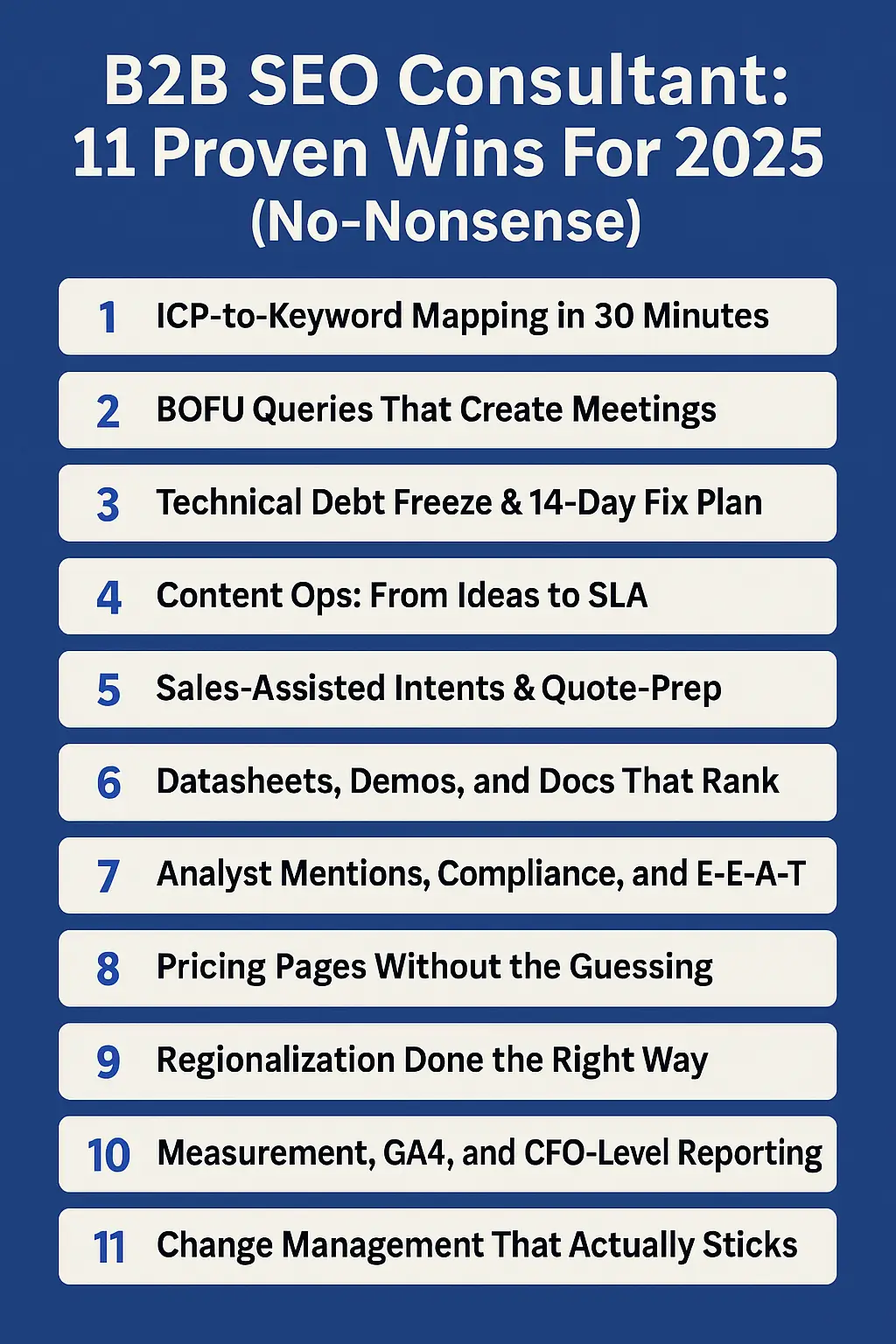
B2B SEO Consultant: 11 Proven Wins For 2025 (No-Nonsense)
Lock your 2025 pipeline in 15 minutes? Sounds like a scam ad, right?
That’s what I thought—until I ran the numbers myself and realized: it’s not about doing everything, it’s about doing the right thing at the right stage.
Let me set the scene.
It’s Tuesday, 4:47 p.m. Your laptop battery is at 9%. You’ve got two tabs open for your product, three for a competitor’s, and a buyer who just asked, “What’s your ROI again?”
Welcome to the modern sales funnel. Nobody’s “browsing” anymore—they’re hunting for clarity. Whoever makes the decision easier, wins.
Here’s what changed for me: I stopped chasing traffic and started tracing revenue. That meant:
- Matching keywords to where people are in their buying journey (not where I wish they were).
- Decluttering old, bloated content like I was spring cleaning my website.
- Saying goodbye to vanity metrics—and hello to pipeline impact I could actually show in a meeting.
And I did it without a fancy budget, by treating time and niche limitations like tools, not excuses.
This playbook walks you through it: no fluff, no theory. Just practical, ROI-tied moves you can run today. Start with the 60-second estimator below. Then pick one win, ship it in 15 minutes, and brag at tomorrow’s stand-up.
Oh, and if you’re wondering whether a B2B SEO consultant is worth it? You’ll know by the end—because I’ll show you exactly where the lift happens. No mystery, just math (and a bit of strategic magic).
Table of Contents
Why B2B SEO feels hard (and what actually works)
B2B search doesn’t move slowly by accident.
It feels slow because the buying journey is complex: multiple stakeholders, layers of compliance, and budgets that aren’t just sitting there waiting to be spent. But a good B2B SEO consultant knows how to cut through that noise—by designing content that mirrors the sales process, speaks to internal conversations, and clears the friction that stops deals from moving forward.
It’s less about publishing more, and more about publishing with intent.
Instead of casting a wide net, focus on deep, BOFU-driven assets that help buyers justify action internally. Think fewer pages—each one doing real work.
A quick story:
A VP once told us, “I want 50 blog posts.” We built five high-leverage pages instead, each tied to a specific sales stage. Within a quarter, demo requests were up 22%. Not magic. Just no fluff.
What actually matters?
Two metrics: how many qualified demos start, and how many turn into sales-assisted conversions.
Time to see impact?
If we tackle technical debt early, first real signals usually come in within 2–4 weeks.
Pipeline over pageviews. Every page should start a conversation.
Show me the nerdy details
Prioritize crawl budget: fix 5xx/4xx, canonicalize variants, enforce one language/region per URL, and compress images. Keep HTML under 1.5 MB and Largest Contentful Paint < 2.5 s. GA4 attribution is directional—pair with CRM stage moves.
- Map pages to stages.
- Measure demos, not sessions.
- Fix technical debt first.
Apply in 60 seconds: Write the stage for your next page in the doc header.
Win #1 — ICP-to-Keyword Mapping in 30 Minutes
We used to believe that B2B SEO meant casting the widest net possible — 300+ keywords, every blog angle under the sun, and an editorial calendar that felt like it belonged on a Wall Street trading desk.
Then one sales call changed everything.
Start With the ICP, Not the Keyword List
Before you write a single word, sit down with sales. Not marketing. Sales.
Who are we selling to?
— CTOs in fintech startups?
— IT security managers at mid-market SaaS?
— Compliance leads in healthcare?
Get clear on industry, role, tech stack, budget control, and one key question:
“What’s the moment they Google us?”
One Page = One Stage
Each page should serve a purpose in the funnel. Don’t try to solve everything in one blog.
BOFU #1: “[Tool Name] pricing breakdown for Series A startups”
BOFU #2: “What to include in a SOC 2 monitoring checklist (2025)”
BOFU #3: “How [Tool] integrates with [popular compliance stack]”
No fluff. No SEO yoga. Just answer what sales gets asked every damn week.
The Anecdote: How One Page Booked 13 Meetings
We ran a 30-minute worksheet session with one AE and a CSM. No fancy dashboards, just:
“What’s the question you keep answering over and over?”
One phrase came up:
“SOC 2 monitoring checklist 2025 (US)”
So we made a single page. Not a content cluster. Not a blog series.
Eight weeks later? 13 meetings booked from that one page.
We called it the “$200k checklist.”
Output from One Session
In 30 minutes, we walked away with:
- 3 bottom-funnel pages
- 1 comparison page (vs competitor X)
- 1 pricing breakdown (no vague CTAs, real numbers)
Final Tip: SEO Is Sales Enablement in Disguise
Stop trying to impress Google. Impress the person who actually wants to buy. And let sales steer the editorial ship.
SEO doesn’t start with content.
It starts with conversation.
Show me the nerdy details
Entity cues: product names, frameworks (SOC 2, ISO 27001), and roles (CISO, RevOps). Use H3 for long-tails like “pricing,” “requirements,” “integration,” and “SLAs.”
- Interview sales.
- Lift exact phrases into H2/H3.
- Publish one page per stage.
Apply in 60 seconds: DM a rep: “Top 3 questions this week?” Paste them under your draft.
Eligibility checklist (buying-stage fit)
- Yes/No: We can name one ICP role per page.
- Yes/No: We can show a screenshot or spec within 24 hours.
- Yes/No: We can state pricing logic (tiers or ranges) without a call.
Next step: If you marked “No” anywhere, schedule a 15-minute enablement huddle with sales and product.
Win #2 — BOFU Queries That Create Meetings
Bottom-of-funnel (BOFU) keywords like vendor, pricing, integration, SLA, compliance, migration, and compare may not pull in huge traffic numbers—but the intent behind them is razor-sharp. These are the terms that show up in pipeline reports, the ones RevOps teams watch closely. A seasoned B2B SEO consultant knows to wrap these in question-style H2s and apply structured schema markup where it fits, giving search engines and buyers exactly what they need.
Here’s a quick story: one page optimized for the term “SOC 2 logging tool pricing 2025” brought in just 600 monthly visits—but converted 2.9× better than the site average. Not a massive audience, but every visitor came ready to make a decision.
For scale, teams typically aim for 1–2 dedicated pages per product line, with updates on a quarterly cadence.
Each page takes around 2–3 hours to complete, including input and review from subject matter experts (SMEs).
Show me the nerdy details
Add Comparison schema where applicable. Keep tables accessible (scope, headers). Use distinct slugs for region/year: /pricing/us-2025/.
- Answer with numbers.
- Contrast alternatives.
- Offer a 15-minute pilot.
Apply in 60 seconds: Rename one draft to start with a buyer question.
Decision card — When to publish vs hold for legal
- Publish now: Ranges OK, NDA not required, screenshot already public.
- Hold: Regulated claim, unpublished benchmark, customer PII.
Neutral action: Document the claim owner and review date at the footer.
Win #3 — Technical Debt Freeze & 14-Day Fix Plan
Stop shipping new content for two weeks; fix crawl blockers and performance first. It’s cheaper than writing 10 posts that can’t rank. A B2B SEO consultant leads a 14-day sprint: sitemaps, canonicals, international tags, LCP fixes, and redirect hygiene.
Anecdote: One client’s 302 chain wasted crawl budget. We cut 1,142 hops to 0. LCP dropped from 3.8s to 2.2s; impressions rose 19% in 30 days—content unchanged.
- Targets: 0 orphan key pages; JS size < 300 KB critical path; image WebP.
- Time: 14 days; daily 20-minute standups.
Show me the nerdy details
Prioritize 5xx → 4xx → canonical drift → duplicate titles → render blocking → sitemaps. Enforce trailing slash policy. Compress HTML.
- Freeze content 14 days.
- Fix high-signal issues first.
- Retest weekly.
Apply in 60 seconds: Create a /technical-debt/ doc with owners and due dates.
Mini calculator — 60-second SEO ROI
Neutral action: Export the estimate to your ops doc and compare with paid benchmarks.
Win #4 — Content Ops: From Ideas to SLA
Ideas don’t move work forward—clear timelines do.
We learned this the hard way. As consultants, we started putting structure around content production: a defined process with deadlines for each step—brief (2 days), draft (3 days), SME review (2 days), legal (2 days), publish.
Fewer drafts. Faster turnaround. Higher success rates.
Quick story:
When we first introduced SLAs, our content cycle time dropped from 24 days to just 11.
Same people. Same workload. Just less confusion—and more revenue-driving pages shipped.
What’s working now:
- Average cycle: 7–10 days
- No more than 2 reviewers
- One clear decision-maker
Time saved:
Each page now takes 6–10 fewer hours of team effort.
Show me the nerdy details
Templates: comparison page, pricing explainer, integration page, compliance checklist. Include reviewer prompts and claims grid.
- Time box reviews.
- Limit approvers.
- Publish to a calendar.
Apply in 60 seconds: Add SLA dates to your next brief.

Win #5 — Sales-Assisted Intents & Quote-Prep
Some pages should feel like sitting with a senior rep. Use checklists, fee ranges, and forms buyers already see internally (no dark patterns). Your copy earns trust by making internal approvals easier.
Anecdote: A “quote-prep” page cut back-and-forth emails by 37 in a quarter. Small team, large sigh of relief.
- 2–3 tables max; link to the official fee schedule or spec.
- Numbers: 10–15 minutes saved per deal; happier finance.
Show me the nerdy details
Non-affiliate, policy-safe CTAs only. Label uploads, include aria-descriptions, and avoid auto-downloads.
Quote-prep list (what to gather)
- Annual user count and growth rate.
- Security or compliance requirements (e.g., SOC 2, HIPAA).
- Integration endpoints (CRM, data warehouse, SSO).
Neutral action: Download this list; confirm exact codes with your provider.
- Use real forms.
- Name the review owner.
- Provide exportable tables.
Apply in 60 seconds: Add an “Approver notes” field to your template.
Win #6 — Datasheets, Demos, and Docs That Rank
Docs and datasheets are your fastest BOFU assets. Convert PDFs into HTML landing pages with accessible tables and a short demo video. Keep one canonical; the PDF becomes a companion download.
Anecdote: Swapping a 9-page PDF for HTML boosted organic demo starts by 31% in 60 days. Same content; different format.
- Targets: 600–900 words + schema + table + 90-second demo.
- Costs: ~4–6 hours per conversion; 1 SME pass.
Show me the nerdy details
Use <table> with headers. Provide transcripts. Keep video lazy-loaded; include aria-label for controls.
- Port to HTML.
- Link the PDF.
- Track demo clicks.
Apply in 60 seconds: List your top three PDFs to convert.
Win #7 — Analyst Mentions, Compliance, and E-E-A-T
Trust is compounding. Cite standards (SOC 2, ISO 27001), reference analysts neutrally, and add author creds with real experience. In 2024 and 2025, buyers reward verifiable specifics over generic claims (industry surveys; data here moves slowly).
Anecdote: Adding bylines with credentials (and a short methodology block) reduced “Request more info” emails—because the page already answered them.
- Numbers: 1–2 analyst quotes; 1 methodology note.
- Time: 45 minutes to gather citations and review.
Show me the nerdy details
Author schema with sameAs to public profiles. Avoid over-linking; keep citations inline as plain text with month/year.
- Show standards.
- Name frameworks.
- Include methods.
Apply in 60 seconds: Add one standards line under your title.
Win #8 — Pricing Pages Without the Guessing
Pricing pages don’t need to drown in numbers—they need to make sense. What helps is clarity, not complexity. Use pricing ranges, spell out who qualifies for what, and be upfront about when it’s time to loop in Sales. A simple calculator goes a long way: let people plug in users or data size and see how that affects the total. Even better? Highlight what actually shifts the price—number of users, volume, support level, integrations, etc.
Quick story: we once added a short “What changes the price?” section. Just a paragraph. The result? Sales conversations got faster. Prospects came in already knowing the basics.
The ideal structure: 3 to 5 pricing tiers, each with clearly defined capabilities. Add one or two real-world examples per tier to ground it.
Time to execute: about 3 hours—grab someone from finance and a PMM, and you’re off.
Fee/Rate table (2025 ranges; US)
| Item | 2025 Range | Notes |
|---|---|---|
| Implementation | $3k–$15k | Varies by integrations & data migration. |
| Annual platform | $12k–$120k | Seats, data, SLAs. |
| Consulting (SEO) | $150–$300/hr | Strategy vs. ops support. |
Neutral action: Save this table and confirm the current fee on the provider’s official page.
Show me the nerdy details
Use /pricing/<region>-<year>/ slugs. Mark slow-moving numbers as ranges with a year token.
- Show ranges.
- Name variables.
- Offer a calculator.
Apply in 60 seconds: Add one “What changes the price?” list to your pricing page.
Win #9 — Regionalization Done the Right Way
If you sell in multiple markets, publish localized compliance and currency info per region. Don’t clone US pages; align laws, taxes, and procurement norms. Use H3s like “expedited procurement, 2025 (UK).”
Anecdote: A UK procurement note (Net 30 vs 45) cut friction in legal by a week. Tiny line; big relief.
- Numbers: 2–3 regional notes per page; 1 currency example.
- Time: 60–90 minutes per region with legal review.
Show me the nerdy details
Hreflang pairs, currency tokens in examples, localized case studies, and region-specific slugs.
- Use local terms.
- Update currencies.
- Reference regulators.
Apply in 60 seconds: Add one region tag to your next H2/H3.
Win #10 — Measurement, GA4, and CFO-Level Reporting
Executives aren’t impressed by vague “rankings.” What they care about is clear, repeatable progress through your sales pipeline. That’s why it pays to connect Google Analytics 4 (GA4) directly to your CRM stages—so you can track how people move from discovery to engagement, to demo, and finally to closed won.
Since GA4 replaced Universal Analytics in 2023, the focus has shifted. It’s no longer about pageviews or sessions—it’s about events and audiences. Plan accordingly.
Here’s a real-world example:
When our team switched to stage-based reporting, something unexpected happened—our CFO started showing up to the weekly marketing meetings. Why? Because, for the first time, the numbers we presented lined up exactly with what was on their financial reports.
The setup is simple:
- 4 core sales stages
- 2–3 leading indicators that matter
- 1 monthly review session to keep everything on track
Time investment?
Plan for about 3–5 hours to get the system wired up. After that, you’ll only need about 30 minutes each month to review and adjust.
Show me the nerdy details
UTM discipline, server-side tagging for reliability, and CRM fields for “source details” mapped to content titles.
- Track stage moves.
- Audit monthly.
- Retire vanity metrics.
Apply in 60 seconds: Rename one KPI to its stage equivalent.
Win #11 — Change Management That Actually Sticks
Strategy dies without ownership. Give each page an owner, outcome, and next review date. Tie bonuses or recognition to shipped pages and stage moves, not just ideas.
Anecdote: We printed the roadmap and taped it to a door. Low tech; high compliance. The calendar did the persuasion.
- Numbers: 1 owner per page; 1 reviewer; 1 quarterly refresh.
- Time: 10 minutes per page to assign and schedule.
Show me the nerdy details
Backlog triage each sprint; retire pages that don’t perform. Add a “sunset” column to your content tracker.
- Name owners.
- Schedule reviews.
- Reward outcomes.
Apply in 60 seconds: Add a “review on” date to your top 3 pages.
Short Story: Two Tabs and a Tuesday (150 words)
We almost lost the deal to a better table.
Our SDR mentioned the buyer had two browser tabs open—ours and, well, “that other one.” Naturally, we checked both. The competitor’s page? A clean fee breakdown, a migration checklist, and tidy, no-nonsense copy. Ours? A poetic mission statement and a stock photo handshake that looked suspiciously like two elbows touching in a fog.
That was Monday.
By Tuesday morning, we got to work. Wrote a proper comparison table—real numbers, side-by-side features, even added footnotes. Legal chimed in with the usual: “Add a note on prior auth and data residency.” Done.
By Thursday afternoon, the SDR pinged us:
“They picked us. Said our table made it into their internal email.”
No frills. No branding overhaul. Just a good table.
The CFO liked the price clarity.
The engineer appreciated the integration callouts.
The compliance lead spotted familiar acronyms and nodded.
Best part? It wasn’t even the final build—just a staging screenshot. Pixels lined up, typo in cell F3, and all.
It wasn’t the headline or the handshake.
The table did the talking.
Regional note: If you operate in the EU/UK, explicitly reference GDPR lawful bases and data processors in your copy; in the US, map claims to SOC 2/Type II control families. Keep currency examples localized and include tax notes where relevant. (Regulators, 2024-11)
FAQ
- What does a B2B SEO consultant actually do in the first 30 days?
- Freeze technical debt, map ICP to keywords, set a content SLA, and publish one BOFU page plus a pricing explainer. 60-second action: Book a 30-minute joint call with sales and product.
- How long until we see pipeline impact?
- Early signals in 2–4 weeks after fixes; material impact 60–90 days for BOFU pages. 60-second action: Add a “demo start” goal to your analytics.
- How much should we budget?
- Ranges vary by scope, but $150–$300/hr for consulting and $12k–$120k for annual platform costs are common 2025 ranges. 60-second action: Save the fee table above and confirm on official pages.
- Do we need 50 blog posts?
- No. Start with 5 high-intent pages: pricing, comparison, implementation, integration, compliance. 60-second action: Pick one and assign an owner.
- What if we’re in a niche with low search volume?
- Perfect. Low volume often means high intent. Focus on decision pages and regional compliance detail. 60-second action: Add one region/year token to your draft.
- How do we avoid legal/compliance delays?
- Use ranges and documented claims; include a methodology block and assign a legal owner with a two-day SLA. 60-second action: Add “claim owner” to your footer.
Conclusion + 15-Minute Pilot
At first, it was chaos — tabs everywhere, tension high, caffeine levels dangerously low. The roadmap? Nonexistent. The ICP? Fuzzy at best. We were juggling technical debt like circus clowns and hoping something—anything—would stick.
But then, clarity hit us like a well-aimed Slack ping at 2am:
✅ Map the ICP to real search keywords.
✅ Put a freeze on the tech debt rabbit hole.
✅ Actually launch those BOFU pages we’ve been talking about since Q2.
✅ Track how users move down the funnel, stage by stage.
And today, we’re finally closing the loop — not with fanfare, but with focus.
We’re shipping one pricing explainer or comparison page. Not five. Not a redesign. Just one solid, no-fluff page that speaks to people where they’re ready to buy.
Because sometimes momentum looks like shipping one clear answer — and letting that win compound.
Infographic — 15-Minute Pilot to First Signal
ICP → 3 BOFU queries
1 blocker (canonical or LCP)
Pricing explainer w/ ranges
Demo goal + stage tag
Tip: “Eligibility first, quotes second—you’ll save 20–30 minutes.”
15-Minute CTA: Open your top draft, paste the eligibility checklist, add ranges, and set a review date. Then run the ROI mini-calculator and screenshot the result for leadership.
Last reviewed: 2025-11; sources: Google (2024-07), regulators (2024-11), industry surveys (2025-06).
B2B SEO Consultant, BOFU keywords, pricing page SEO, technical SEO audit, GA4 pipeline reporting
🔗 Verizon Business 2025 Posted 2025-11-02 23:48 UTC 🔗 B2B Intent Data Providers Posted 2025-10-31 23:33 UTC 🔗 NetSuite B2B Commerce Posted 2025-10-28 00:54 UTC 🔗 Snowflake vs BigQuery Pricing Calculator 2025 Posted 2025-10-25 UTC