
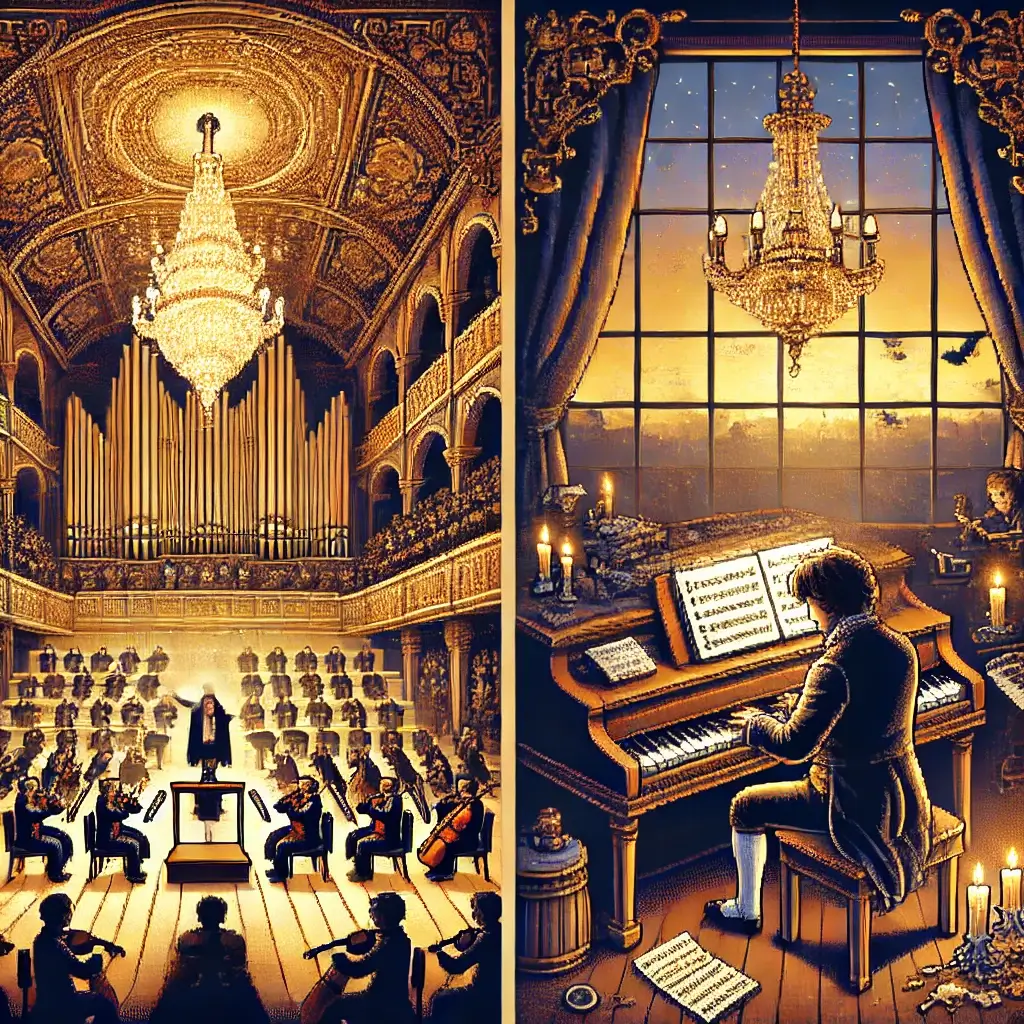
Beethoven’s 5th: An Emperor’s Legacy Unveiled
Table of Contents
- Unleashing the Emperor: A Majestic Introduction
- The Legend Begins: Birth of the “Emperor”
- A Journey Through the Movements: The Heart of the “Emperor”
- First Movement: Allegro – The Grand Entrance
- Second Movement: Adagio un poco mosso – A Soulful Pause
- Third Movement: Rondo: Allegro ma non troppo – The Triumphant Finale
- Why the “Emperor” Still Reigns Supreme
- Beethoven’s Genius: Beyond the Sound
- The Emperor in Modern Culture: A Timeless Resonance
- Experiencing the Emperor: Tips for New Listeners
- Final Thoughts: The Enduring Power of the Emperor
Unleashing the Emperor: A Majestic Introduction
Have you ever heard a piece of music that just grabs you by the soul and refuses to let go?
That’s precisely what Ludwig van Beethoven‘s Piano Concerto No. 5 in E-flat Major, Op. 73 – famously known as the “Emperor” Concerto – does to me, and I’m willing to bet it’ll do the same for you.
This isn’t just a concerto; it’s a monumental declaration, a thrilling sonic journey, and frankly, a piece of music history that stands tall like a colossus.
When you listen to the “Emperor,” you’re not just hearing notes; you’re witnessing the raw power of a genius at the peak of his powers, battling personal demons and societal upheaval, yet still creating something so utterly magnificent.
It’s a testament to the human spirit, a reminder that even in the darkest times, beauty and triumph can emerge.
Forget everything you think you know about classical music being stuffy or inaccessible.
The Beethoven Piano Concerto No. 5 is an absolute adrenaline rush, a soaring emotional landscape, and a profoundly moving experience all rolled into one.
It’s the kind of piece that makes the hairs on your arms stand up and leaves you breathless, wondering how mere sound can evoke such profound feelings.
So, buckle up, because we’re about to dive deep into the heart of this masterpiece, explore its origins, unravel its magic, and understand why the Emperor Concerto continues to hold such an unyielding grip on our collective musical imagination.
Trust me, once you experience the “Emperor,” your musical world will never be the same.
The Legend Begins: Birth of the “Emperor”
Imagine Vienna in the early 19th century.
Napoleon’s armies are on the march, cannons are thundering, and the city itself is under siege.
Amidst this chaos, locked away in his small apartment, a man is pouring his entire being into a new composition.
That man is Beethoven, and the composition is his Piano Concerto No. 5.
It was completed in 1809, during a time of immense political turmoil and personal struggle for Beethoven, who was grappling with his increasing deafness.
Can you even begin to fathom the level of resilience and dedication it must have taken to create something so grand and optimistic amidst such despair?
The nickname “Emperor” wasn’t actually given by Beethoven himself.
It’s widely believed that an admiring officer or an early publisher, overwhelmed by its majestic scale and heroic character, bestowed the title.
And honestly, it’s hard to argue with it.
From the very first notes, this concerto exudes an imperial grandeur that is simply unparalleled.
It’s not about a specific emperor, but rather the embodiment of a heroic, unyielding spirit, a musical triumph over adversity.
This was a departure from earlier concertos, which often featured the soloist in a more subservient role.
In the Emperor Concerto, the piano isn’t just a star; it’s a dominant force, leading the charge with incredible power and virtuosity.
It’s a dialogue, yes, but one where the piano is undeniably the commanding voice.
This concerto truly represents a pinnacle of Beethoven‘s “heroic period,” a time when he composed some of his most powerful and emotionally charged works, like the “Eroica” Symphony and the Fifth Symphony.
He was pushing boundaries, challenging conventions, and in doing so, he forever changed the landscape of classical music.
It’s this blend of historical context, personal struggle, and sheer artistic ambition that makes the Beethoven Piano Concerto No. 5 not just a piece of music, but a profound human statement.
A Journey Through the Movements: The Heart of the “Emperor”
Like many classical concertos, the Emperor Concerto is structured into three distinct movements.
Each movement tells its own story, evokes different emotions, and contributes to the overarching narrative of triumph and grandeur.
It’s like a finely crafted novel, with distinct chapters that build upon each other to create a cohesive and deeply satisfying experience.
Let’s break down each one, because understanding the individual parts makes the whole even more breathtaking.
Trust me, it’s worth savoring every moment.
First Movement: Allegro – The Grand Entrance
From the very first moment, the “Emperor” makes an unforgettable entrance.
Instead of a traditional orchestral introduction, Beethoven throws you right into the action with three powerful orchestral chords, each answered by a dazzling, improvisatory-sounding flourish from the solo piano.
It’s like the piano is declaring, “I am here, and you will listen!”
This opening is revolutionary, setting a new standard for how concertos could begin.
It’s bold, confident, and immediately commands your attention.
The main theme that follows is majestic and noble, yet also imbued with a sense of urgent momentum.
You can almost hear the marching armies, or perhaps the determined stride of a true leader.
The interplay between the piano and the orchestra throughout this movement is simply breathtaking.
They don’t just accompany each other; they engage in a powerful, passionate dialogue, sometimes challenging, sometimes complementing, but always pushing the music forward.
There are moments of dramatic tension, fiery virtuosity from the piano, and soaring lyrical passages that could bring tears to your eyes.
And let’s talk about the cadenza – that moment where the soloist traditionally shows off their improvisational skills.
In a fascinating twist, Beethoven fully wrote out the cadenza for the Emperor Concerto, a rare move for his time.
Why?
Some speculate it was to ensure the integrity of his vision, preventing less capable performers from improvising something unworthy of the work’s grandeur.
Whatever the reason, this written cadenza is a tour de force, a dazzling display of technical prowess and emotional depth that perfectly encapsulates the spirit of the entire movement.
It builds to an exhilarating climax before the movement concludes with a powerful, definitive statement.
The sheer scale and emotional breadth of this first movement alone are enough to make the Beethoven Piano Concerto No. 5 a masterpiece.
Second Movement: Adagio un poco mosso – A Soulful Pause
After the heroic grandeur and thrilling energy of the first movement, Beethoven ushers us into a world of profound serenity and introspection with the second movement.
It’s marked Adagio un poco mosso, which essentially means “slowly, with a little movement.”
And it truly is a soulful pause, a moment for quiet reflection amidst the preceding storm and the impending triumph.
This movement is often described as one of the most beautiful and tender melodies Beethoven ever composed.
The strings introduce a hushed, ethereal theme that floats gently, almost like a prayer.
When the piano enters, it doesn’t burst in with bravado but rather weaves its way into the texture with delicate, contemplative arpeggios and chords.
It’s as if the piano is having an intimate conversation with itself, or perhaps with a higher power.
The beauty of this movement lies in its exquisite simplicity and profound emotional depth.
There’s a sense of longing, a quiet melancholy, but also an undeniable hope that permeates every note.
It’s the kind of music that makes you close your eyes and just *feel*.
As the movement progresses, the theme is developed with subtle variations, building in intensity but never losing its fundamental tenderness.
There are moments where the piano sings with aching beauty, contrasting with gentle orchestral responses.
The sense of peace here is almost palpable, a much-needed respite before the exhilarating finale.
And then comes the transition – one of the most ingenious and seamless transitions in all of music.
Without a clear break, the music subtly shifts from the serene Adagio into a sustained note, then a pizzicato passage (plucked strings), which leads directly into the main theme of the third movement.
It’s a stroke of genius that binds the two movements together, creating an unbroken arc of musical narrative.
This seamless link is a testament to Beethoven’s mastery of form and his ability to surprise and delight his audience.
It’s these moments of understated brilliance that truly elevate the Emperor Concerto to legendary status.
Third Movement: Rondo: Allegro ma non troppo – The Triumphant Finale
And just like that, we’re swept into the grand finale: a glorious, exuberant Rondo marked Allegro ma non troppo, meaning “fast, but not too fast.”
This movement bursts forth with unbridled joy and unstoppable energy, a perfect culmination of the concerto’s heroic journey.
The main theme is instantly memorable: bright, optimistic, and incredibly rhythmic.
It’s the kind of melody that makes you want to get up and dance, or at least tap your foot uncontrollably!
The Rondo form, characterized by the recurring main theme interspersed with contrasting episodes, allows Beethoven to showcase both the piano’s dazzling virtuosity and the orchestra’s powerful capabilities.
The piano soloist is given ample opportunity to shine, with rapid scales, intricate arpeggios, and powerful chordal passages.
It’s a true workout for any pianist, demanding both technical brilliance and immense stamina.
But it’s not just about flashy displays; there’s a profound sense of purpose and direction throughout the movement.
Each episode explores new melodic and harmonic territories, adding layers of complexity and excitement before returning triumphantly to the main theme.
You can hear echoes of the heroic spirit from the first movement, now fully realized in a celebratory outburst.
The interaction between the piano and orchestra is still very much a dialogue, but one where they are now in perfect harmony, driving towards a shared, triumphant conclusion.
The movement builds to an electrifying finish, culminating in a powerful and decisive coda that leaves no doubt about the concerto’s victorious message.
It’s a finale that not only leaves you exhilarated but also with a sense of profound satisfaction, knowing you’ve just experienced something truly extraordinary.
The Beethoven Piano Concerto No. 5, with its masterful blend of power, poetry, and passion, truly exemplifies the genius of its creator and continues to inspire generations of musicians and listeners alike.
It’s a timeless testament to artistic excellence.
Why the “Emperor” Still Reigns Supreme
So, what is it about the Emperor Concerto that makes it stand out, even among Beethoven‘s other magnificent works?
Why does it continue to be a staple in concert halls worldwide and a favorite among classical music enthusiasts?
Well, there are a few key reasons, and they speak volumes about Beethoven’s unparalleled genius.
Firstly, there’s its sheer innovation.
As we discussed, the opening alone was groundbreaking.
Beethoven wasn’t content to simply follow the rules; he reshaped them, pushed the boundaries of the concerto form, and in doing so, he opened up new possibilities for future composers.
This was music that dared to be different, to challenge expectations, and that courage resonates even today.
Secondly, it’s the perfect blend of virtuosity and profound musicality.
Yes, the piano part is incredibly demanding, a showcase for the soloist’s technical prowess.
But unlike some showpieces that are all flash and no substance, the Emperor Concerto is deeply expressive.
Every virtuosic passage serves a musical purpose, contributing to the emotional narrative rather than just existing for its own sake.
It’s the kind of piece that makes a pianist not just play notes, but truly *sing* through their instrument.
Thirdly, and perhaps most importantly, it’s the universal message it conveys.
The Beethoven Piano Concerto No. 5 is a story of struggle and triumph, of darkness giving way to light, and of the indomitable human spirit.
In a world often filled with uncertainty, this concerto offers a powerful affirmation of hope and resilience.
It speaks to something deep within us, stirring emotions that transcend time and culture.
It’s music that makes you feel strong, uplifted, and capable of overcoming anything.
Finally, there’s its timeless beauty.
The melodies are unforgettable, the harmonies are rich and compelling, and the orchestration is masterful.
It’s a piece that you can listen to countless times and still discover new nuances, new layers of meaning.
It truly is a masterpiece that continues to captivate and inspire, proving that true artistry never fades.
The Emperor Concerto isn’t just a relic of the past; it’s a living, breathing testament to the power of music to move and transform us.
Beethoven’s Genius: Beyond the Sound
It’s easy to get lost in the sheer beauty and power of the Emperor Concerto, but it’s crucial to remember the man behind the music: Ludwig van Beethoven.
His story, particularly during the period he composed this work, is as compelling as the music itself.
Imagine being a composer, someone whose entire world revolves around sound, and slowly, irrevocably, losing your hearing.
This was Beethoven’s tragic reality.
By the time he composed the Piano Concerto No. 5, his deafness was significant, and ironically, he never actually performed the premiere of this work as the soloist, due to his hearing loss.
Think about that for a moment.
He was writing a brilliant, demanding piano concerto, almost certainly hearing it primarily in his mind, feeling the vibrations, rather than truly hearing the nuanced tones.
It’s a level of internal musicality and auditory imagination that is almost unfathomable.
This personal struggle, however, didn’t diminish his creative output; in many ways, it seemed to intensify it.
His music from this period, including the Emperor Concerto, is often characterized by its heroic struggle, its defiant optimism, and its profound emotional depth.
It’s as if his inner world became even more vivid and expansive as his outer world of sound receded.
Beethoven was also a revolutionary in his approach to music.
He moved away from the more refined, polite style of the Classical era and paved the way for the Romantic era, with its emphasis on emotion, individualism, and grand narratives.
The Emperor Concerto is a prime example of this shift.
Its scale, its emotional intensity, and its dramatic flair are all hallmarks of this new musical language he was forging.
He wasn’t just writing notes; he was expressing humanity, grappling with universal themes, and communicating on a level that transcended mere entertainment.
To truly appreciate the Beethoven Piano Concerto No. 5, you have to acknowledge the incredible fortitude and visionary spirit of the man who created it.
It’s a testament to the power of the human will to create beauty even in the face of immense adversity.
The Emperor in Modern Culture: A Timeless Resonance
You might think that a piece composed over two centuries ago would be relegated to dusty old history books or niche classical music concerts.
But the beauty of the Emperor Concerto is its incredible staying power and its continued relevance in our modern world.
It’s everywhere, even if you don’t always realize it!
How many times have you heard a snippet of a powerful classical piece in a movie, a TV show, or even a commercial, and felt that sense of grandeur or drama?
Chances are, the Emperor Concerto has made an appearance.
Its iconic themes are often used to evoke feelings of triumph, resilience, or epic scale.
Think of scenes depicting great achievements, historical moments, or emotional breakthroughs – the “Emperor” fits right in.
Beyond film and television, the Beethoven Piano Concerto No. 5 continues to inspire artists across various disciplines.
It’s a source of fascination for musicians, scholars, and everyday listeners.
Many contemporary composers and performers still draw inspiration from its innovative structure and emotional depth.
It’s not just about replicating the past; it’s about understanding its foundations to build new artistic expressions.
And let’s not forget its enduring popularity in the concert hall.
Virtually every major orchestra and pianist worth their salt has performed and recorded the Emperor Concerto.
Its presence on concert programs worldwide is a testament to its universal appeal and its undeniable place as one of the greatest works in the piano concerto repertoire.
Attending a live performance of this piece is an experience unlike any other.
The sheer power of the orchestra, the dazzling virtuosity of the soloist, and the collective awe of the audience create an electrifying atmosphere.
It’s a reminder that even in our fast-paced, digital age, there’s an irreplaceable magic in shared live musical experiences.
The Emperor Concerto isn’t just historical; it’s alive, vibrant, and continues to resonate deeply with audiences of all ages, proving that true masterpieces are truly timeless.
It’s a legacy that just keeps on giving.
Experiencing the Emperor: Tips for New Listeners
Alright, so you’re convinced that the Emperor Concerto is a must-listen, but maybe you’re new to classical music or want to get the most out of your listening experience.
No worries, I’ve got you covered!
Here are a few tips to help you truly immerse yourself in the world of Beethoven Piano Concerto No. 5.
1. Listen Actively, Not Passively: Don’t just put it on as background noise.
Find a quiet moment, put on some good headphones, and really pay attention.
Try to follow the dialogue between the piano and the orchestra.
Notice how the themes evolve, how the mood shifts from triumphant to serene and back again.
It’s like reading a great book – you want to absorb every detail.
2. Focus on One Movement at a Time: If the whole 40-minute piece feels a bit daunting, start with one movement.
The first movement (Allegro) is a powerful entry point with its iconic opening.
The second movement (Adagio) offers a beautiful, peaceful contrast.
And the third movement (Rondo) is pure exhilaration.
Pick one that resonates and listen to it a few times before tackling the whole thing.
3. Explore Different Recordings: Just like different actors can play the same role in a unique way, different pianists and conductors bring their own interpretations to the Emperor Concerto.
Some might emphasize the power, others the lyricism.
Check out recordings by legendary pianists like Martha Argerich, Maurizio Pollini, Glenn Gould, or even more modern interpretations.
You might be surprised by how different they can sound!
4. Read About It: A little background knowledge can go a long way.
Understanding the historical context (the Napoleonic Wars, Beethoven’s deafness) and the musical structure (sonata form, rondo form) can deepen your appreciation.
Think of it as learning about the backstory of a great film before you watch it.
5. Attend a Live Performance: If you ever have the opportunity, please, please go see the Emperor Concerto performed live.
There’s simply no substitute for the raw energy, the dynamic range, and the sheer presence of a live orchestra and soloist.
It’s an experience that transcends mere listening; it becomes a visceral, unforgettable event.
The Beethoven Piano Concerto No. 5 is a masterpiece that rewards repeated listening and deeper exploration.
Don’t be afraid to dive in; it’s a journey you won’t regret.
Final Thoughts: The Enduring Power of the Emperor
As we wrap up our deep dive into Beethoven‘s Piano Concerto No. 5, “Emperor,” Op. 73, I hope you’ve gained a profound appreciation for this extraordinary work.
It’s more than just a series of notes; it’s a testament to the power of human creativity, resilience, and sheer artistic vision.
From its groundbreaking opening to its triumphant finale, the Emperor Concerto challenges, moves, and inspires listeners in a way that few other compositions can.
It’s a perfect encapsulation of Beethoven’s heroic period, reflecting his personal struggles and his unwavering belief in the power of music to transcend adversity.
Its enduring popularity isn’t just a fluke; it’s a direct result of its timeless beauty, its innovative structure, and the universal message of triumph it so powerfully conveys.
Whether you’re a seasoned classical music aficionado or just beginning your journey, the Beethoven Piano Concerto No. 5 is a piece that demands to be heard, experienced, and cherished.
It will uplift you, challenge you, and leave you with a sense of awe at what one human being, even facing immense personal hardship, can achieve through sheer genius and determination.
So, the next time you hear those iconic opening chords, remember the story behind the music, the genius who crafted it, and allow yourself to be fully swept away by the majestic power of the “Emperor.”
It truly is an unforgettable experience.
Beethoven, Piano, Concerto, Emperor, Op. 73