
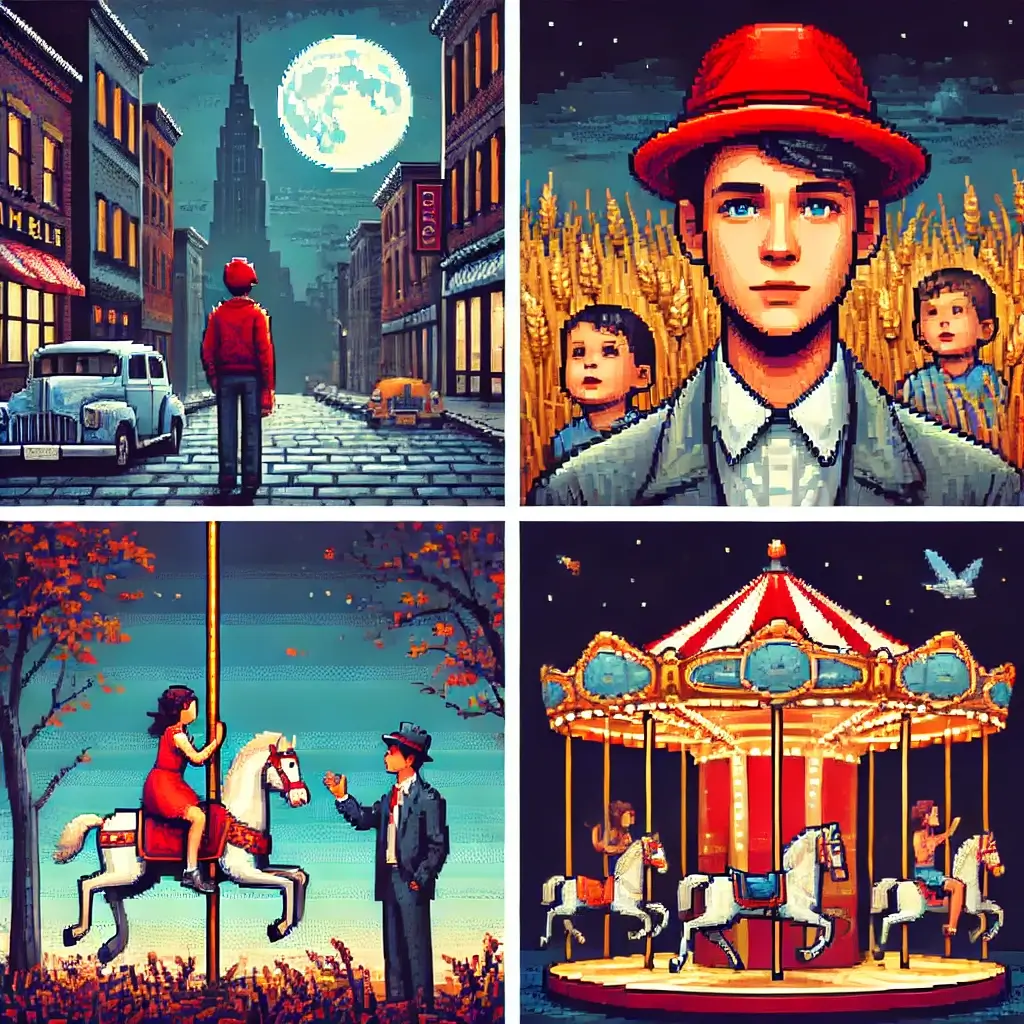
The Catcher in the Rye: 1 Trillion Reasons Why Holden Caulfield Still Haunts Our Souls
Let’s get one thing straight.
If you’ve ever felt like the world was full of nothing but phonies, if you’ve ever wanted to just disappear, if you’ve ever felt like an outcast in your own life… well, then you already know Holden Caulfield.
He’s not just a character in a book; he’s the ghost in the machine, the voice in your head that screams, “I don’t belong here.”
And if you haven’t felt that way?
Give it time.
J.D. Salinger’s masterpiece, “The Catcher in the Rye,” isn’t just some dusty old book they make you read in high school.
It’s a mirror.
A broken, cracked, and brutally honest mirror that reflects the anxiety, the rage, and the profound sadness of a boy trying to find his place in a world that feels completely, utterly wrong.
It’s been over 70 years since this novel first hit the shelves, and it’s still just as relevant, just as raw, and just as maddeningly brilliant as the day it was written.
So, let’s talk about it.
Let’s dive headfirst into the mind of Holden Caulfield and figure out why this book continues to resonate so deeply with millions of us, one generation after another.
Why do we still feel that gut-punch of recognition when he talks about a world that’s just too full of fake people?
Buckle up, because this isn’t going to be your typical literary analysis.
This is a conversation, a confessional, a deep-dive into the heart of a novel that saved, and maybe sometimes broke, a lot of us.
We’re going to explore the themes, the characters, and the legacy of a book that dared to be different, and in doing so, changed everything.
Ready?
—
Table of Contents
—
That Phony World, Man: The Core of the Catcher in the Rye
Let’s be honest, we all know a phony.
That person who says all the right things, wears all the right clothes, and has the perfect, plastic smile plastered on their face.
They’re the walking, talking embodiment of everything Holden Caulfield despises.
They’re the reason he’s so angry, so cynical, so desperately searching for something real.
Holden’s whole journey is a quest for authenticity in a world he sees as nothing but a giant, grotesque stage play.
He sees the adults—his teachers, his parents’ friends, even the pimps and prostitutes he encounters—as nothing more than actors playing a part.
They’re all putting on a show, and Holden just can’t stomach it.
He calls them “phonies,” and it’s not just some teenage complaint.
It’s his moral compass.
His word for someone who lacks genuineness, who is insincere, and who conforms to social norms just for the sake of it.
Think about his old headmaster, Mr. Haas, who would only talk to the parents he thought were “swell” and would ignore the “crumby” ones.
Or the students at Pencey Prep, who Holden feels are all just faking their way through life.
It’s a powerful and relatable feeling, isn’t it?
That moment you realize someone you respected is a complete fraud.
It’s a betrayal of the soul.
And for Holden, that betrayal is everywhere he looks.
He’s not just a cynical kid; he’s a truth-seeker, a lonely soldier on a one-man crusade against a world he sees as corrupted by materialism and insincerity.
He’s so desperate for genuine human connection that he’s willing to alienate himself from everyone around him rather than pretend to be something he’s not.
This is the core of “The Catcher in the Rye”—a raw, unfiltered cry for a world that’s real, for people who are true to themselves, and for a place where a kid can just be a kid without having to put on a show.
It’s a feeling that never goes out of style.
And it’s why we still, after all these years, can’t stop thinking about Holden.
—
The Loneliness of the Long-Distance Dropout: Alienation and Solitude
Have you ever felt completely alone in a crowded room?
Like you’re an island, and everyone else is just a blur of noise and color?
That, my friends, is Holden’s entire existence.
He spends the majority of the book wandering around New York City, a place with millions of people, yet he’s never felt more isolated.
He’s not just physically alone; he’s spiritually and emotionally cut off from the world.
He pushes people away, not because he hates them, but because he’s terrified of being hurt or disappointed by their insincerity.
Think about his failed attempts to connect with people.
He tries to talk to the cab drivers about the ducks in Central Park, hoping for a moment of shared wonder, but they just dismiss him.
He goes to a nightclub and tries to connect with some women, but they’re only interested in spotting movie stars.
He tries to have a conversation with a prostitute, Sunny, but she’s just there for a job.
His interactions are a series of missed connections, each one a little punch to the gut that reinforces his belief that he is, and will always be, alone.
This isn’t just teenage angst.
It’s a profound sense of alienation that stems from a genuine inability to reconcile his internal world with the external one.
He’s a misfit, a square peg in a round hole, and he can’t—or won’t—force himself to fit.
This is what makes Holden so damn relatable.
We’ve all been there, haven’t we?
Feeling like an outsider, like everyone else has the secret to life and you’re the only one left out of the loop.
Holden’s journey is a stark reminder of the pain of loneliness, but also the strange comfort that comes with embracing your own solitude.
He may be lonely, but at least he’s honest.
And in a world full of phonies, sometimes that’s all you have left.
—
A Catcher in the Rye: A Desperate Plea for Innocence
This is the heart of the whole thing, the reason for the title itself.
The name “The Catcher in the Rye” comes from a poem by Robert Burns, and it’s the only time in the book where Holden truly seems happy, truly seems to have a purpose.
He has this fantasy, this beautiful, heartbreaking vision of himself standing at the edge of a cliff, a field of rye below him, and a bunch of children playing in it.
His job?
To be “the catcher in the rye,” to catch the children before they fall off the cliff.
This isn’t just some childish daydream.
It’s his one true desire: to protect innocence.
He wants to save the children from the very same fall he has experienced—the fall from the pure, simple world of childhood into the complex, corrupt world of adulthood.
He sees the world as a place that relentlessly tries to steal your innocence, to make you jaded and phony.
He’s desperately trying to hold onto his own, but he’s also trying to protect others.
This is where his love for his little sister, Phoebe, comes in.
She is his last connection to that innocent world.
She is his hope, his solace, and his reason for living.
When he sees her riding the carousel at the end of the book, reaching for the gold ring, he realizes something profound.
He realizes that you can’t save everyone.
You can’t be “the catcher in the rye.”
Kids have to grow up, they have to fall, and they have to learn to catch themselves.
It’s a painful but necessary realization that marks the beginning of his acceptance of the world, even if he still despises it.
It’s a beautiful and tragic moment, and it’s the reason this book will forever be a rite of passage for anyone trying to navigate the messy, confusing transition from childhood to adulthood.
—
Holden’s Haunted Family Tree: The Ghosts of the Caulfield Clan
You can’t talk about Holden without talking about his family.
His parents are mostly absent, and the one person who truly seems to understand him, his older brother D.B., has “sold out” to Hollywood.
But the two most important figures in his family are the ghosts that haunt him: his younger brother Allie, and his little sister Phoebe.
Allie is the reason for Holden’s deep-seated trauma.
He was a brilliant, kind, and incredibly smart boy who died of leukemia.
Holden was so grief-stricken that he punched out all the windows in the garage.
Allie’s death isn’t just a sad backstory; it’s the catalyst for Holden’s entire breakdown.
Allie was pure, a true innocent, and his death shattered Holden’s world.
Holden’s grief is a silent, constant companion throughout the novel.
He talks to Allie in his head, and he keeps Allie’s baseball mitt with the poems written all over it as a sacred relic.
Allie’s death is the ultimate example of innocence being destroyed by a cruel and random world, and it’s what fuels Holden’s desperate desire to protect the innocence of others.
Then there’s Phoebe.
She is his emotional anchor, his only real source of unconditional love and understanding.
When he sees her, he can drop his guard, and he can be his true self.
She’s the one who calls him out on his BS, and she’s the one who ultimately makes him confront his own emotional turmoil.
When she tells him she’s going to run away with him, and when she gives him her Christmas money, it’s a moment of profound love and sacrifice.
It’s the first time in the book that someone gives him a real, genuine connection, and it’s what finally makes him realize that he can’t run away forever.
The Caulfield family isn’t just a backdrop; it’s the very foundation of Holden’s psyche.
Their love, loss, and dysfunction are what shape him into the complex, confused, and deeply human character we know and love.
—
The Catcher in the Rye: More Than a Book, It’s a Revolution and a Controversy
You might think that a book about a confused teenager would be universally loved.
But “The Catcher in the Rye” is one of the most challenged and controversial books in American literary history.
It’s been banned from schools for its profanity, its sexual content, and its rebellious themes.
Some people argue that Holden is a poor role model for teenagers, and that his cynical, disillusioned worldview is a bad influence.
They argue that the book promotes teenage rebellion and disrespect for authority.
And let’s not forget the more sinister side of its legacy.
The book has been linked to the assassinations of John Lennon and the attempted assassination of Ronald Reagan.
Mark Chapman, Lennon’s killer, was found with a copy of the book and claimed that the book was his “statement.”
This is, of course, a horrific tragedy, and it’s a testament to the power of the book’s themes, even if they were tragically misinterpreted by a disturbed individual.
But for millions of readers, the book is a lifeline, a comfort, and a testament to the power of authenticity.
It tells us that it’s okay to feel different, to feel angry, and to feel like you don’t belong.
It tells us that our confusion and our pain are valid.
And in a world that often demands conformity, that’s a revolutionary message.
The controversy surrounding “The Catcher in the Rye” isn’t a sign of its failure; it’s a sign of its power.
It’s a book that forces us to confront uncomfortable truths about ourselves and our society.
And that, my friends, is what great literature is all about.
This book isn’t just about a boy; it’s about all of us, and the struggle to find our place in a world that doesn’t always make sense.
If you want to read more about the book’s history and its impact on the literary world, check out these articles.
—
Why a 17-Year-Old Boy Still Matters in a 21st-Century World
So, why do we still care about a book written in 1951, about a guy who thinks everyone’s a phony?
In a world of social media, where everyone curates a perfect, filtered version of their life, Holden’s desperate cry for authenticity feels more relevant than ever.
We’re all so busy building our online personas, our “brands,” that we’ve forgotten how to be real.
Holden’s journey is a stark reminder that being true to yourself, even if it makes you an outcast, is the only way to find peace.
And his struggle with loneliness?
It’s a universal human experience.
It’s the fear of not being understood, of being completely alone, even when surrounded by others.
It’s a fear that has transcended time, technology, and culture.
“The Catcher in the Rye” isn’t a book about a teenager; it’s a book about the human condition.
It’s about the pain of growing up, the struggle to find your place, and the desperate search for something real in a world that feels increasingly fake.
It’s a testament to the power of a single, honest voice.
And it’s a reminder that no matter how many times we fall, there’s always a chance to catch ourselves.
We’ll be back soon with more on this topic and other books that changed the world.
The Catcher in the Rye: A Visual Summary
Key Themes and Characters Explained at a Glance
Holden Caulfield
The protagonist. A 17-year-old dropout, cynical yet sensitive. He hates “phonies” and is desperately searching for authenticity.
Main Themes
- Alienation & Loneliness: His isolation is a defining characteristic.
- Innocence vs. Adulthood: The struggle to protect himself and others from the corrupt adult world.
- Phonies & Authenticity: His crusade against people who are insincere or fake.
Symbolism
- Red Hunting Hat: His unique identity and desire for protection.
- The Museum: Represents the unchanging, pure world he longs for.
- Allie’s Baseball Mitt: A symbol of lost innocence and grief.
- The Carousel: The final acceptance that you can’t save everyone.
“Don’t ever tell anybody anything. If you do, you start missing everybody.” – Holden Caulfield
Final keywords: The Catcher in the Rye, J.D. Salinger, Holden Caulfield, Phonies, Innocence.
🔗 The 4 Seasons – Vivaldi Posted 2025-08-15 09:41 UTC 🔗 Time Management for Remote Workers Posted 2025-08-15 07:48 UTC 🔗 Black Mirror’s Narrative Structure Posted 2025-08-14 14:42 UTC 🔗 Building a Sustainable Trail on Your Land Posted 2025-08-14 12:04 UTC 🔗 Convert Your Gas Motorcycle into an Electric Posted 2025-08-14 🔗 1 Shocking Truth: Why Anna Karenina’s Story Still Hurts Posted 2025-08-15