
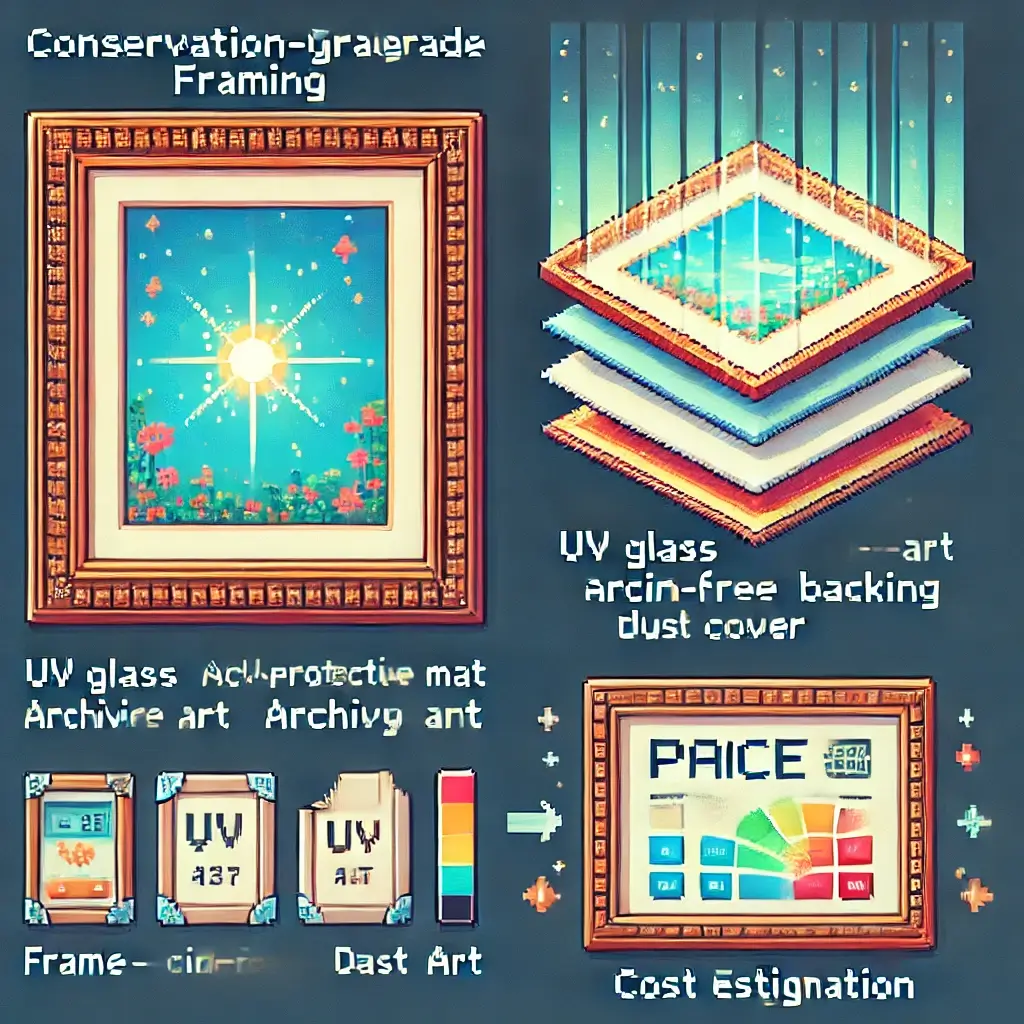
Conservation-Grade Framing: 17 Secrets to UV Glass, Acid-Free Mats & Price Calculators
Table of Contents
Conservation-Grade Framing: Why It’s the Unsung Superhero of Your Walls
Summary: Conservation-grade framing is the difference between “pretty today” and “preserved for decades.” It balances aesthetics with archival safety: UV filtration, acid-free materials, reversible mounting, and stable environments.
Key Takeaway: If your art, photos, prints, or posters are irreplaceable (emotionally or financially), conservation-grade framing isn’t fancy—it’s necessary.
I have a friend who hung a signed poster in direct sunlight because it looked “luminous.”
It did look luminous—for six months.
Then it looked like a haunted memory of itself.
That’s the quiet tragedy conservation-grade framing prevents, without demanding a soul-offering to the pricing gods.
Think of conservation-grade framing as putting your art in a breathable space suit.
It doesn’t suffocate the piece, but it protects it from the worst cosmic rays of home life: UV light, acid migration, humidity swings, mystery kitchen fumes, and tape that ages like milk.
Beginners: you don’t need to become a conservator to do this.
Intermediates: you probably already suspect that mat color is less important than mat chemistry.
Experts: you can skip the pep talk and dive into the mounting and glazing specs later, but I dare you to read the confessional “mistakes” section and not nod.
Beginner Layer
Imagine your art as a peach.
Sun cooks it, humidity wrinkles it, and bad packaging bruises it.
Conservation-grade framing is the cushioned, shaded, peach-friendly box.
Intermediate Layer
We’re talking UV-filtering glass or acrylic, acid-free mats and backings, reversible hinges, and a little discipline about where you hang the piece.
Don’t buy a “fancy” mat that secretly contains lignin destined to turn your art the color of old toast.
Expert Layer
Consider the interaction between lignin, pH buffering, and atmospheric pollutants like nitrogen oxides.
Ask whether the glazing is spectrally selective and how anti-reflective coatings impact color neutrality.
Use rag boards when possible, and if you go with alpha-cellulose, verify the buffer and purity.
Conservation-Grade Framing: UV Glass—Filtering, Myths, and Real-World Light Risks
Summary: UV glass (or acrylic) can filter a high percentage of ultraviolet light, but it doesn’t erase risk from visible light exposure or heat.
Key Takeaway: UV glazing is essential, but location and duration of light exposure still matter, so think “shield plus strategy.”
Let’s be honest.
UV is like that one chaotic aunt at weddings—responsible for a disproportionate amount of drama.
UV glazing helps, and modern coatings can be shockingly effective.
But visible light still carries energy, and long exposures still age pigments and paper.
Rule of thumb: reduce total light exposure.
Use UV glazing, avoid direct sun, and rotate display if you can.
Yes, you’re allowed to be the person who moves art seasonally.
Beginner Layer
If light is a slow cooker, UV is the high heat setting.
UV-filtering glass turns the dial down without ruining dinner.
Intermediate Layer
There are tiers: basic UV-filtering, conservation-grade with high UV rejection, and “museum” glass that adds anti-reflective features with minimal color cast.
Acrylic can be lighter and safer for large pieces, but it’s more scratch-prone without care.
Expert Layer
Check spectral transmission curves when available.
Look for consistency of AR coatings across viewing angles and minimal color shift.
In high-humidity regions, acrylic’s lower thermal conductivity can be helpful, but static can challenge delicate media unless properly spaced and sealed.
Conservation-Grade Framing: Acid-Free Mats—Why Chemistry Beats Color Swatches
Summary: Acid-free, lignin-free (or purified alpha-cellulose) and preferably cotton rag mats remain stable over time, preventing yellowing and embrittlement.
Key Takeaway: Choose mat boards for long-term chemistry first, color second, and always allow a margin so the art can “breathe.”
Color is flirtation.
Chemistry is commitment.
Acid-free mats (especially cotton rag) don’t just look lovely today—they keep the paper underneath from turning into archaeological material.
Yes, you can pick a delicious off-white, but ask how the mat was made and what the pH buffering looks like.
Beginner Layer
Acid-free means the mat won’t “burn” your art like lemon juice on old paper.
Rag = cotton = fancy pajamas for your picture.
Intermediate Layer
If your art touches the window mat, that contact should be with neutral, stable fibers.
Alkaline buffers help neutralize acids that drift in from the atmosphere or migrate from your wall.
Expert Layer
Verify cellulose purity, buffering agents, and pass/fail on PAT (Photographic Activity Test) for photographs.
Use spacer strips or a secondary mat to keep glazing off charcoal or pastel surfaces.
Conservation-Grade Framing: Backing Boards, Tapes & Hinges—Your Art’s Safety Harness
Summary: Use neutral-pH, archival backer boards and reversible Japanese paper hinges with wheat starch paste or conservation-grade adhesives.
Key Takeaway: Permanent mounting may seem secure but can be irreversible heartbreak; choose methods you or a conservator can safely undo.
Every frame is a tiny theater.
The hinges are stagehands—supposed to be invisible, absolutely crucial, and completely calm during a crisis.
Use Japanese paper hinges for delicate works on paper.
They fail safely under stress, meaning the hinge breaks before the art does.
Pressure-sensitive tapes that promise “archival” without testing can age into gummy messes.
Beginner Layer
Think of hinges as little paper arms holding the art lightly from the top.
If the frame falls, you want the hinge to give way, not tear your art.
Intermediate Layer
Use a rigid, archival backer board to reduce cockling and warping.
Consider adding a sealed dust cover to keep out insects and drifting debris.
Expert Layer
Opt for museum board backers or archival corrugated boards with good stiffness-to-weight ratios.
Sealants inside frames should be selected for low off-gassing profiles; watch out for certain foams and adhesives.
Conservation-Grade Framing: Climate, Humidity & Light—The Environmental Trio
Summary: Framing slows damage, but your room’s climate finishes the story.
Key Takeaway: Avoid direct sun, maintain moderate humidity, and give art room to acclimate; consider silica gel or microclimate enclosures for high-value works.
Art hates drama, but homes produce it constantly.
Showers fog mirrors, heaters kiss the air too warmly, and summer throws humidity parties no one asked for.
Place framed pieces away from radiators, kitchens, and bathrooms when possible.
If that sounds impossible, you’re living a real life, which is allowed.
Just increase inspection frequency and consider glazing with better UV and AR performance.
Beginner Layer
Don’t hang valuable art in steamy bathrooms.
Window walls look gorgeous and dangerous.
Intermediate Layer
Use bump-ons or spacers to allow airflow behind frames.
Silica gel compartments can help stabilize microclimates inside larger frames.
Expert Layer
Measure RH if you’re in a volatile climate; aim for moderate, relatively stable humidity.
Use sealed enclosures for photographs, cyanotypes, or sensitive inks in challenging environments.
Conservation-Grade Framing: Choosing Glass & Acrylic—Museum, Conservation, AR, or Laminated?
Summary: The right glazing balances UV filtration, reflectivity, weight, size, and safety.
Key Takeaway: For most home collections, conservation-grade AR glass or UV acrylic provides an excellent balance; choose acrylic for oversized works and high-traffic areas.
If you’ve ever seen your face perfectly reflected in your art, congratulations—you bought a mirror with a print behind it.
Anti-reflective coatings dramatically improve legibility and reduce eye strain.
Museum glass and premium acrylics also shift the vibe from “living room” to “small gallery” without making the room feel like a lab.
Beginner Layer
Glass is heavier and can shatter, acrylic is lighter and safer.
Both can filter UV if you pick the right grade.
Intermediate Layer
Anti-reflective coatings reduce glare, which is extra helpful for dark or detailed artwork.
Consider acrylic for pieces over 24×36 inches to avoid catastrophic wall moments.
Expert Layer
Check haze values, reflectance percentages, and abrasion-resistant top coats on acrylics.
Laminated or security glazing is a niche but valuable option for public spaces.
Conservation-Grade Framing: Mounting Methods—Float, Window, Sink & Shadow
Summary: Mounting should be elegant, structurally sound, and reversible whenever possible.
Key Takeaway: Float mounts show edges and deckles, window mounts are classic, sink mounts support thicker objects; plan for gravity and expansion.
Mounting is where engineering pretends to be poetry.
A float mount with a generous shadow line turns a humble drawing into a confident statement.
A sink mount cuddles a thick object safely and invisibly.
Choose methods that won’t fight with your media.
Beginner Layer
Float = you see the edges.
Window = the mat opens like a window and frames the image area.
Intermediate Layer
Use Japanese paper hinges at the top edge only, letting gravity do the rest.
For float mounts, hidden support corners can keep the piece flat without adhesives on the face.
Expert Layer
For heavy papers, use multiple hinges with long fibers pointing with the grain.
For photographic prints, ensure all contact surfaces have passed PAT.
Conservation-Grade Framing: Sizing, Spacing & The Art of Breathing Room
Summary: The right mat margin and sightline keep work from feeling cramped and reduce risk of contact damage.
Key Takeaway: Start with 2 to 3 inches for small pieces, scale up margins for larger works; sometimes asymmetry looks sophisticated, not crooked.
Frames are like conversation bubbles around your art.
If the bubble is too tight, everything sounds rushed.
If it’s too roomy, the art whispers from across the room.
Balance is the point.
Beginner Layer
Don’t let the art touch the glass.
Use a mat or spacers to keep a little air in there.
Intermediate Layer
Try larger bottom margins for visual lift; our eyes are used to gravity.
Remember the frame itself also adds visual weight, so mock up with painter’s tape before committing.
Expert Layer
Think in ratios; 1:1.6 mat-to-art margin can feel balanced for many works.
Consider overall wall composition when selecting frame proportions.
UV Glass Protection Levels
More UV protection = longer life for your artwork.
Acid-Free vs Standard Mats
Standard Mat
Contains acids & lignin
Turns yellow in 5-10 years
Can stain artwork edges
Acid-Free Mat
Neutral or alkaline pH
Stays stable for decades
Prevents discoloration
Typical Framing Cost Breakdown
Anatomy of a Conservation Frame
- 🟦 UV/AR Glass – Blocks harmful rays
- 🟩 Spacer – Prevents art-glass contact
- 🟨 Acid-Free Mat – Neutral pH support
- 🟧 Artwork – Hinged & reversible mount
- 🟪 Archival Backing – Long-term stability
- ⬛ Dust Cover – Keeps insects & debris out
Conservation-Grade Framing: Budget Strategies—Splurge, Save, and Smart DIY
Summary: Spend on UV glazing and archival boards; save by picking simpler mouldings and standard sizes when possible.
Key Takeaway: Quality where it counts beats ornate frames with sketchy materials; the art won’t care how fancy the corners look if the mat is acidic.
I love a dramatic profile, but the best-looking moulding can’t undo a poor mat choice.
Spend your budget on the parts that touch (or almost touch) the art: glazing, mats, spacer, backing.
Then keep the frame profile minimal, modern, and kind to your wallet.
Beginner Layer
Use a standard-size frame and custom mat to fit odd-sized art.
That combo saves real money.
Intermediate Layer
Choose a medium-quality moulding but step up to museum-grade glazing for art you truly love.
You’ll notice the clarity every day.
Expert Layer
Consider modular framing systems for rotating collections.
Buy archival boards in bulk if you frame often.
Conservation-Grade Framing: Price Calculator—Estimate Your Costs in 60 Seconds
Summary: A quick estimator helps you set expectations before visiting a framer or starting a DIY project.
Key Takeaway: Real quotes vary by region and supplier, but understanding cost drivers empowers better decisions.
Let’s wrestle the mystery monster.
Below is a simple, friendly calculator that turns height, width, and a few options into a ballpark estimate.
Is it perfect?
No.
Is it a remarkably decent coffee-chat starting point?
Yes, absolutely.
DIY Conservation-Grade Framing Estimator
Enter art dimensions and choose materials to estimate your framing cost.
Estimated Cost: —
Play with it.
Yell “aha.”
Then, if you’re framing a family heirloom, still get a human quote.
Because people and regions differ, and the last person who handled the glass may have a story to tell.
Conservation-Grade Framing: Infographic—A Simple Anatomy Map
Summary: See the layers from wall to glass at a glance.
Key Takeaway: Each layer has a job: support, separation, and protection, all working together like a tiny, polite orchestra.
Sometimes you just need to see it.
Here’s a plain-vanilla diagram that shows the stack of a good frame.
Conservation-Grade Framing: Mistakes I’ve Made—And How to Avoid My Oopsies
Summary: I once used “archival” tape that aged like a banana on fast-forward.
Key Takeaway: When in doubt, default to reversible methods and materials with proven tests and neutral pH.
I cringe remembering the time I over-tightened spring clips and pressed a pastel drawing into its own glazing.
I didn’t sleep properly for a week.
Lesson: subtle pressure is still pressure.
Use spacers.
Test fits.
Breathing room is not a luxury; it’s a health plan.
Beginner Layer
Don’t put tape on the art face—ever.
Even “gentle” tapes can be too much for old paper.
Intermediate Layer
Use clean hands or nitrile gloves.
Finger oils look invisible until ten years pass.
Expert Layer
Consider the coefficient of expansion for substrates when mixing materials.
Watch for optical brightening agents in some papers that can shift under UV exposure.
Conservation-Grade Framing: Trends, Insights & What Pros Are Whispering
Summary: Today’s best practice blends high-clarity AR glazing, rag or purified alpha-cellulose boards, clean, minimal profiles, and reversible mounts.
Key Takeaway: Minimalist frames plus maximal conservation equals quietly powerful displays that age gracefully.
The quiet trend is restraint.
Let the art lead, and the materials follow like an expert dance partner who never steps on toes.
Small floating shadows, true blacks, warm whites, and nearly invisible reflections—this is the chic toolkit.
Beginner Layer
Simple frames are not “cheap.”
They’re timeless.
Intermediate Layer
AR glazing sometimes makes prints look as if there’s no glass at all.
That sounds like marketing fluff until you hang two frames side by side and blink.
Expert Layer
Keep an eye on low-iron glass for better color neutrality and acrylics with improved abrasion resistance.
Microclimate packages are becoming more accessible for domestic collectors.
Conservation-Grade Framing: Maintenance—Cleaning, Checkups & When to Reframe
Summary: Annual inspections catch condensation, slipped hinges, and dust or insect ingress early.
Key Takeaway: Clean glazing with non-ammonia solutions and lint-free cloths; if you see ripples, stains, or mold, pause and consult a professional.
Frames are not forever; they are more like long-term apartments for your art.
Sometimes the building needs a renovation.
If you see mat burn, foxing, or cockling, it may be time to reframe with updated materials or a different mount.
Beginner Layer
Dust with a soft cloth and never spray cleaner directly on the glazing—it can seep inside.
Move the piece to a table first.
Intermediate Layer
Check wire and D-ring hardware annually.
Gravity works every day, and screws have feelings.
Expert Layer
Maintain a simple log of RH, room temperature, and any visual changes if you’re managing multiple pieces.
For photographs, consider cool storage when off-display.
Conservation-Grade Framing: Interactive Checklist & Mini-Quiz
Summary: A tiny ritual before you buy or build can save years of regret.
Key Takeaway: Use this checklist, then take the quiz to gauge your comfort level.
Pre-Frame Checklist
60-Second Quiz
Answer key in the vibes of your heart: float mount, conservation glazing, Japanese paper hinges.
If you chose otherwise, it’s fine.
We’ve all been young and chaotic.
Conservation-Grade Framing: Trusted Resources & Reading
Summary: When in doubt, listen to conservators and institutions who guard priceless collections.
Key Takeaway: Bookmark a few resources so you can sanity-check choices before you buy.
Sometimes you want a second voice—preferably one wearing archival cotton gloves.
Here are three solid places to learn more.
Explore U.S. National Archives Preservation Guidance
Visit the American Institute for Conservation
See The Met’s Conservation & Scientific Research
FAQ
Summary: Five common questions answered with honesty and minimal jargon.
Key Takeaway: The safest path is reversible, neutral materials and sensible display conditions.
1) Do I really need UV glass if my room doesn’t get direct sun?
Yes, because ambient daylight and even some artificial light contain UV and visible components that age paper over time.
UV glazing is inexpensive insurance for pieces you value.
2) What’s the difference between “conservation” and “museum” glass?
“Conservation” typically indicates strong UV filtration.
“Museum” adds premium anti-reflective coatings for better clarity and reduced glare.
3) Are acid-free mats enough, or do I need cotton rag?
High-quality alpha-cellulose mats are excellent for many projects.
Rag boards are a gold standard for long-term stability and sensitive works.
4) Can I frame a pastel or charcoal drawing without smudging?
Yes.
Use spacers or a deep mat so nothing touches the media, and keep the frame sealed.
5) How often should I check my framed pieces?
Give them a quick glance every few months and a thorough inspection annually.
Look for condensation, rippling, or insects, and act early.
Conservation-Grade Framing: Final Pep Talk & Emotional Send-Off
Summary: You can absolutely do this—sensibly, beautifully, and within a budget.
Key Takeaway: Choose UV/AR glazing, acid-free boards, reversible mounts, and sane display spots; your future self will send you a thank-you text from the year 2040.
Here’s the truth I want to stitch into the back of your favorite frame.
Art deserves kindness.
Not because it’s expensive, but because it holds our timelines together.
The ticket stub you saved, the doodle your kid made, the print you finally bought after months of scrolling—these are your artifacts.
Frame them like you mean it.
Maybe I’m wrong, but I believe homes feel calmer when the things we love are protected.
Pick the good glass.
Pick the safe mat.
Use the calculator, make a plan, and then hang that story on your wall.
When you walk by, you won’t just see an image.
You’ll see a promise you kept.
Conservation-Grade Framing: Micro-Bonus Tips for Overachievers
Summary: Little moves, big wins.
Key Takeaway: A spacer here, a dust seal there, and you’ve extended your art’s lifespan by quiet miles.
Store spare mats flat and dry.
Label frames discreetly with materials and dates.
If you move, acclimate frames before rehanging—let them sit a day inside the new room.
For photo-heavy walls, pilot test cleaning products on a spare acrylic scrap to avoid haze surprises.
Conservation-Grade Framing: One-Page Recap So You Can Pretend You Read Everything
Summary: Protection first, looks second (but still stunning), reversibility always.
Key Takeaway: The winning combo is UV/AR glazing + acid-free/rag boards + reversible hinges + good placement + occasional checkups.
Glazing: choose UV filtration, add AR if glare bothers you.
Mats/Backing: acid-free/rag, buffered when appropriate, PAT-passing for photo contact.
Mounting: reversible hinges or non-invasive supports.
Environment: avoid bathrooms and direct sun, maintain stable humidity.
Budget: splurge on materials that touch the art; save on ornate mouldings.
Maintenance: gentle cleaning, annual inspection, reframe if damage appears.
Conservation-Grade Framing: Gratitude & Real-World Sanity
Summary: Framing is part craft, part science, part love letter.
Key Takeaway: You don’t need perfection; you need a thoughtful plan and materials that age gracefully.
If you made it this far, consider yourself a gentle guardian of paper, ink, and pigment.
And if something still feels confusing, breathe.
Art has survived caves, monasteries, and apartments with radiators that clank like haunted suitcases.
With a few smart choices, yours will too.
Conservation-Grade Framing: A Tiny Acknowledgment of Imperfection
Summary: Even pros argue about a few details.
Key Takeaway: If two experts disagree, pick the more reversible, less chemically aggressive option and sleep well.
Some will swear by one acrylic brand, others by another.
Some adore slightly warm rag boards; others only cool white.
It’s okay.
Your art won’t mind if you treat it with caution and respect.
Conservation-Grade Framing: Your Turn—Tell the Wall a Story
Summary: The choice to frame well is the choice to keep what matters.
Key Takeaway: Start today with one piece; upgrade glazing or remat something you love, and feel the room soften.
Pick one artwork right now.
Maybe it’s a photo that still smells like the day you took it (in your head, I mean, don’t sniff it).
Give it the frame it deserves.
Let it glow safely for years.
Watch a clear comparison: regular glass versus conservation-grade glass for framing, including UV protection insights.
Conservation-Grade Framing: Closing Arguments (From a Person Who Cares Too Much)
Summary: You’ve got this.
Key Takeaway: Protection, clarity, reversibility, and calm display conditions are the pillars; the rest is style.
I want you to feel a tiny thrill every time you pass your framed piece.
Not the “I hope it doesn’t fade” kind of thrill—the “I chose well” kind.
If you can, upgrade one element today: glazing, mat, backing, or mounting.
Tomorrow, maybe another.
Little decisions add up to quiet permanence.
And if my enthusiasm is showing, good.
I care because your walls deserve archives, not accidents.
Keywords: conservation-grade framing, UV glass, acid-free mats, museum glass, framing price calculator
🔗 Best POS Systems for Art Galleries Posted 2025-08-27 12:57 UTC 🔗 Gallery Insurance Cost Posted 2025-08-27 02:30 UTC 🔗 Decoding Art Therapy Billing Codes Posted 2025-08-26 02:25 UTC 🔗 Fine Art Shipping Insurance 2025 Posted 2025-08-25 04:18 UTC 🔗 Fine Art Shipping Insurance Posted 1