
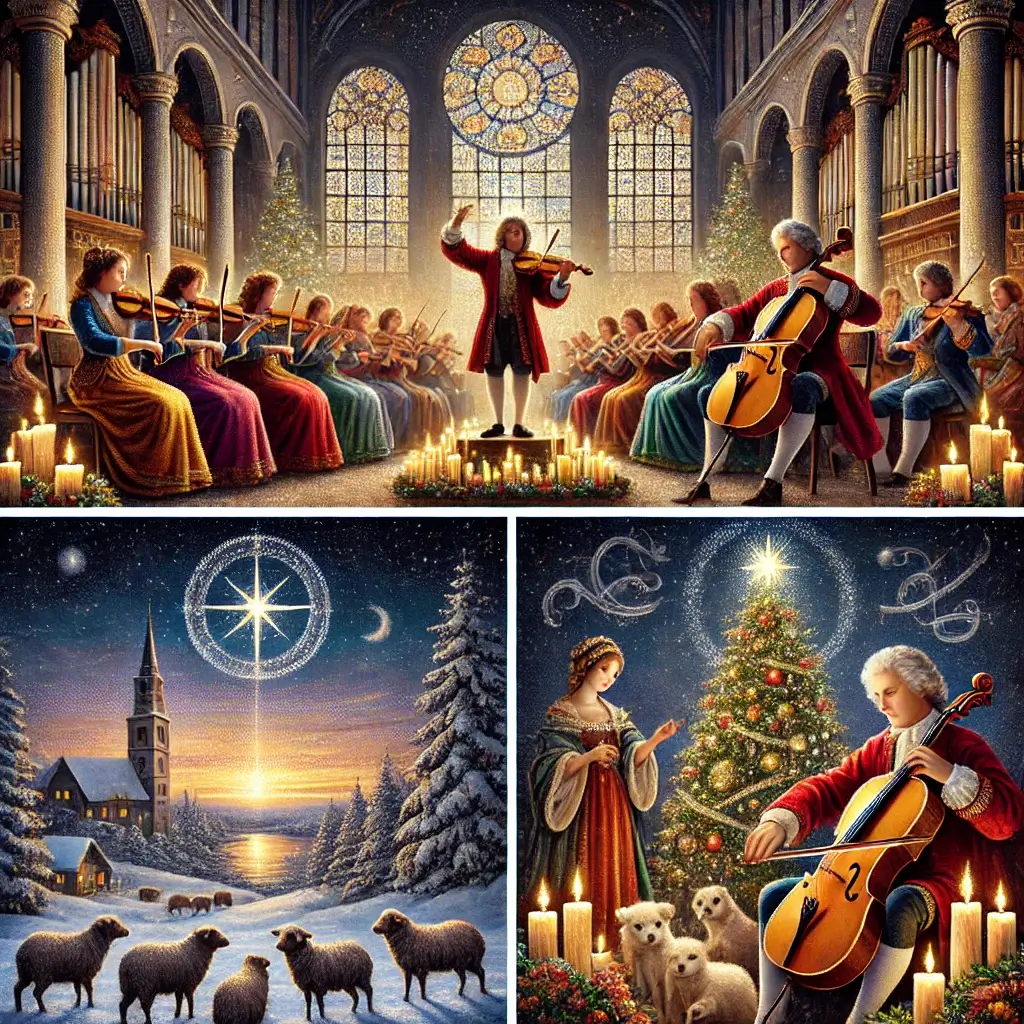
Unwrap the Magic of Corelli’s Christmas Concerto, Op. 6, No. 8: A Timeless Masterpiece
Hey there, fellow music lovers!
Have you ever found yourself in that special time between Christmas Eve and Christmas Day, maybe a little too full of cookies, and the house is quiet except for the glow of the tree lights?
Suddenly, a melody fills the air.
It’s not a cheesy pop song or a saccharine carol.
It’s something else entirely.
Something that feels both ancient and utterly new.
It’s a sound that seems to capture the very essence of the season—the quiet reverence, the joyous anticipation, the sense of wonder.
If you’ve had that experience, chances are you’ve been listening to Arcangelo Corelli’s Concerto Grosso in G minor, Op. 6, No. 8, affectionately known as the **”Christmas Concerto.”**
I’m not going to lie; this piece has a special place in my heart.
It’s the kind of music that doesn’t just fill a room; it fills a soul.
It’s a masterpiece that transports you back in time, yet feels perfectly at home in the present.
And let me tell you, there’s a reason this concerto has endured for over 300 years.
It’s a journey, a conversation, and a prayer all rolled into one.
I’ve spent countless hours with this piece, and I’m always discovering something new.
The way the strings weave in and out, the way the mood shifts from solemn to celebratory… it’s pure genius.
If you think classical music is stuffy or boring, this is the piece that will change your mind.
It’s vibrant, emotional, and packed with drama.
So, grab a warm drink, get comfortable, and let’s dive into the fascinating world of Corelli’s Opus 6, No. 8.
We’ll explore its history, its structure, and what makes it so darn special.
Trust me, you’ll never listen to it the same way again.
Before we get started, a quick heads-up: I’ve put together a few buttons for you that link to some incredible resources.
These are sites I use all the time for my own musical deep-dives.
Think of them as your musical roadmap to the world of Corelli.
—
Table of Contents: Navigating the Concerto Grosso
Sometimes, a great piece of music needs a guide.
Think of this like a concert program for your brain.
It’ll help us keep track of all the incredible things we’re about to uncover.
- What Exactly IS a Concerto Grosso?
- The Master Behind the Music: Who Was Corelli?
- Opus 6: The Ultimate Collection
- A Movement-by-Movement Guide to the **Christmas Concerto**
- That Final Movement: The Pastorale
- Why Does It Still Give Us Chills?
- Performance and Legacy: The Christmas Concerto Today
—
What Exactly IS a Concerto Grosso? It’s a Musical Conversation!
Okay, before we get too deep, let’s talk about the title itself.
“Concerto Grosso.”
It might sound a bit intimidating, but it’s really not.
It literally means “great concerto” in Italian, and it was a wildly popular form of music during the Baroque period (roughly 1600-1750).
Think of it like this: a regular concerto is a conversation between one superstar soloist and the orchestra.
You have a violinist or a pianist, and they are the star of the show.
A concerto grosso is a bit different.
It’s more like a lively debate or a roundtable discussion.
Instead of one soloist, you have a small group of soloists, called the **concertino** (which literally means “little group”).
They play back and forth with the full orchestra, or the **ripieno** (meaning “full”).
The concertino for Corelli’s Christmas Concerto is a simple but powerful trio: two violins and a cello.
This constant interplay between the small group and the large group is what gives the music its incredible energy and drama.
You hear the concertino present a theme, and then the ripieno echoes or expands on it.
It’s like a call and response, a kind of musical dialogue that keeps you on the edge of your seat.
I remember the first time I really paid attention to this.
I was listening to a recording, and I closed my eyes, picturing the musicians.
I could almost see the small group of string players leaning into their instruments, playing with a focused intensity, and then the full orchestra joining in, swelling the sound and filling the space.
It’s a breathtaking effect, and Corelli was a master of it.
He didn’t invent the form, but he perfected it, writing music that was elegant, balanced, and full of emotion.
—
The Master Behind the Music: Who Was Corelli, Anyway?
Arcangelo Corelli (1653-1713) was a rock star in his day.
And I’m not just saying that to sound cool.
He was a violinist and a composer who basically defined the Italian style of violin playing for generations.
He was so good, in fact, that people would travel from all over Europe just to hear him play.
Imagine a packed concert hall in Rome, everyone on the edge of their seats, waiting for Corelli to step on stage.
The guy wasn’t just a musician; he was an institution.
He lived and worked in Rome for most of his career, and he was a major influence on other composers, including giants like Bach and Handel.
Handel even studied with Corelli for a time!
Think of him as the godfather of Baroque violin.
He’s the reason many of the techniques and styles we associate with the violin today even exist.
What’s fascinating about Corelli is that he didn’t write a ton of music compared to some other composers.
He was incredibly meticulous.
He only published six collections of music, but each one was a masterpiece, a carefully crafted gem.
He didn’t just throw things together; he refined and polished every single note.
This is a composer who knew exactly what he wanted to say and how to say it with the utmost elegance and clarity.
He was also an incredibly respected teacher, and his students went on to become some of the leading musicians of the next generation.
So, when you hear his music, you’re not just hearing a random piece of classical music.
You’re hearing the work of a master, a pioneer who shaped the very sound of an entire era.
It’s like listening to the Beatles and realizing they invented half of what we consider modern rock music.
Corelli is that foundational for the Baroque era.
—
Opus 6: The Ultimate Collection of Concerto Grosso
Corelli’s Concerto Grosso in G minor is just one of twelve concertos in a collection he published posthumously in 1714.
This collection, known as **Opus 6**, is considered the pinnacle of the Baroque concerto grosso form.
It’s a textbook example of how to do it right.
Each concerto in the collection is a gem, but Number 8 holds a special distinction.
Corelli himself added a note to the manuscript: “Fatto per la notte di Natale” — “Made for the night of Christmas.”
This little note is everything.
It tells us the composer had a specific time and place in mind for this music.
He wasn’t just writing a generic piece; he was writing a piece meant to evoke the sacred and magical atmosphere of Christmas Eve.
This is the kind of detail that makes music so powerful.
It gives it a purpose, a story, a reason for being.
It’s like finding a letter a great artist wrote about one of their paintings.
It provides a key to unlocking the true meaning behind the work.
The Opus 6 collection as a whole is a testament to Corelli’s genius.
It showcases his incredible ability to write for strings, his masterful control of harmony, and his flair for both grand spectacle and intimate emotion.
If you love Number 8, I highly recommend checking out the rest of the collection.
You’ll find a whole world of musical treasures waiting for you.
—
A Movement-by-Movement Guide: Exploring the Emotional Journey
Let’s take a deep breath and walk through this incredible piece of music, movement by movement.
The concerto has six main movements, but they’re often grouped together, giving the piece a sense of continuous flow.
It’s like a story being told in chapters, but the chapters are all interconnected.
Movement 1: Vivace – Grave (Fast, then Slow and Serious)
The piece starts with a quick, energetic “Vivace” section.
It’s a flash of energy, a burst of light.
But this is immediately followed by a “Grave” section.
“Grave” literally means “grave” or “serious” in Italian.
And that’s exactly what it is.
The music slows down, becomes somber, almost heavy.
It’s like the initial joy of the season is tempered by a sense of deep reverence and solemnity.
This opening is a powerful statement.
It sets the tone for the entire piece, telling you that this isn’t just a happy little tune.
It’s a profound exploration of emotion.
Movement 2: Allegro (Fast and Lively)
The second movement is a joyous “Allegro.”
It’s fast, it’s exciting, and it’s full of that incredible back-and-forth between the concertino and the ripieno.
The strings are flying, trading melodies, and building a thrilling sense of momentum.
This is the kind of music that makes you want to get up and dance (or at least tap your foot along).
It’s a burst of pure, unadulterated holiday cheer.
Movement 3: Adagio – Allegro – Adagio (Slow – Fast – Slow)
This is one of the most interesting parts of the concerto.
It starts slow and expressive (“Adagio”), builds to a fast and energetic section (“Allegro”), and then returns to the slow, contemplative mood.
Think of it as a moment of reflection, a question, an answer, and then a return to quiet thought.
The way Corelli transitions between these moods is seamless and masterful.
He doesn’t just change the tempo; he changes the entire emotional landscape.
Movement 4: Vivace (Fast)
Another burst of energy!
This “Vivace” is a lively dance, full of bouncing rhythms and playful melodies.
It’s pure celebration, a moment of unbridled joy.
You can almost picture a group of people dancing in a grand hall, full of laughter and light.
Movement 5: Allegro – Pastorale (Fast, then The Pastoral)
This movement starts with another “Allegro,” full of the same driving energy as before.
But then, something magical happens.
The music suddenly shifts.
The tempo slows, the key changes, and a new, incredibly beautiful melody emerges.
This is the famous “Pastorale,” the heart and soul of the Christmas Concerto.
We’ll talk more about this in the next section because it deserves a whole conversation on its own.
It’s the reason this piece is so deeply tied to the Christmas season.
It’s a moment of profound beauty and peace that feels like a benediction.
—
That Final Movement: The Divine Simplicity of the Pastorale
Okay, let’s talk about the “Pastorale” because it’s the showstopper.
If you’ve ever heard this concerto, this is the part you remember.
The title itself is a clue.
A “pastorale” is a piece of music meant to evoke the feeling of shepherds in the countryside.
Think of shepherds on a quiet, starry night.
They’re playing their simple flutes and pipes, their music drifting on the cool air.
This is what Corelli captures so perfectly.
The music becomes gentle, lilting, and incredibly serene.
The melodies are simple, almost hymn-like.
It feels like a moment of peace, of profound stillness.
This is the musical equivalent of the Nativity scene.
It’s not about the hustle and bustle of the season; it’s about the quiet, miraculous moment at the heart of it all.
The way Corelli writes for the strings here is just breathtaking.
The violins and cello sing with a simple, pure beauty.
There’s no flashy virtuosity, no dramatic flourishes.
It’s just… beautiful.
And that’s the genius of it.
He takes all the energy and drama from the previous movements and brings it to this one perfect moment of quiet reverence.
It feels like coming home.
Like a deep, calming breath after a long journey.
When I listen to this part, I always picture a scene from a painting, with the soft light of a lantern, the gentle sway of the animals, and the quiet awe of the shepherds.
It’s a masterclass in emotional storytelling, all done without a single word.
—
Why Does It Still Give Us Chills? The Enduring Power of a Classic
So, why does a piece of music written over 300 years ago still resonate with us today?
I’ve thought about this a lot, and I think it comes down to a few key things.
First, it’s the sheer quality of the craftsmanship.
This isn’t just a jumble of notes; it’s a perfectly constructed piece of art.
Every melody, every harmony, every dynamic shift feels deliberate and meaningful.
It’s like looking at a perfectly carved sculpture.
You can appreciate the beauty even if you don’t know anything about the tools or the techniques.
Second, it taps into something universal.
The feelings it evokes—joy, solemnity, peace, wonder—aren’t specific to any one time or place.
They are part of the human experience.
Whether you’re listening to this in 1714 Rome or 2025 New York, the emotional core of the music remains the same.
It’s music that speaks directly to the soul.
Third, the story behind it gives it context.
Knowing that Corelli wrote this specifically for Christmas Eve gives the music an added layer of meaning.
It transforms it from a beautiful piece of music into a musical representation of a sacred event.
And that final “Pastorale”?
It’s one of the most perfect pieces of music ever written.
It’s a moment of pure, unadorned beauty that can bring a tear to your eye and a sense of calm to your spirit.
It’s a reminder that even in the midst of a busy, chaotic world, there are moments of profound peace and grace to be found.
That’s a message that will never get old.
—
Performance and Legacy: The Christmas Concerto Today
You’ve probably heard this piece more times than you realize.
It’s a staple of holiday concerts, and it’s used in countless movies, TV shows, and commercials.
It’s become part of the very fabric of the Christmas season.
But hearing a good performance is key.
The best recordings are often by groups that specialize in **”period performance,”** which means they use instruments and techniques from the Baroque era.
This gives the music a different flavor—a little lighter, a little more transparent, and full of historical authenticity.
You hear the subtle details that might get lost in a modern orchestra.
It’s like the difference between seeing a play in a massive Broadway theater and seeing it in a small, intimate black box space.
Both can be great, but the experience is very different.
The legacy of Corelli’s Opus 6, No. 8, is massive.
It set the standard for the concerto grosso and influenced composers for a century after his death.
Every time you hear a Christmas-themed classical piece, you can probably trace some of its DNA back to this concerto.
So, the next time you hear it playing somewhere, don’t just let it be background music.
Stop for a moment and really listen.
Follow the conversation between the small group and the big group.
Feel the shift from the lively dance to the quiet, serene “Pastorale.”
You’ll be listening not just to a piece of music, but to a piece of history, a work of art that has stood the test of time and continues to bring joy and peace to millions.
It’s a truly wonderful thing.
Corelli, Concerto Grosso, Christmas Concerto, Op. 6 No. 8, Baroque music