
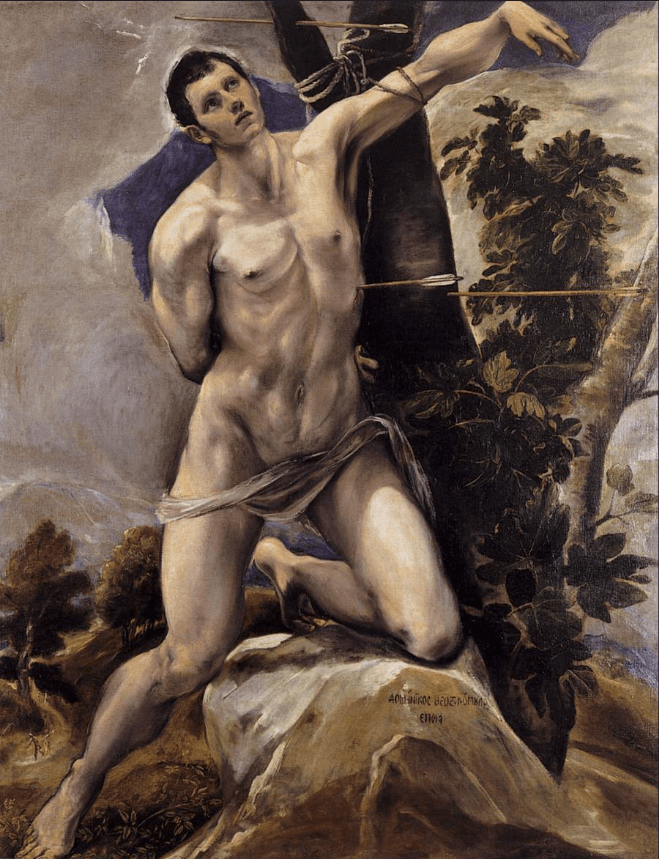
El Greco’s St. Sebastian: A Martyr’s Agony in 3 Masterpieces!
Have you ever stood before a painting and felt a shiver run down your spine, not from cold, but from the sheer power of the emotion radiating from the canvas?
That’s often my experience with El Greco, and nowhere is it more palpable than in his haunting renditions of Saint Sebastian.
It’s not just a painting; it’s an experience, a window into profound human suffering and unwavering faith.
Today, we’re diving deep into the dramatic world of El Greco and his captivating depictions of **Saint Sebastian** – a truly iconic figure who inspired some of his most moving works.
Prepare to be moved, fascinated, and perhaps even a little awestruck.
Table of Contents
Why Saint Sebastian? The Enduring Allure of a Martyred Hero
Before we delve into El Greco’s specific interpretations, let’s talk about the man himself: Saint Sebastian.
He’s a figure steeped in legend, a Roman soldier martyred for his Christian faith during the persecution under Emperor Diocletian.
The popular imagery, and what El Greco masterfully captures, is his bound body pierced by numerous arrows, yet still very much alive, enduring the unimaginable.
Why this particular saint, you might ask, captured the imagination of so many artists, including El Greco?
Well, for starters, his story is incredibly dramatic.
Think about it: a brave soldier, secretly Christian, defying an empire, and then miraculously surviving an execution by arrows, only to be clubbed to death later.
It’s a tale of resilience, conviction, and divine intervention that resonated deeply in religious societies.
Furthermore, Sebastian was often invoked against plagues and illness, especially the Black Death, which ravaged Europe for centuries.
The arrows piercing his body were often seen as symbolic of the disease’s invisible, painful strikes.
So, depicting him wasn’t just about art; it was about prayer, hope, and a plea for protection in a world often gripped by fear.
Artists, being sensitive souls, could pour their understanding of human suffering, vulnerability, and spiritual strength into this one figure.
El Greco, with his intense focus on spiritual drama and expressive forms, found a perfect muse in Saint Sebastian.
It allowed him to explore themes of pain, transcendence, and the human body as a vessel for divine experience.
He didn’t just paint a scene; he painted a soul laid bare.
El Greco: The Visionary Master Behind the Brush
To truly appreciate El Greco’s depictions of Saint Sebastian, we need to understand the artist himself.
Doménikos Theotokópoulos, better known as El Greco (meaning “The Greek”), was a fascinating and enigmatic figure.
Born in Crete, trained in Venice under the likes of Titian and Tintoretto, and then eventually settling in Toledo, Spain, he was a true artistic nomad.
He brought a unique blend of Byzantine icon painting, Venetian color and light, and his own intensely personal vision to the Spanish Renaissance.
His style is instantly recognizable: elongated figures, often spiritualized and almost ethereal, vibrant and often unsettling colors, dramatic lighting, and a profound sense of emotional and spiritual intensity.
He wasn’t interested in simple realism; he was interested in capturing the inner world, the divine, and the human soul’s struggle and triumph.
El Greco’s Toledo workshop was a hive of activity, and he wasn’t afraid to experiment.
He had this incredible knack for taking traditional religious subjects and injecting them with a fresh, almost hallucinatory energy that could be both deeply moving and, for some contemporaries, a little unsettling.
He was a master of conveying ecstasy, agony, and spiritual fervor, often blurring the lines between the earthly and the divine.
When you look at an El Greco painting, you’re not just looking at a scene; you’re looking into a mind that saw the world differently, with a heightened sense of the spiritual and the dramatic.
This is precisely why his renditions of **Saint Sebastian** are so compelling; they are not just representations but profound meditations.
He had a singular vision, and thankfully for us, he brought that vision to the story of this resilient saint.
If you want to dive deeper into the world of El Greco and his revolutionary approach, you might find this resource from the **National Gallery of Art** incredibly insightful:
Explore El Greco at the National Gallery of Art
The First St. Sebastian: A Glimmer of Genius in Palencia
Let’s start our journey with perhaps El Greco’s earliest known depiction of **Saint Sebastian**, painted around 1576-1579, now housed in the Cathedral of Palencia in Spain.
This work is often seen as a significant stepping stone in his Spanish period, showcasing his burgeoning mastery and unique stylistic elements.
In this version, Saint Sebastian is presented with a youthful, almost serene face, despite the arrows piercing his body.
He’s depicted against a somewhat dark and tumultuous sky, which adds a sense of foreboding and drama, characteristic of El Greco’s later works.
His body, though pierced, retains a certain classical idealism, reflecting El Greco’s Venetian training.
But even here, you can see the nascent signs of what would become his signature style: the elongated limbs, the expressive hands, and the way light seems to emanate from the figure itself.
It’s not as overtly dramatic or as intensely spiritual as his later works, but it’s a powerful start.
You can sense the artist experimenting, pushing the boundaries of traditional representation.
The focus here is very much on the stoic endurance of the saint, a quiet heroism rather than an overtly theatrical display of agony.
It’s a more restrained interpretation, perhaps reflecting the expectations of his early Spanish patrons.
Yet, the seeds of his future genius are undeniably present.
The subtle tension in the saint’s muscles, the gentle turn of his head, and the way the light catches his skin—these are all hallmarks of an artist destined for greatness.
It’s a fantastic piece to begin with because it shows us El Greco’s starting point in Spain, before his style became even more radically individual.
It’s like seeing a young, brilliant musician play a classical piece, hinting at the jazz improvisation they’ll master later.
The Prado’s St. Sebastian: A Study in Stoicism and Serenity
Next, we move to a truly iconic rendition, the **Saint Sebastian** at the Museo del Prado in Madrid, painted around 1577-1579.
This is arguably one of the most famous and accessible of El Greco’s Saint Sebastian paintings, and for good reason.
Here, El Greco takes a slightly different approach.
The saint’s body is more elongated, more ethereal, reflecting El Greco’s developing stylistic preferences.
His gaze is directed upwards, towards the heavens, conveying a profound sense of spiritual transcendence amidst physical torment.
It’s as if the pain of the arrows is merely a temporary earthly sensation, secondary to the spiritual connection he feels.
The lighting is dramatic, almost theatrical, illuminating the saint’s pale flesh against a dark, brooding background.
The landscape is minimal, almost abstract, drawing all attention to the central figure.
What truly captivates me about this piece is the expression on Saint Sebastian’s face.
It’s not one of agony or despair, but of quiet resignation, even peace.
It’s a powerful statement on faith conquering suffering, a recurring theme in El Greco’s religious works.
The arrows themselves seem almost decorative, beautiful even, a testament to the saint’s enduring spirit rather than instruments of torture.
It’s as if the physical wounds are merely temporary marks on an immortal soul.
You feel the human vulnerability, yet simultaneously, the overwhelming spiritual strength.
It’s a testament to the power of belief, and it makes you think about what it truly means to face adversity with unwavering conviction.
The Prado version truly exemplifies El Greco’s ability to imbue his figures with a profound psychological and spiritual depth.
If you’re ever in Madrid, make sure to seek out this masterpiece.
For more on the Prado’s collection and this specific work, check out their official site:
Visit St. Sebastian at the Prado Museum
The Roman St. Sebastian: A Baroque Burst of Emotion
Our third major stop is the Saint Sebastian from the Pallavicini-Rospigliosi Collection in Rome, often dated a bit later, around 1610-1614, towards the end of El Greco’s life.
This version is a whirlwind of emotion, a stark contrast to the earlier, more serene interpretations.
Here, El Greco unleashes his full Baroque intensity.
The figure of Saint Sebastian is even more elongated, his body twisted in a dramatic contrapposto that suggests movement and agony, yet still with a profound spiritual uplift.
The colors are more vibrant, almost glowing, with an intensified play of light and shadow that creates a powerful sense of drama.
The background is less important than the swirling, dynamic atmosphere around the saint.
What strikes me most about this piece is the raw emotion.
The face, while still looking upwards, seems to convey a more intense suffering, a more visceral connection to the pain, yet it’s not devoid of hope.
It’s a sublime blend of human agony and divine grace.
The arrows seem to inflict more immediate wounds, and the blood, while subtle, is more present.
This is El Greco at his most expressive, pushing the boundaries of form and color to convey an almost mystical experience of martyrdom.
It’s a testament to his continued artistic evolution, even in his later years.
He was not content to simply repeat himself; he was constantly refining, deepening, and intensifying his vision.
This Roman **Saint Sebastian** is a powerful testament to the emotional power that El Greco could command, making it an absolute must-see for anyone interested in the later phases of his career and the emergence of Baroque sensibilities.
It’s like he’s taken all the quiet intensity of his earlier works and blasted it with a spiritual fireworks display.
El Greco’s Artistic Choices: More Than Just Arrows
So, what made El Greco’s renditions of Saint Sebastian so unique and powerful?
It’s not just the subject matter; it’s his masterful artistic choices that truly set them apart.
First, let’s talk about his **elongated figures**.
This isn’t just a stylistic quirk; it’s a deliberate choice that elevates his figures beyond the purely physical.
The stretching of the limbs and torsos creates a sense of upward movement, of aspiration, linking the earthly suffering to heavenly transcendence.
It’s as if the bodies are reaching for the divine, shedding their mortal coil.
Then there’s his **use of color and light**.
El Greco didn’t stick to naturalistic palettes.
He used vibrant, often jarring colors – deep blues, piercing yellows, and shimmering whites – to create emotional resonance.
Light often seems to emanate from within his figures, or from an unseen divine source, illuminating them with an almost otherworldly glow.
This dramatic chiaroscuro (the contrast between light and dark) enhances the emotional intensity, pulling you into the scene.
Consider the **composition**.
His figures often dominate the canvas, with minimal or abstracted backgrounds.
This forces the viewer to confront the subject directly, focusing solely on the saint’s experience.
He also often employs a low viewpoint, making the figure seem monumental and awe-inspiring, as if we are looking up at a divine manifestation.
Finally, his **psychological insight**.
Each of El Greco’s Saint Sebastian paintings captures a different facet of the martyr’s experience.
From stoicism to serene acceptance to raw, yet transcendent, agony, he explores the full spectrum of human and spiritual emotion.
He doesn’t just show us what happened; he shows us what it felt like.
This is where he truly excels – in painting not just bodies, but souls.
It’s why his work feels so intensely personal, so deeply human, even when depicting the divine.
He’s inviting you to feel, to contemplate, and to be moved.
His radical vision was, and still is, a masterclass in emotional storytelling through paint.
The Enduring Legacy: Why These Paintings Still Speak to Us
So, why do these centuries-old paintings of Saint Sebastian by El Greco still hold such a powerful sway over us?
Why do art lovers, historians, and casual visitors alike continue to be drawn to them?
Part of it, undoubtedly, is El Greco’s sheer artistic genius.
His style was so radically individual that it transcends eras.
He wasn’t merely painting; he was channeling something profound and universal.
His use of light, color, and form creates an experience that is both visually stunning and deeply emotionally resonant.
But beyond the technical mastery, there’s the enduring power of the story itself.
The narrative of Saint Sebastian—of enduring immense suffering for one’s beliefs, of finding spiritual strength in the face of insurmountable odds—is timeless.
In a world that still grapples with persecution, faith, and the search for meaning, Sebastian’s story remains incredibly relevant.
El Greco brings this narrative to life in a way that feels both historical and intensely present.
His saints aren’t distant, idealized figures; they are alive with struggle and transcendence, making them relatable even across centuries.
The paintings also serve as a powerful testament to the human spirit’s capacity for resilience.
They remind us that even in moments of extreme vulnerability, there can be an unwavering internal strength.
This universal message of enduring hardship with dignity and faith continues to inspire.
And let’s be honest, there’s something undeniably mesmerizing about the way El Greco twists and elongates the human form.
It challenges our perceptions of reality and forces us to look beyond the literal, into the symbolic and spiritual.
It’s art that makes you think, makes you feel, and ultimately, makes you question.
That’s the mark of true masterpiece, and El Greco’s Saint Sebastian series undeniably fits the bill.
They are not just historical artifacts; they are living, breathing works of art that continue to provoke and inspire a deeper understanding of faith, suffering, and the enduring power of the human spirit.
For more insights into the broader impact of religious art and its legacy, you might find this link to the **Metropolitan Museum of Art**’s collection of European paintings quite enriching:
Explore European Paintings at The Met
Final Thoughts: A Journey Through Faith and Art
As we wrap up our deep dive into El Greco’s incredible depictions of **Saint Sebastian**, I hope you’ve gained a new appreciation for these profound works.
They are so much more than mere religious paintings; they are powerful explorations of faith, suffering, and the transcendent human spirit.
From the early, classical influences seen in the Palencia piece to the ethereal intensity of the Prado version, and finally, the raw, emotional power of the Roman rendition, El Greco’s journey with **Saint Sebastian** reflects his own artistic evolution and unwavering spiritual vision.
Each brushstroke, each elongated limb, each dramatic play of light tells a story that resonates across centuries.
He didn’t just paint a martyr; he painted the very essence of martyrdom, the painful yet glorious ascent from earthly torment to spiritual triumph.
These paintings challenge us to look beyond the superficial, to seek deeper meaning, and to confront the powerful interplay between physical pain and spiritual grace.
They are a testament to El Greco’s genius and a timeless reminder of the enduring power of art to move, inspire, and provoke.
So, the next time you encounter an El Greco, especially one of his **Saint Sebastian** paintings, take a moment.
Don’t just see the canvas; feel the emotion, listen to the silent scream, and witness the unwavering faith.
It’s an experience that truly stays with you, long after you’ve walked away.
Thank you for joining me on this artistic adventure!
If you’re eager to learn more about the broader context of Renaissance and Baroque art, a fantastic resource is the **Khan Academy** which offers a wealth of free educational content:
Discover Renaissance Art on Khan Academy
El Greco, Saint Sebastian, Martyrdom, Spanish Renaissance, Prado Museum