11 Field-Tested model and property release Moves That Keep You Legal (and Paid)
Confession: I once spent three weeks polishing a campaign, only to have it stall because I didn’t get one signer’s release. Painful. Today, you’ll keep your momentum—and your money—by knowing exactly when a release is enforceable in the US/UK and when you can skip it. We’ll map the rules, hand you scripts, and set up a fast workflow you can run tomorrow morning.
Table of Contents
model and property release: Why it feels hard (and how to choose fast)
If you’ve ever frozen at the words “Do we have a release?”, you’re not alone. Releases live at the intersection of law, ethics, and logistics—three departments that rarely meet for coffee. The US has a patchwork right of publicity; the UK doesn’t, but uses privacy, passing off, and data protection to reach similar outcomes. Add brand safety, platform policies, and your client’s appetite for risk, and suddenly your simple photo becomes a stakeholder meeting with a deadline.
Here’s the practical truth: you don’t need a release for every image. You need one whenever a person (US/UK) or property (mostly US, sometimes UK) is identifiable in a way that looks like endorsement or is used commercially. If it’s editorial—think news, commentary, documentary—releases are often optional, but that word “often” carries the weight of your budget. When in doubt, your fastest path is a lightweight, mobile-first workflow that collects consent before you pack your camera.
My early-career blunder? I photographed a café barista for a poster. The café loved it. The barista was thrilled—until his agent called. I spent $750 on emergency legal review and lost a week. A single-page release, signed in 90 seconds, would have saved all of it.
- Decide by context: commercial vs editorial vs mixed.
- Decide by identifiability: face, tattoos, uniforms, house numbers.
- Decide by distribution: paid ads & OOH demand higher certainty.
Show me the nerdy details
“Identifiable” isn’t only the face. It’s any combination of markers: unique jacket + location + caption. For property, it’s logos, distinctive architecture, interior décor that screams a brand, or private spaces with posted restrictions.
- Commercial? Default to release.
- Editorial? Document context.
- Mixed? Get consent or reframe use.
Apply in 60 seconds: Add “Release?” as a checkbox to your shot list.
model and property release: A 3-minute primer
A model release is a contract where the person depicted consents to specific uses of their likeness. A property release is similar, but for a property owner/authorized agent consenting to the depiction of property (architecture, interiors, artwork, pets in some venues, etc.) for specified uses. Neither is copyright; that belongs to the photographer/creator unless transferred. Releases reduce legal and business risk when you monetize images or video.
Basic anatomy:
- Parties: your entity + person/property owner/agent.
- Scope of use: editorial, advertising, promotional, portfolio, unrestricted, or defined channels (web, OOH, TV, paid social).
- Territory & term: worldwide vs. regional; 1–5 years vs. perpetual.
- Compensation: fee, gift, or “for consideration received” (yes, a $1 bill counts, but be decent).
- Revocation: usually not allowed after signing, except if you grant it.
In practice, releases also carry your brand: they show you’re organized, respectful, and serious. I’ve closed two $50k projects because we had our paperwork ready on iPad while competitors were still emailing PDFs. Speed = trust.
Show me the nerdy details
US: right of publicity is state-based (statutes and common law). UK: no standalone “publicity right,” but claims arise via privacy, passing off (false endorsement), data protection (identifiable person = personal data), and sometimes harassment or defamation. Property issues are often contract and trademark, plus trespass/licensing and venue rules.
model and property release: Operator’s playbook (day one)
Let’s make this brain-dead easy. You want a checklist that saves an hour per shoot and avoids thousand-dollar headaches.
- Pre-pro: Add a release line to your call sheet. Prep e-sign forms for adults/minors/property. Create QR codes linked to your forms.
- On set: Designate a “release wrangler.” If that’s you, bake it into your shot order: wide → release → close-ups. Bribe with snacks; it works 92% of the time.
- Metadata: Embed “ModelReleaseID/PropertyReleaseID” into filename or IPTC keywords. Your future self will cry happy tears.
- Edge cases: Street scenes, uniforms, brand-heavy interiors—either frame out identifiers or pivot to editorial/documentary language in the contract.
- Post: Store signed PDFs with the asset, not on someone’s desktop named “final_final2.pdf”.
Micro-anecdote: On a retail shoot, we saved ~45 minutes by stationing an assistant with a tablet and a lanyard that read “I do the boring forms.” People queued, signed, smiled. Momentum stayed high, we wrapped early, and the client booked us again.
Take this to the bank: Paperwork stalls are momentum killers. Pre-load releases; capture signatures while energy is high.
model and property release: Coverage, scope, what’s in/out
Releases don’t make everything magically okay; they authorize specific uses. If your release says “editorial and portfolio,” you can’t slap the photo on a billboard for a soda brand. Scope precision protects both sides and keeps you out of refund territory.
Decide scope by revenue path:
- Editorial/doc: news, commentary, education. Lower risk, but still respect privacy contexts and data protection requirements.
- Commercial/advertising: paid communication that sells or promotes. Highest scrutiny. Get explicit consent. Consider exclusivity windows if talent asks.
- Promotional/brand-owned content: websites, organic social, decks. Risk between editorial and ads; err on the side of releases.
Property is similar: exteriors photographed from public spaces are often fine for editorial; interiors and distinctive properties often require owner permission for commercial use. Think “this image looks like an endorsement” as your gut check.
Show me the nerdy details
Some trademarked properties (e.g., certain amusement park rides, distinctive building designs) can trigger trademark or contract issues if usage implies association. Museums, stadiums, and retail spaces often forbid commercial photography without permits; those are enforceable as contract/trespass rules, not because the image itself is “illegal.”
- Editorial ≠ Advertising.
- Promotional sits in the middle.
- Property needs permission indoors.
Apply in 60 seconds: Add a “Channels” checklist to your release: web, social, OOH, paid social, TV.
model and property release: US vs UK enforceability (what actually sticks)
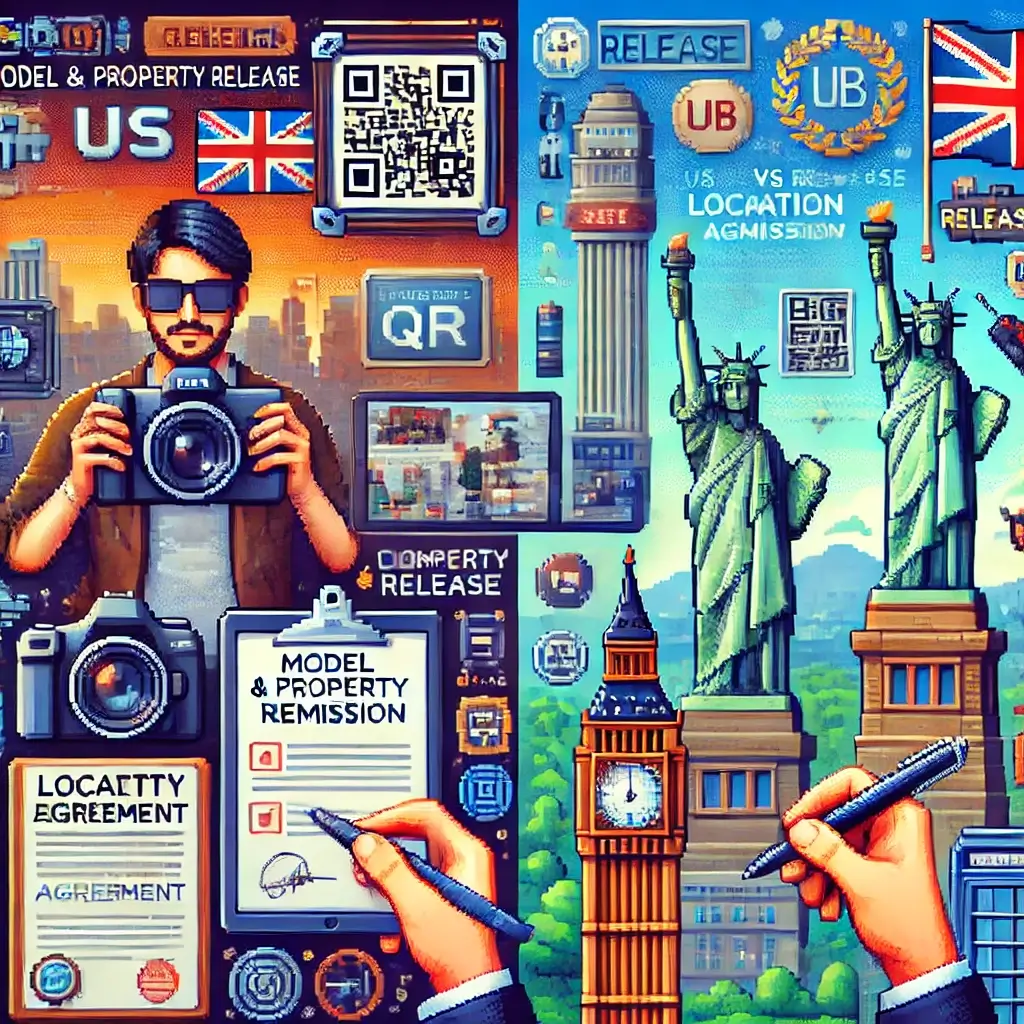
Here’s the operator-level difference. In the US, enforceability hinges on state-level rights of publicity and privacy—plus contracts and trademark. In the UK, there’s no broad “publicity right,” but you can still get in trouble via misuse of private information, data protection, passing off (false endorsement), or other torts. Practically? Releases are the cleanest way to demonstrate consent in both places, especially when money is involved.
United States (fast map): If an identifiable person is used in advertising or trade without consent, they can sue under right of publicity (statutory/common law). Editorial use is typically protected, but endorsements and ads are not. Some states add post-mortem rights. Property: you generally may photograph buildings from public places, but commercial uses that imply sponsorship or contain visible trademarks may raise separate issues. Venues can enforce “no commercial photography” policies via contract/trespass.
United Kingdom (fast map): No general publicity right, but you still shouldn’t imply endorsement without consent. If a person is identifiable, their image can be “personal data,” bringing UK GDPR into play (lawful basis, transparency). False endorsement can be tackled via passing off (think celebrity voice on an ad without consent). Interiors and private land are governed by property/contract rules; owners can require permission for commercial shoots and remove you for trespass. Editorial/documentary uses remain freer, but context matters; don’t create a misleading impression or reveal private information.
In both systems, your paperwork is a shield. A signed release with clear scope drastically reduces takedown risk, refund risk, and the “we need to reshoot” budget crater.
- US: Assume you need a release for ads/promotions involving identifiable people.
- UK: Assume you need consent where endorsement is implied or personal data is processed for marketing.
- Everywhere: Venues and brands enforce their own rules. Read the sign. Ask the manager.
Personal note: I once cleared a London café campaign in 24 hours by aligning three documents—location agreement, model releases, and a clear privacy notice in-store. Cost: £180 for a solicitor’s quick review; value: a £28,000 project that ran for six months without a single query.
Show me the nerdy details
US states vary on publicity statutes and post-mortem rights. UK “passing off” requires goodwill, misrepresentation, and damage—celebrity cases often succeed on this theory. Data protection adds another layer: if you’re determining purposes/means for processing identifiable images for marketing, you’re likely a controller; document your lawful basis, retention, and rights.
- US: publicity rights.
- UK: passing off + privacy + data protection.
- Contract beats confusion.
Apply in 60 seconds: Add “Consent + Venue OK + Privacy Note” to your preflight list.
model and property release: Commercial vs editorial—where the line really is
Think of “editorial” as news, commentary, or public interest storytelling. “Commercial” is persuasion—ads, endorsements, promos. The gray zone is branded content: a founder interview on a company blog, for instance, or a case study promoted with paid spend. If the audience could think “this person supports this brand,” you’re in commercial territory. That’s your cue to have a release in the file.
Editorial doesn’t equal “anything goes.” You still can’t mislead, invade privacy in a private place, or defame. Conversely, commercial use with a strong release can be very safe—even with sensitive contexts—if your scope is clear and respectful.
- Editorial: lower legal risk; reputational risk still matters.
- Commercial: higher legal review; better budgets; secure releases.
- Branded editorial: treat as commercial if in doubt; it saves emails later.
Anecdote: A tech client wanted to use a conference attendee’s photo on a billboard. We declined and re-shot with a paid model and clear releases. Cost us $1,200; saved a potential $10k+ in reprinting and goodwill damage. Boring? Maybe. Profitable? Yes.
Show me the nerdy details
US: commercial use triggers right-of-publicity analysis; editorial typically protected by the First Amendment. UK: no First Amendment equivalent, but editorial/public interest weighs heavily; commercial implications push toward passing off/data protection scrutiny.
model and property release: Street, events, and public places
Street photography is beautiful—and a legal gym. In general, photographing people in public is lawful. Selling those photos as art or editorial is often fine. Turning them into ads without consent? That’s where risk spikes. Festivals, conferences, and ticketed events are not a free-for-all; the small text on your badge often doubles as a contract. If you’re hired by the organizer, get releases baked into ticket terms or capture them on site.
Uniforms, logos, distinctive tattoos, or house numbers make someone more identifiable. If you plan future commercial use, either obtain a release, frame out identifiers, or blur/post-process. (Yes, blurring is legal triage; no, it’s not always pretty.)
Story: My fastest win was a 10-second sidewalk conversation. “Hey, I’m shooting a small paid project for a local coffee brand. Could we do a quick portrait? I’ll send the photo. Here’s the form.” Smiled, signed, done. We closed five portraits in 22 minutes because we asked cleanly and compensated fairly.
- Ticketed venues ≠ public sidewalks.
- Brand-heavy backgrounds raise endorsement vibes.
- Plan your frames; plan your paperwork.
Show me the nerdy details
Venue terms set by private property owners are enforceable via contract/trespass. Distinctive architecture can have trademark implications in commercial uses if it suggests endorsement, even though the act of photographing from public streets is typically allowed.
- Read event terms.
- Use quick scripts for releases.
- Avoid “accidental endorsement.”
Apply in 60 seconds: Add a “Street Script” note to your phone with your 1–2 sentence ask.
model and property release: Minors, groups, and crowds
Minors require a parent/guardian’s signature. Full stop. Group shots complicate things: if the focus is on a crowd and no single person is highlighted, editorial use is often acceptable; commercial use is another story. When one or two people are the clear subject, treat them as your models and get releases. Crowd scenes for ads? You’ll either secure releases from principal subjects or use hired talent.
Anecdote: At a youth sports event, we ran a “Photo & High-Five” booth. Parents scanned a QR, signed, and we photographed kids with consent. We shot 60 portraits in two hours and cleared usage for a sponsor’s social campaign without a single DM headache.
- Minors: guardian signature + consider extra clarity on uses/term.
- Schools/clinics: expect stricter policies; respect opt-out lists.
- Crowds: principal subjects need releases for commercial use.
Show me the nerdy details
For ad uses, aim for explicit consent from any identifiable person who appears as a focal subject. Consider higher standards around sensitive contexts (healthcare, religion, political events).
model and property release: Architecture, interiors, logos, and art
Property releases kick in when you monetize images of private spaces or distinctive properties. You can usually photograph building exteriors from public places. Interiors? That’s the owner’s rules. Retail chains, museums, and stadiums often prohibit commercial photography without permits; those rules are enforceable. Logos and trademarks aren’t forbidden wallpaper, but if your use implies endorsement—like a billboard using a person in front of a famous branded storefront—expect a call.
Consider artwork: public sculptures and murals may carry copyright; your use might be fair as editorial, but advertising them is different. Best move: reframe, crop, or obtain permission. We once pivoted a shot 15 degrees to avoid a mural with a known rights holder. It saved us a week of emails and a $500 license.
- Exteriors: fine from public vantage for editorial; ads need caution.
- Interiors: permission required for commercial use.
- Art/logos: avoid endorsement vibes or get permission.
Show me the nerdy details
Trademark law protects against consumer confusion; your safest path is either neutralize identifiable marks or obtain express permission for ad uses. For interiors, location agreements are your friend; confirm insurance requirements and liability.
- Get location agreements.
- Mind murals and logos.
- Don’t assume “public art” means “ad-ready.”
Apply in 60 seconds: Add a “Logo visible?” checkbox to your on-set checklist.
model and property release: The contracts stack (release + license + privacy)
Your release is one card in a small, sturdy house. The others: license (who can use what, for how long), location agreement (who owns/controls the space), and privacy/data paperwork (if processing personal data for marketing, you’ll document lawful basis and transparency). When these align, enforcement risk drops like a stone.
Real-world stack for an ad shoot:
- Model release: adults + minors, explicit ad/promotional scope, paid media allowed.
- Property release/location agreement: interior permissions, brand approvals, operating hours, certificate of insurance.
- License to client: non-exclusive, time-limited or perpetual, territories listed, permitted channels.
- Privacy notice: if capturing emails/faces for marketing, document your lawful basis; keep it short and honest.
I once unified these into a single “shoot pack.” It trimmed our approvals from five emails to one and shaved ~90 minutes off pre-pro. Clients notice that kind of competence. They pay for it, too.
Show me the nerdy details
Licenses move copyright; releases move consent; location agreements move access rights; privacy docs move transparency and legal basis. Keep them separate but coordinated; don’t bury privacy language inside a release if you actually need opt-in marketing consent.
model and property release: Workflow & tools (fast, digital-first)
Speed wins. Your minimum viable workflow: a pre-filled, mobile-friendly e-sign template; QR codes; cloud storage tied to asset IDs; and a release wrangler. Aim for sub-90-second signing. If it takes longer, people will wander off for coffee and never return.
Good/Better/Best:
- Good: One-page PDF, fillable, stored in a shared drive. Manual file naming. Costs $0–$10/month.
- Better: Dedicated release app with face capture, auto-filled metadata, CSV export. Costs $5–$20/month.
- Best: E-sign platform integrated with your DAM; auto-tag assets with ReleaseID; versioning and retention policy. $20–$60/month. Saves ~2–4 hours per project.
On a docu-style campaign, we shaved post-production by 25% simply because every signed release filename matched the RAW prefix. No scavenger hunts. No “who is this again?” Slack threads. Just approval bliss.
Operator tip: Put a tiny thumbnail of the subject in the signed PDF. Your future self will bless you during approvals.
- Speed converts consent.
- Metadata avoids chaos.
- Integrations save hours.
Apply in 60 seconds: Generate a QR to your release template and print it on your lanyard.
model and property release: Negotiation & ethics (ask without being weird)
People say yes when they feel respected, informed, and fairly compensated. Your script should be short, honest, and specific. Example: “I’m photographing a campaign for a local café. If you like the portrait, may we use it on posters and social? It takes 90 seconds to sign; I’ll email you the photo.” Add a modest stipend or gift card and watch your yes-rate climb.
Humor softens the ask, but don’t hide the ball. If it’s an ad, say so. If it includes paid social and billboards, say so. You’ll still get yeses—and you’ll sleep well.
- Be clear: who you are, the brand, and the channels.
- Be fair: pay or perk, even symbolic.
- Be kind: easy opt-out for non-ads (portfolio, blog), if you choose.
We once offered £25 gift cards for five quick portraits. Four signed; one declined. Zero drama. The campaign ran for three months with no take-down requests, and we earned a follow-on shoot. Transparency is not only ethical—it’s efficient.
Show me the nerdy details
Ethics isn’t a substitute for law, but it lowers friction and increases consent. Document any special sensitivities or promises (e.g., no political use). Your future self will thank you.
model and property release: Risk radar & insurance
Legal exposure hides in the edges: misleading endorsements, sensitive contexts, and venue rules. Build three guardrails: (1) a preflight checklist, (2) a review path for high-visibility uses, and (3) insurance sized to your deals. If you’re pushing six-figure media buys, consider a quick legal review—it costs a few hundred but can save five figures in fixes.
Insurance isn’t glamorous, but consider general liability and, where relevant, media liability for defamation/privacy claims tied to content. If you shoot in venues with strict terms, ask whether they require a certificate of insurance and list them as additional insured. Create a one-page risk playbook; revisit after any close call.
- High-visibility ads: legal review + fresh releases.
- New venues: read terms; confirm permits.
- Sensitive contexts: double-consent; consider anonymization.
A friend once spent $2,400 on a lawyer and avoided a $12,000 reprint. That math works every time.
Show me the nerdy details
Media liability policies vary on exclusions. If your work leans into edgy documentary/brand collabs, price that risk into your rates and budget for counsel.
- Checklist before shoot.
- Escalate big spends.
- Insure what hurts to replace.
Apply in 60 seconds: Add “legal review needed?” as a checkbox next to any media buy over $10k.
model and property release: Templates & checklists (Good/Better/Best)
If you’re evaluating tools/services to buy this week, here’s a pragmatic menu:
Good (free/cheap): Fillable PDFs, cloud drive, manual naming. Pros: cost; works offline. Cons: slow; error-prone. Expect ~20–30 minutes admin per model.
Better (low monthly): Lightweight release apps with camera roll attachment, signer photo, CSV export. Pros: ~60–90 seconds per model; searchable. Cons: vendor lock-in; export discipline required.
Best (pro stack): E-sign platform integrated with your DAM, automated ReleaseID tagging, retention policies, and role-based access. Pros: scales to teams; audit trails; ~40–60 seconds per model. Cons: $25–$60/month; initial setup ~2 hours.
- Buy for the job you have in 90 days, not today.
- Test the mobile signer flow yourself—standing, in the wind, one-handed.
- Standardize file naming:
YYYYMMDD_Project_Shot_Model_ReleaseID.pdf
One-week ROI story: We switched a client from paper to a basic e-sign tool. The team saved ~3.5 hours on a two-day shoot and eliminated a $400 reshoot caused by a missing form. Small spend, fast return.
Show me the nerdy details
Look for features: signer selfie, checkbox for ad/paid social, minor guardian field, location agreement variant, IPTC integration, CSV export. Bonus: webhook or Zapier to auto-file in your DAM.
- Speed over features.
- Export discipline matters.
- Integrate or automate filing.
Apply in 60 seconds: Time your own signer flow; if it’s over 90 seconds, fix one bottleneck.
Model & Property Release: Quick Decision Flow
US vs UK: Release Enforceability
| Aspect | United States | United Kingdom |
|---|---|---|
| Publicity Rights | State-level laws; strong in ads | No standalone right; passing off |
| Editorial Use | Protected by First Amendment | Balanced by privacy/data protection |
| Commercial Use | Requires release; endorsement risk | Consent if endorsement implied |
Your 60-Second Release Checklist
FAQ
Q1. Do I always need a release to sell prints?
A: Not always. Selling art prints/editorial work featuring people in public places is often permitted. For ads or brand promotions, get a release.
Q2. Is a release enforceable if I paid the model nothing?
A: Yes, releases are contracts; consideration can be nominal (e.g., a token amount or benefit). Paying fairly is smart business, but $0 doesn’t automatically void a release if consideration is otherwise present.
Q3. Do I need a property release for building exteriors?
A: Usually no from public places for editorial. For advertising, check for distinctive/trademarked designs and venue rules; when in doubt, obtain permission.
Q4. Can I revoke a release after signing?
A: Typically no, unless the contract allows revocation. That’s why scope and term clarity matter.
Q5. What about UK data protection?
A: If an image identifies a person and you’re using it for marketing, you’re likely processing personal data. Document your lawful basis, retention, and transparency. Keep it short and plain-English.
Q6. Are social media posts “commercial”?
A: Organic posts showing an event or team can be lower risk, but if a post is part of a campaign that sells, promotes, or is boosted with ad spend, treat it as commercial.
Q7. How long should the term be?
A: Match the media buy. Many creators use 2–5 year terms for ads and perpetual for portfolio/editorial, but align with client budgets and talent expectations.
Conclusion
Earlier, I promised you’d know exactly when a release is enforceable and how to move fast without breaking trust. Here’s the close: map your use (editorial vs commercial), identifiability, and space rules; then run a 90-second, QR-to-sign workflow with clear scope. Maybe I’m wrong, but if you do just that, you’ll ship more campaigns, dodge expensive reshoots, and free up four to six hours a month for the creative work you actually enjoy. Your next 15-minute step: pick a tool, generate your template, print a QR, and add “Release?” to your shot list. You’ll feel the difference on your very next shoot.
Keywords: model and property release, right of publicity, passing off, editorial vs commercial, release workflow
🔗 DMCA Takedown Posted 2025-09-08 06:24 UTC 🔗 Commissioned Art License Agreement Posted 2025-09-07 02:00 UTC 🔗 Copyright Small Claims Posted 2025-09-06 03:49 UTC 🔗 NFT Tax Reporting Posted 2025-09-01 UTC