
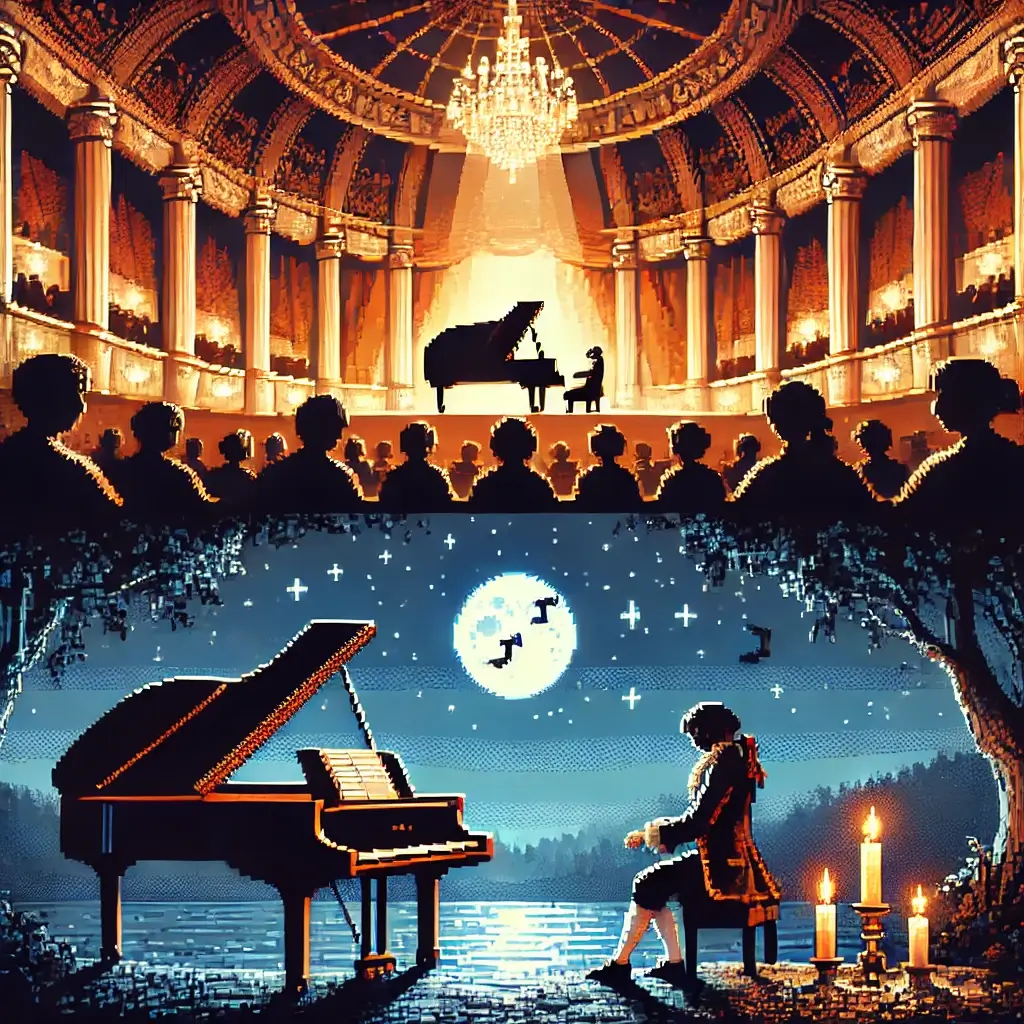
Mozart’s 21st Piano Concerto: A Timeless Masterpiece That Will Stir Your Soul!
Have you ever heard a piece of music that just stops you in your tracks?
A melody so utterly beautiful, so profoundly moving, that it feels like it was written just for your heart?
For me, and for countless others across centuries, that piece is undoubtedly Wolfgang Amadeus Mozart’s Piano Concerto No. 21 in C Major, often lovingly nicknamed “Elvira Madigan,” K. 467.
It’s more than just notes on a page; it’s an experience, a journey through joy, sorrow, and an almost divine elegance that only Mozart could conjure.
If you’re new to classical music, or even if you’re a seasoned aficionado, this is one concerto you simply *must* dive into.
It’s not just a classic; it’s a revelation.
And trust me, once you hear it, you’ll understand exactly what I mean.
Table of Contents
Beyond the “Elvira Madigan” Moniker: Why This Concerto Shines Bright
Let’s be real, most people know this concerto because of its appearance in the 1967 Swedish film “Elvira Madigan.”
And while that film certainly brought this particular Mozart Piano Concerto to a wider audience, reducing it to just its cinematic association is like saying the Mona Lisa is famous only because it’s on a coffee mug.
It’s so much more than that.
This Mozart concerto, K. 467, stands on its own as a monumental achievement in classical music.
It’s a testament to Mozart’s unparalleled ability to weave intricate musical tapestries that speak directly to the human spirit.
It’s vibrant, it’s introspective, it’s dazzling, and it’s deeply, deeply profound.
It’s a piece that has fascinated me for years, drawing me back again and again, like an old friend with endless stories to tell.
Every time I listen, I discover something new, a hidden nuance, a subtle shift in emotion that I hadn’t noticed before.
That’s the magic of Mozart’s 21st Piano Concerto – it truly rewards repeated listening.
The Unrivaled Genius of Wolfgang Amadeus Mozart: A Glimpse into His World
Before we dive deep into the concerto itself, let’s take a moment to appreciate the man behind the music: Wolfgang Amadeus Mozart.
Born in Salzburg in 1756, this prodigy showed extraordinary musical talent from a ridiculously young age.
He was composing by five, performing for royalty by six – I mean, talk about an overachiever!
But beyond the child prodigy phenomenon, Mozart matured into one of the most prolific and influential composers of all time.
He wrote over 600 works, including operas, symphonies, chamber music, and, of course, these magnificent piano concertos.
His music is characterized by its incredible melodic beauty, its structural perfection, and an emotional range that goes from the lightest, most playful moments to the deepest, most heart-wrenching despair.
He had this uncanny ability to blend elegance with profound emotion, creating music that feels both perfectly balanced and utterly spontaneous.
It’s this very genius that flows through every note of Piano Concerto No. 21.
He wasn’t just writing notes; he was painting vivid soundscapes, crafting narratives without words, and expressing the full spectrum of human experience.
You can literally feel his passion and brilliance radiating from the score.
A Whirlwind of Creation: The Historical Context of K. 467
Now, let’s set the scene for the creation of this stunning Mozart Piano Concerto.
Mozart wrote his Piano Concerto No. 21 in 1785, during what many consider to be his “golden age” in Vienna.
This was a period of incredible productivity and success for him.
He was not only composing masterpieces like “The Marriage of Figaro” but also performing regularly as a virtuoso pianist, often premiering his own concertos.
Think about that for a second: he was writing these incredibly complex pieces, often for his own concerts, sometimes finishing them just days or even hours before the premiere!
It’s mind-boggling.
K. 467 was premiered on March 9, 1785, at a concert in Vienna, with Mozart himself at the keyboard.
Can you imagine being in that audience, hearing this breathtaking music for the very first time, played by the composer himself?
It must have been absolutely electrifying.
This was a time when the piano concerto was evolving, and Mozart was at the forefront, pushing its boundaries, making the solo instrument an equal partner with the orchestra, engaged in a dialogue rather than just showing off.
This concerto is a perfect example of that sophisticated interplay.
He really understood how to make the piano sing, how to make it converse with the various orchestral sections – it’s like a beautifully choreographed dance between the soloist and the ensemble.
Movement I: Allegro Maestoso – A Grand Overture to Brilliance
The first movement, Allegro Maestoso, kicks things off with an immediate sense of grandeur and purpose.
It’s in C Major, a key often associated with brightness and triumph, and Mozart really leans into that.
The orchestra begins with a noble, almost march-like theme, full of grace and power.
It feels like stepping into a sunlit palace, don’t you think?
Then, the solo piano enters, not with a flourish, but with a more lyrical, almost questioning theme, gently unfolding.
This interplay between the orchestra’s robust pronouncements and the piano’s more intimate reflections is a hallmark of the movement.
Mozart expertly weaves multiple themes, developing them, transforming them, and allowing them to interact in a sophisticated, conversational manner.
There are moments of sparkling virtuosity for the piano, where it simply dances across the keyboard with breathtaking agility.
But it’s never just about technical display; every run, every arpeggio, serves the musical narrative.
It’s like watching a master orator, whose words are not just beautiful but also carry profound meaning.
This movement is a masterclass in classical form, yet it never feels rigid or academic.
It’s alive, breathing, and full of vibrant energy, setting the stage perfectly for what’s to come in this iconic Mozart concerto.
Movement II: Andante – The Heart of the Matter, the Soul of “Elvira Madigan”
Ah, the second movement. The one, the only, the truly unforgettable Andante.
This is the movement that gives the Mozart Piano Concerto No. 21 its “Elvira Madigan” nickname, and for good reason.
It’s in F Major, a parallel key to C Major, but here, the mood shifts dramatically to one of serene beauty, profound melancholy, and an almost unbearable tenderness.
When those strings begin that unbelievably simple, yet utterly sublime melody, it feels like time itself slows down.
The piano enters with a hushed, almost whispered response, and then takes up the melody, transforming it into something even more ethereal.
It’s a melody that will haunt you, in the best possible way, long after the music has faded.
Many describe it as “heavenly,” and I couldn’t agree more.
It’s pure, unadulterated emotion, expressed with such exquisite restraint and grace.
There are moments of aching beauty, brief flashes of light, and then a return to that central, heart-achingly lovely theme.
It’s often cited as one of the most beautiful pieces of music ever written, and honestly, I don’t think that’s an exaggeration.
This is the kind of music that makes you pause, reflect, and perhaps even shed a tear or two.
It touches a universal chord, speaking of love, loss, longing, and the profound beauty of human experience.
It’s the movement that makes this Mozart concerto truly legendary.
It’s the very soul of the piece, and it’s where Mozart’s genius for expressing deep emotion through simple, elegant means shines brightest.
Movement III: Allegro Vivace Assai – A Dazzling, Spirited Finale
After the profound introspection of the Andante, the third movement, Allegro Vivace Assai, bursts forth with infectious joy and boundless energy.
It’s back in C Major, and it’s a rondo, a form where a main theme keeps returning, interspersed with contrasting sections.
This movement is pure delight, a glittering display of Mozart’s playful side.
The main theme is irresistibly catchy, light-hearted, and full of spirited charm.
It’s like a sparkling conversation, full of witty remarks and playful banter between the piano and the orchestra.
The piano gets to show off its virtuosity here, with dazzling runs, brilliant arpeggios, and quick, nimble passages that demand incredible precision and lightness of touch.
But again, it’s not just flash; there’s a structure and purpose to every note.
Mozart weaves in delightful little surprises, unexpected turns of phrase, and charming melodic fragments that keep the listener utterly engaged.
It feels like a grand celebration, a joyful affirmation of life, leaving you with a sense of exhilaration and pure contentment.
It’s the perfect, high-spirited conclusion to one of Mozart’s most beloved and enduring works, tying together all the emotional threads of the 21st Piano Concerto with a flourish.
It sends you off feeling uplifted and utterly charmed by the sheer brilliance you’ve just experienced.
Why Does This Mozart Concerto Endure? Its Timeless Appeal
So, why has Mozart’s Piano Concerto No. 21 captivated audiences for over two centuries?
It’s not just the “Elvira Madigan” connection, I assure you.
Firstly, there’s the sheer melodic beauty.
Mozart had an unparalleled gift for melody, and this concerto is overflowing with memorable tunes that are both exquisitely crafted and immediately appealing.
They stick with you, long after the music has stopped.
Secondly, it’s the emotional depth.
While the first and third movements are full of joy and sparkle, the second movement delves into a profound emotional landscape that resonates with everyone.
It’s a perfect balance of light and shade, joy and introspection.
Thirdly, the perfect balance between the soloist and the orchestra.
It’s not just a showpiece for the piano; it’s a true dialogue, a conversation between equals.
Each instrument, each section, plays a vital role in the overall tapestry of sound.
And finally, it’s the sense of effortless grace and perfection.
Mozart’s music often feels divinely inspired, as if it simply flowed from him without effort, even though we know he worked tirelessly.
This concerto embodies that feeling – a masterpiece of seemingly boundless invention and flawless execution.
It’s a piece that transcends time and culture, speaking a universal language that continues to move and inspire.
It’s a testament to the enduring power of great art.
My Own Journey with K. 467: A Deeply Personal Connection
I remember the first time I truly *heard* the Andante of Mozart’s 21st Piano Concerto.
I was in college, utterly stressed out with exams, and stumbled upon a recording.
It was like a balm for my soul.
The world just melted away, and for those few minutes, nothing else mattered.
It wasn’t just background music; it was a profound emotional experience.
Since then, it’s become one of my go-to pieces whenever I need comfort, inspiration, or simply a reminder of the sheer beauty that exists in the world.
I’ve listened to countless different performances, each bringing out different nuances, different colors, but the core magic remains.
It’s a piece that grows with you.
What I loved about it ten years ago is still true, but now I appreciate its complexities and subtleties even more.
It’s like discovering new layers in a cherished book, or finding new details in a beloved painting.
This Mozart concerto has been a constant companion on my musical journey, a source of endless fascination and deep personal joy.
It reminds me that even in moments of chaos or sadness, there’s always something beautiful to hold onto.
Experiencing K. 467: Tips for the Listener
If you’re ready to dive into Mozart’s 21st Piano Concerto, here are a few tips to enhance your listening experience:
First, find a good recording.
There are hundreds out there, but some standouts include performances by Murray Perahia, Mitsuko Uchida, or Daniel Barenboim.
Each pianist brings their unique interpretation, so explore a few and see what resonates with you.
Second, listen actively.
Don’t just have it on in the background.
Sit down, close your eyes, and really pay attention to the interplay between the piano and the orchestra.
Notice how the themes develop, how the mood shifts, and how Mozart builds tension and release.
Third, if you can, try to experience it live.
There’s nothing quite like hearing a full orchestra and a brilliant pianist performing this masterpiece in a concert hall.
The acoustics, the energy, the shared experience with other listeners – it’s truly unforgettable.
And finally, allow yourself to feel.
Don’t try to analyze every note.
Just let the music wash over you, and see where it takes you emotionally.
This is music for the heart, not just the head.
The Enduring Legacy of Mozart’s 21st Piano Concerto
The impact of Mozart’s Piano Concerto No. 21 extends far beyond just classical music enthusiasts.
Its iconic second movement has permeated popular culture, appearing not just in “Elvira Madigan” but also in countless commercials, TV shows, and even video games.
This widespread recognition speaks volumes about its universal appeal.
It’s a piece that has introduced generations to the beauty of classical music, serving as a gateway to Mozart’s vast repertoire and the broader world of orchestral works.
For aspiring pianists, it’s often a rite of passage, a challenging yet incredibly rewarding piece to learn and perform.
Its structural perfection and emotional depth continue to inspire composers, musicians, and artists across various disciplines.
It’s a testament to the power of art to transcend its original time and place, to continue speaking to new generations with fresh relevance.
This concerto is a living, breathing work of art, constantly reinterpreted and rediscovered, ensuring its place in the pantheon of greatest musical compositions.
It’s a beacon of beauty in a sometimes-turbulent world, a reminder of the enduring power of human creativity.
And that, my friends, is a legacy worth celebrating.
Don’t Just Listen, Feel: The Immortal Magic of Mozart’s Piano Concerto No. 21
So, there you have it – a glimpse into the mesmerizing world of Wolfgang Amadeus Mozart’s Piano Concerto No. 21 in C Major, K. 467.
Whether you know it as “Elvira Madigan” or by its formal title, its power to move and enchant is undeniable.
It’s a piece that reminds us of the profound beauty that human genius can create, a work that speaks directly to the soul.
If you haven’t had the pleasure of truly immersing yourself in this particular Mozart concerto, I urge you to do so.
Put aside distractions, find a quiet moment, and let its sublime melodies wash over you.
I promise you, it will be an experience you won’t soon forget.
It’s not just music; it’s a journey, an emotion, a timeless conversation with one of history’s greatest minds.
Dive in, and let Mozart’s 21st Piano Concerto sweep you off your feet!
—
Want to explore more about Mozart or classical music?
Check out these fantastic resources:
Britannica: Wolfgang Amadeus Mozart
Wolfgang Amadeus Mozart, Piano Concerto No. 21, K. 467, Elvira Madigan, Classical Music, Masterpiece