
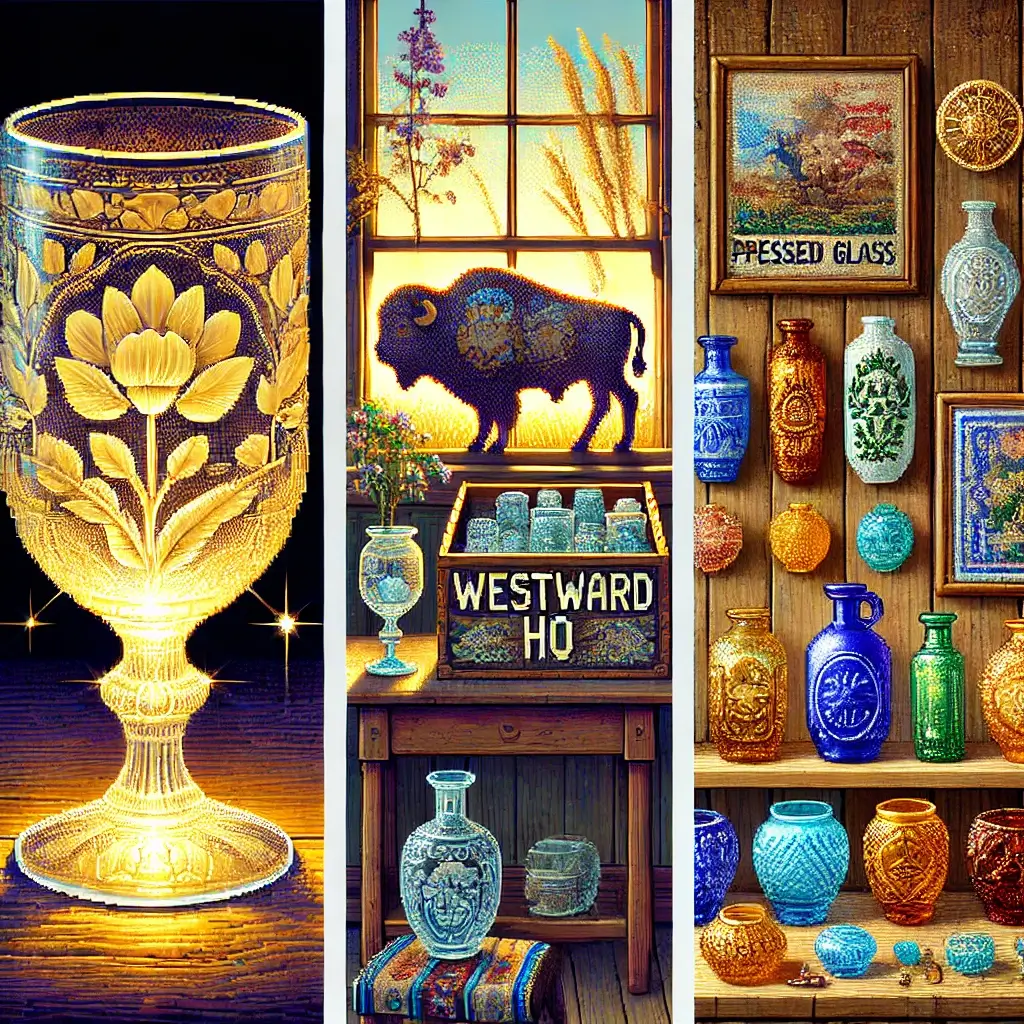
The 7 Glass Patterns That Can Make You a Pressed Glass Millionaire!
Hello, fellow treasure hunters and glass fanatics!
Let me tell you a little secret.
I still remember the first time I held a piece of Early American Pressed Glass, or EAPG as we insiders call it.
It was a frosty January morning, and I was shivering my way through a dusty old barn sale, my breath puffing out like a steam train.
There, tucked away on a rickety shelf, was a small, unassuming jelly compote.
It was covered in a layer of grime you could practically scrape off with a spoon.
But something about the way the light hit its intricate, almost lace-like patterns caught my eye.
I picked it up, wiped a spot clean with my thumb, and my heart did a little flutter.
It wasn’t just glass; it was a story, a piece of American history you could hold in your hand.
That day, I paid a whopping five dollars for it.
That little piece of glass, it turns out, was a rare pattern called “Frosted Lion.”
I sold it at auction a few years later for a very pretty penny.
That, my friends, is the magic and the madness of collecting EAPG.
It’s a world where you can find a forgotten treasure in a junk shop, and with a little knowledge and a keen eye, you can turn a five-dollar investment into something truly special.
So, you’ve probably seen these beautiful, often ornate glass pieces at antique shops, flea markets, or even your grandmother’s house.
You’ve admired their beauty, but you’ve wondered:
What makes one piece worth a few bucks while another is a museum-worthy rarity?
How do you even begin to tell the difference?
If you’re ready to embark on this journey with me, to become a Sherlock Holmes of glass, then you’ve come to the right place.
We’re going to dive deep into the fascinating, and sometimes frustrating, world of Early American Pressed Glass.
We’re going to talk about how to recognize those elusive patterns and, most importantly, what makes certain pieces so incredibly rare and valuable.
We’ll talk about patterns that can actually change your financial situation—no kidding!
This isn’t just a guide; it’s your roadmap to becoming a savvy EAPG collector.
So, grab a cup of coffee, or a glass of water from a beautiful old pressed glass tumbler, and let’s get started.
First things first, let’s get a lay of the land.
Here’s a quick-and-dirty table of contents to guide you through this treasure trove of information:
Table of Contents
What Exactly IS Pressed Glass Anyway?
A Quick Dip into the History of EAPG
Mastering Pattern Recognition: Your Secret Weapon
The Holy Grail: What Makes a Piece of Glass Rare?
The 7 Rarest and Most Valuable EAPG Patterns
Spotting Fakes and Reproductions: Don’t Get Scammed!
What Exactly IS Pressed Glass Anyway?
Before we can get to the good stuff—the rare patterns and the big money—we need to understand what we’re even talking about.
Imagine this: It’s the early 19th century.
Glass is expensive, a luxury item for the wealthy.
It’s all blown glass, shaped by a master artisan’s breath and skill.
Think of those fancy, delicate Venetian goblets.
Then, along comes a brilliant idea in America.
Instead of blowing glass, why not press it into a mold?
This was a game-changer, like going from hand-carved furniture to mass-produced, affordable pieces.
Molten glass was poured into a mold, and a plunger pressed it down, forcing the glass into every nook and cranny of the design.
The result?
Complex, decorative, and beautiful glassware that could be made quickly and, most importantly, cheaply.
This made glass tableware accessible to the average American family for the first time.
It was a true revolution in manufacturing and design.
So, when we talk about Early American Pressed Glass, we’re generally referring to glass made using this method between the 1820s and roughly the turn of the 20th century.
After that, the term can get a little blurry, but the golden age is considered to be the mid-to-late 19th century.
So, how do you tell the difference between blown glass and pressed glass?
It’s not always easy, but here’s a quick cheat sheet for you.
Pressed glass will often have mold lines or seams where the two halves of the mold met.
Blown glass usually has a pontil mark on the bottom—a rough, scarred spot where the pontil rod was broken off.
Pressed glass bottoms, on the other hand, are often smooth or have a simple, pressed design.
Sometimes you’ll see mold lines running right through the base, a dead giveaway.
This technique allowed for those incredibly intricate, repeated patterns that we collectors go absolutely crazy for.
A Quick Dip into the History of EAPG
The story of EAPG is the story of America’s industrial revolution.
The first patent for a pressed glass machine was filed in 1825, and within a few decades, glass factories popped up all over the northeastern United States.
The most famous ones were in New England and Pennsylvania, with names that still ring bells today: Sandwich Glass, Gillinder & Sons, and countless others.
They cranked out everything from goblets and plates to celery vases and butter dishes.
Each factory, and sometimes even individual mold makers, had their own distinct style, their own signature.
They created patterns that reflected the times—floral motifs, historical events, patriotic symbols, and even animals.
It was a golden age of glass design, and the sheer variety is mind-boggling.
Think about it: at a time when most people had very simple, utilitarian dishes, suddenly they could own beautiful, decorative pieces that sparkled on their dining room tables.
The glass was a sign of prosperity, of a growing middle class, and of a nation on the rise.
This history is a huge part of the appeal for collectors.
When you’re holding a piece, you’re not just holding a cool object; you’re holding a tangible link to the past.
You’re holding a piece of a Thanksgiving table from 1880, a butter dish that might have sat on a farm family’s table in Ohio, or a goblet that clinked at a New Year’s Eve party in Boston.
It’s the human connection that makes it so much more than just a hobby.
Mastering Early American Pressed Glass Pattern Recognition: Your Secret Weapon
This, my friends, is where the rubber meets the road.
Pattern recognition is the most crucial skill you can develop as an EAPG collector.
It’s like being able to identify a rare coin by the tiniest detail or spotting a genuine vintage car part in a sea of rust.
A non-collector sees a pretty piece of glass.
You, my soon-to-be expert, will see a “Loop” pattern from the 1840s or a “Pleat and Panel” celery vase from the 1870s.
The patterns are the keys to the kingdom, the names that unlock the value and the history of each piece.
So, how do you learn them?
First, you need to understand that the names can be a bit… creative.
Some patterns were named by the original manufacturers, but many more were named by early collectors and researchers in the 20th century.
This means you have to be careful with terms and use reliable sources.
The most important tool in your arsenal is a good reference book or a trusted online database.
You can’t be expected to memorize thousands of patterns overnight.
It’s a gradual process, but I promise you, it’s a lot of fun.
Start with the big, recognizable motifs.
Look for things that stand out, like animals, historical figures, or distinctive shapes.
Take the “Westward Ho!” pattern, for example.
It’s one of the most famous and, as we’ll discuss later, one of the most valuable.
It features pioneers, buffalo, log cabins, and a frontiersman on horseback.
Once you see it, you’ll never forget it.
Another great example is the “Lion” pattern.
There’s a frosted lion’s head on the finial of the lid, sometimes a reclining lion on the base.
These big, bold motifs are a great way to start building your mental library of patterns.
But what about the more abstract patterns, like “Diamond Point” or “Honeycomb”?
This is where you need to get up close and personal with the glass.
Run your fingers over the surface.
Feel the raised texture, the lines, the dots, the little rosettes.
Look at the way the light refracts through the different angles.
A good piece of pressed glass will have a satisfying heft to it, and the pattern will feel deliberate, not like an afterthought.
I’m not going to lie; sometimes it’s hard.
Sometimes you’ll see two patterns that look almost identical, and the only difference is the number of dots in a particular row or the shape of a tiny leaf.
This is where your reference books and trusted online resources become your best friends.
Here’s a little trick I’ve used for years: Take a good, clear picture of the piece, especially the pattern.
Then, use a reverse image search on Google, or even better, a specialized glass identification website.
It’s not foolproof, but it can often point you in the right direction.
Another thing to pay attention to is the color.
While most EAPG is clear, or what we call “flint” glass, certain patterns were made in rare colors like amber, vaseline (a pale yellow-green that glows under blacklight), blue, or even a deep, dark amethyst.
A common pattern in a rare color can be worth far more than a rare pattern in a common clear color.
The combination of pattern and color is often the key to unlocking a piece’s true value.
The Holy Grail: What Makes a Piece of Glass Rare?
This is the fun part, the part that gets your blood pumping.
We’ve all heard the stories: the woman who found a butter dish at a thrift store for a dollar and sold it for thousands.
Those stories aren’t just myths; they’re the reality of the EAPG world.
So, what makes one piece of glass a common dime-a-dozen find and another a five-figure unicorn?
It’s a combination of several factors.
First and foremost is production numbers.
Some patterns were immensely popular and were made for decades by multiple factories.
Others were made for a very short period, sometimes only for a year or two, by a single small company.
The shorter the production run, the fewer pieces are out there, and the more valuable they become.
Think of it like a limited-edition art print versus a mass-produced poster.
Then there’s condition.
This is a big one.
Glass is fragile, obviously.
Finding an EAPG piece from the 1880s without any chips, cracks, or serious scratches is a feat in itself.
A perfect piece of a rare pattern is worth exponentially more than a damaged one.
When you’re hunting, always, always, always run your finger along the rim, the edges, the base.
Feel for any nicks or tiny chips.
They can be hard to see with the naked eye, but your fingertips will find them.
Don’t be afraid to take your time and inspect every square inch.
Another factor is the form or shape of the piece.
Some patterns were made into a wide range of forms: plates, platters, goblets, tumblers, and compotes.
But some forms within a popular pattern are rare themselves.
For example, a bread plate in a certain pattern might be common, but a rare celery vase or an unusual water pitcher in that same pattern could be worth hundreds or thousands more.
The real holy grail pieces are often those obscure forms that were produced in very limited numbers.
Finally, there’s color, as I mentioned before.
While most EAPG was made in clear flint glass, some patterns were also produced in a handful of colors.
A piece in a deep sapphire blue or a vibrant amber can send its value skyrocketing.
A great example is the “Lacy” period glass from the 1820s-1850s.
These intricate, nearly paper-thin patterns are stunning in clear glass, but find a piece in cobalt blue, and you’ve found a truly special, and valuable, item.
The 7 Rarest and Most Valuable Early American Pressed Glass Patterns
Alright, this is what you came here for.
Let’s talk about the legends, the patterns that make experienced collectors’ eyes light up.
These are some of the most sought-after and valuable EAPG patterns in existence.
Finding any of these in a perfect, undamaged state is a true accomplishment.
Get your mental flashcards ready!
1. Westward Ho!
Ah, the king of them all.
This pattern, made by Gillinder & Sons in Philadelphia around 1879, is an icon.
It was created to commemorate the centennial of American independence and the nation’s westward expansion.
The pieces feature pioneers, a buffalo, and a log cabin scene.
Most pieces are frosted, but the clear versions are also highly sought after.
The rarity and desirability of this pattern are largely due to its iconic, uniquely American design and the relatively short production period.
A full set of this pattern, especially with perfect pieces, is the dream of many a collector.
A Westward Ho! covered butter dish or covered sugar bowl can fetch thousands of dollars at auction, especially if the frosted details are still crisp and undamaged.
2. Frosted Lion
This is the pattern that started my own collecting journey.
It’s another masterpiece from Gillinder & Sons, made around the same time as Westward Ho!.
The pattern is famous for its detailed frosted lions’ heads on the finials and bases, which are often reclining or standing guard.
There are multiple variations, but all feature the distinct, proud lion.
What makes this pattern so valuable is the intricate frosting, which is often worn or chipped on lesser pieces.
A complete set, in mint condition, can easily command a five-figure sum.
Keep a close eye out for a covered compote or a jam jar with this pattern; they are particularly rare and valuable.
3. Early Thistle
This pattern, also known as “Thistle” or “Scottish Thistle,” is one of the more graceful and elegant EAPG patterns.
It’s an older pattern, often attributed to the Boston & Sandwich Glass Company, dating to the mid-19th century.
The pattern features a detailed thistle design, a symbol of Scotland.
While the pattern itself is beautiful, what truly makes it rare and valuable are the pieces made in colors like cobalt blue, amethyst, or a milky opal.
A clear piece might be a nice find, but a colored piece in this pattern is a serious collector’s item.
The scarcity of colored examples is what drives the market for this pattern.
Be on the lookout for pieces like goblets or wine glasses in these vibrant hues.
4. Lacy Glass
This isn’t a single pattern, but a whole category of EAPG from the earliest period, roughly 1825-1850.
It’s called “Lacy” because of the incredibly fine, intricate, and densely packed patterns that resemble lace.
These pieces are often wafer-thin and fragile, which is why so many have not survived intact.
They are the pioneers of pressed glass, the first to show what the technology could do.
Because of their age, fragility, and the complexity of the molds, finding a perfect, undamaged piece of Lacy glass is a major event.
The patterns often feature geometric designs, stippling, and elaborate borders.
Finding a complete plate or a perfect cup is like finding a genuine artifact.
The most sought-after pieces are in unusual forms or rare colors, especially a deep blue or a fiery red.
5. Vaseline Glass Patterns
Again, this is more of a color category, but it’s one that contains some of the rarest and most valuable pieces.
Vaseline glass is a pale yellowish-green glass that contains uranium dioxide, and its most distinguishing feature is that it glows a brilliant fluorescent green under a blacklight.
This glowing quality is a powerful hook for collectors.
While many EAPG patterns were made in vaseline glass, certain patterns are particularly rare and valuable in this color.
Pieces in patterns like “Shell and Tassel” or “Panelled Daisy” can be highly collectible in vaseline glass.
The key here is to always carry a small blacklight with you when you’re hunting.
You never know when you’ll find a hidden glowing treasure among the everyday clear glass!
6. Canadian National Exhibition (CNE) Glass
This is a niche, but incredibly valuable, category.
Beginning in 1904, the Canadian National Exhibition gave away commemorative glass items to attendees.
These are often referred to as “CNE Glass” and are highly prized by collectors.
The pieces are not EAPG in the strictest sense, but they are from the tail end of the pressed glass era and are considered “early” pressed glass by many.
The rarity comes from the fact that they were limited-edition giveaways and many have been lost or broken over the decades.
Keep an eye out for any glass with the initials “CNE” or designs related to Canada, especially in colors like amethyst or emerald green.
Finding one of these is like finding a golden ticket.
7. Beaded Oval and Scroll
This is a fantastic example of a pattern where the color makes all the difference.
The pattern, produced by the Riverside Glass Company around 1890, features beaded ovals and scrolls.
In clear glass, it’s a lovely but relatively common find.
However, pieces in a vibrant, almost electric blue are exceptionally rare and valuable.
The blue color was produced in very limited quantities, and collectors go wild for it.
This is a great pattern to look for if you want to train your eye to see beyond the clear glass and start appreciating the value of rare colors.
These are just a few of the many amazing patterns out there, but they represent some of the most exciting and financially rewarding finds you could possibly make.
Knowing these patterns is the first step to becoming a true expert.
You’re doing great! Let’s take a quick break before we move on to spotting fakes and starting your own collection.
It’s a lot to take in, I know.
But the thrill of the hunt is fueled by this knowledge.
Imagine walking into a shop and spotting a rare piece that everyone else just sees as “old glass.”
It’s a fantastic feeling.
Now, take a deep breath, and let’s get back to it.
We’ve talked about what to look for, but what about what to avoid?
Spotting Fakes and Reproductions: Don’t Get Scammed!
With great value comes great risk.
Just like with any valuable collectible, the world of EAPG has its fair share of fakes, reproductions, and outright scams.
Don’t panic!
A little knowledge and a healthy dose of skepticism will keep you safe.
The key here is to know the difference between a “reproduction” and a fake.
A reproduction is a piece made in a vintage pattern, often by a modern company.
Sometimes, these are marketed honestly as reproductions.
A fake, on the other hand, is a reproduction sold deceptively as an original antique.
This is what you need to be on the lookout for.
So, what are some of the tell-tale signs?
First, and this is a big one, check the mold lines and seams.
Original EAPG often has crisp, sharp mold lines and a certain heft to it.
The details of the pattern, like the faces on the “Westward Ho!” pattern, should be well-defined.
Reproductions often have softer, blurrier details and less defined mold lines because they’re made from a recast of the original mold, which loses detail with each generation.
The glass itself is a giveaway, too.
Early flint glass often has a beautiful, bell-like ring when you flick it with your finger.
The glass can also feel slick and smooth in a way that modern glass doesn’t quite replicate.
Modern reproductions often have a slightly different feel and weight.
Pay attention to the patina and wear.
An antique piece that’s over 100 years old will almost always have some signs of age.
This could be tiny scratches on the bottom from being slid across a table, or a certain haziness that comes from decades of washing.
A brand new, squeaky-clean piece that is supposedly a rare, 150-year-old artifact should immediately raise a red flag.
Another big clue is the finish.
Many valuable EAPG pieces have a frosted finish, like the “Lion” pattern.
Old frosting often has a subtle, almost grainy texture.
Modern frosting can look too uniform, too perfect, or even have a slightly waxy feel.
Don’t be afraid to pull out your magnifying glass and really examine the piece up close.
And finally, be wary of too-good-to-be-true deals.
If you see a perfect, mint-condition Westward Ho! compote for ten dollars at a garage sale, there’s a very high probability it’s a reproduction.
I’m not saying you can’t find a steal; I’ve found a few myself, but you have to be realistic.
If you’re unsure, it’s always better to walk away and do some research than to buy a fake and be disappointed later.
When you’re first starting, stick to buying from reputable dealers and auctions.
Once you’ve trained your eye, you’ll be more confident hunting in the wild.
The Collector’s Journey: Where to Hunt and How to Start
So, you’re hooked.
You’ve got the bug.
You’re ready to start your own collection.
Where do you even begin?
First, don’t feel like you have to start with the rarest, most expensive pieces.
That’s a surefire way to get discouraged and drain your wallet.
Start with what you love.
Do you love a certain color? A specific pattern? Or a particular form, like goblets or salt cellars?
Find a pattern that speaks to you, one that you enjoy looking at, and start collecting pieces in that pattern.
This is a great way to learn and build your knowledge base without breaking the bank.
Now, where to find these pieces?
The best part about EAPG is that it’s still very accessible.
Here are some of my favorite hunting grounds:
1. Antique Shops and Malls: This is the most traditional hunting ground.
Sellers in these places often have a bit of knowledge, but not always.
It’s a great place to practice your pattern recognition skills.
Always inspect the pieces carefully for damage!
2. Flea Markets and Garage Sales: This is where you have the highest chance of finding a true bargain.
Many sellers don’t know what they have, and they’ll price glass by the piece or by the table.
I once found a beautiful compote in a rare pattern mixed in with a box of modern glasses for a dollar.
You have to be willing to get your hands dirty and dig, but the payoff can be huge.
3. Auctions (Online and In-Person): This is where the big money pieces are sold.
It’s also where you can get a good sense of the current market value for different patterns and forms.
Sites like eBay can be great, but you have to be smart.
Check the seller’s reputation, ask for clear photos of any damage, and be prepared to pay a premium for authenticated, rare pieces.
4. Online Forums and Collector Groups: There are many online communities for EAPG collectors.
These are invaluable resources for learning, asking questions, and even buying and selling pieces with other enthusiasts who share your passion.
The camaraderie in these groups is half the fun.
As you collect, remember to handle your pieces with care.
Wash them gently by hand, and don’t put them in the dishwasher (the harsh detergents can dull the glass over time).
Display your collection in a place where you can see and enjoy it every day.
Collecting isn’t just about the value; it’s about the beauty and the history.
A quick story for you…
I was at an estate sale a few years back, and I saw a woman pick up a beautiful, frosted glass sugar bowl.
She looked at it, squinted, and then put it down with a sigh.
“Too old,” she said to her friend.
I waited for her to walk away, then I went over and picked it up myself.
I recognized the pattern immediately: it was “Pleasant View,” a nice, but not super rare, pattern.
But when I turned it over, the base was perfect, not a single chip.
The frosting was still crisp.
I paid $15 for it, and it now sits proudly on my mantelpiece.
It’s a beautiful piece of history, and I’ll cherish it forever.
The point is, not every piece has to be a five-figure unicorn.
Sometimes, the joy is in finding a piece you love, a piece with a story, and a piece that you rescued from a dusty corner.
That’s the true spirit of collecting.
Essential Resources for Every EAPG Enthusiast
We’ve covered a lot of ground, but there’s always more to learn.
No single guide can teach you everything.
The best way to become an expert is to keep learning, keep looking, and keep connecting with other collectors.
Here are some of my go-to resources, the ones that I use all the time when I need to verify a pattern or check on a piece’s rarity.
Click on the buttons below to explore these invaluable resources and level up your EAPG knowledge.
The EAPG Society is, in my opinion, the holy grail of online resources.
Their database is immense, and it’s a fantastic place to start if you have a piece you need to identify.
You can search by pattern name, motif, or even glass type.
The Pittsburgh Glass Center is a phenomenal resource for all things glass, and their history section is particularly well-curated.
And the Glass Collector’s Online Guide is another excellent, well-maintained site that offers tons of information and photos.
These sites are maintained by people who are just as passionate about glass as you are, and they are the perfect companions on your collecting journey.
I hope this guide has given you the tools and the confidence to start your own adventure into the world of Early American Pressed Glass.
Remember, it’s not just about the value; it’s about the history, the artistry, and the thrill of the hunt.
So, get out there, start looking, and happy hunting!
Early American Pressed Glass, EAPG, Westward Ho!, Pattern Recognition, Glass Rarity
🔗 Corporate HR Job vs. Freelance HR Consultant Posted 2025-08-10 08:39 UTC 🔗 Digital Nomad Capsule Wardrobe Posted 2025-08-10 08:13 UTC 🔗 Favorite Period Dramas Posted 2025-08-10 08:03 UTC 🔗 Ethical Fashion Brands for Professional Women Posted 2025-08-09 13:35 UTC 🔗 Alley-Oop Tactics Posted (No Date Provided) 🔗 9 Critical Red Flags: How to Spot Fake News Posted 2025-07 (Exact Time Unknown)