
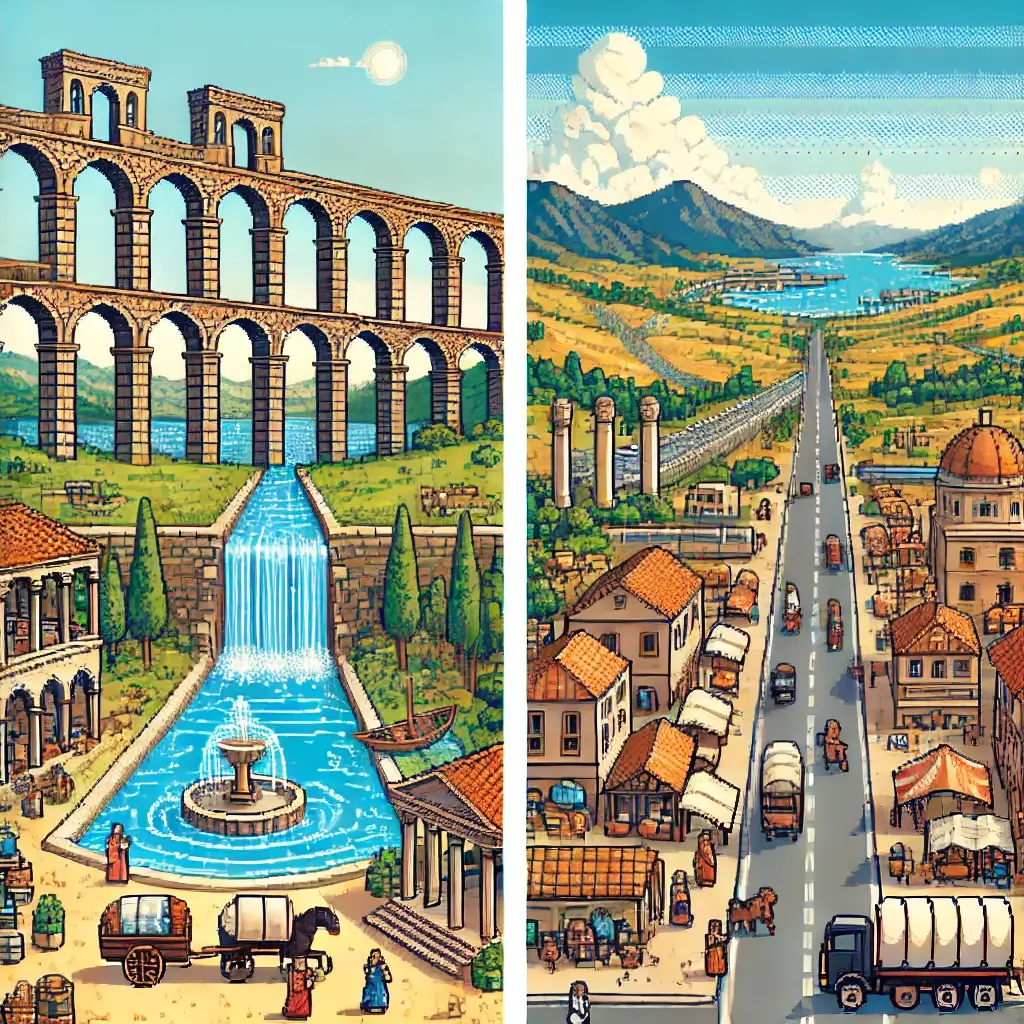
How Roman Engineering Unleashed 2000 Years of Unprecedented Prosperity!
Alright, gather ‘round, history buffs and modern-day innovators! Have you ever stopped to truly marvel at the sheer audacity and brilliance of **Roman engineering**? I mean, we’re talking about a civilization that, without our fancy machinery and digital blueprints, managed to build structures that have literally stood the test of time for millennia. It’s not just about pretty arches and sturdy walls, though. Oh no, the real unsung hero of the Roman Empire, in my humble opinion, was the profound **economic impact of Roman engineering**. It wasn’t just construction; it was the engine of an economic revolution that propelled their society to dizzying heights.
Imagine a world where travel was a muddy nightmare, where clean water was a luxury, and trade was a snail’s pace affair. That was much of the ancient world. Then came the Romans, with their tireless legions, their ingenious engineers, and a vision that stretched across continents. They didn’t just build; they engineered prosperity. They laid down the infrastructure that allowed goods, ideas, and people to move with unprecedented efficiency, transforming local economies into a vast, interconnected network. It’s like they invented the ancient world’s superhighway system and its plumbing, all rolled into one!
So, buckle up, because we’re about to take a deep dive into how these ancient master builders didn’t just construct an empire, but engineered its astounding wealth. It’s a story far more compelling than just bricks and mortar; it’s about how strategic innovation can reshape an entire civilization. —
Table of Contents
—
The Liquid Gold: How Aqueducts Fueled Urban Growth and Industries
Let’s kick things off with what I consider one of the most transformative **Roman engineering** feats: the aqueduct. Seriously, these aren’t just glorified pipes; they were the lifeblood of Roman cities, a testament to incredible foresight and hydraulic genius. Before aqueducts, cities were limited by local water sources – wells, rivers, springs. This meant smaller populations, limited sanitation, and a constant struggle for basic necessities.
But the Romans? They looked at a distant mountain spring and said, “Yeah, let’s bring that water here, across valleys and through mountains, even if it means building massive, multi-tiered stone bridges for miles!” And they did it! The impact was immediate and profound. Suddenly, Roman cities could support massive populations. Rome itself, at its peak, was home to over a million people – a truly staggering number for the ancient world – largely thanks to its eleven major aqueducts delivering an estimated 1 million cubic meters of water daily. Imagine that! That’s enough water to fill about 400 Olympic-sized swimming pools every single day.
This abundance of clean water wasn’t just for drinking, though that was vital. It enabled public baths, which were not just places for hygiene but also social and economic hubs. Think of them as ancient community centers, gyms, and spas rolled into one. They employed countless people, from attendants to masseurs, and facilitated commerce and networking. What’s more, water powered flour mills, supported textile production, and even facilitated early industrial processes, leading to increased productivity and specialized labor. You couldn’t run a fulling mill or a pottery workshop without a reliable water supply, could you? The aqueducts literally irrigated the Roman economy, allowing it to blossom in ways previously unimaginable.
And let’s not forget the sheer ingenuity involved. They mastered gravity, created siphons, and understood gradients with an accuracy that still astounds modern engineers. It was a massive investment, yes, but the return on that investment in terms of public health, urban expansion, and economic output was absolutely astronomical. It truly was **liquid gold** for the Roman Empire. —
Paving the Way: Roman Roads as Economic Arteries
If aqueducts were the veins of the empire, then **Roman roads** were undeniably its arteries. And let me tell you, these weren’t just glorified dirt tracks. We’re talking about engineered masterpieces, built to last – and many still do! The famous Via Appia, for instance, parts of which you can still walk on today, is a testament to their incredible durability. These roads were a revelation for ancient travel and trade.
Before the Romans, moving goods overland was a torturous affair. Muddy paths, constant banditry, and difficult terrain meant that trade was localized and expensive. Enter the Roman road network: an estimated 400,000 kilometers (that’s about 250,000 miles!) of expertly constructed, all-weather thoroughfares crisscrossing the empire. It’s like they invented the ancient world’s internet for goods and information!
What did this mean for the economy? Well, for starters, it dramatically reduced travel times and transportation costs. Suddenly, a merchant in Gaul could transport goods to Rome or beyond with far greater speed and security. This opened up vast new markets for local producers, encouraging specialization. Regions known for their olive oil could easily ship it to distant provinces, and vineyards could send their wine across the empire. This increased market access stimulated production, fostered competition, and ultimately led to greater economic efficiency. Think of it as Amazon Prime for the ancient world, but with chariots instead of drones!
The roads also facilitated the rapid deployment of legions, ensuring peace and stability – a critical factor for any thriving economy. No one’s investing in a region rife with rebellion, right? And they weren’t just for military might; imperial messengers could travel at incredible speeds, allowing for efficient administration and communication across the vast empire. This centralized control, facilitated by rapid communication, further bolstered economic stability. It was a symbiotic relationship: the empire needed the roads to function, and the roads allowed the empire to flourish economically. Truly, these **Roman roads** were the backbone of their commercial success. —
Seaborne Superpowers: Harbors and Trade Expansion
While the roads were vital for overland movement, don’t underestimate the power of the seas in the Roman economic machine. The Mediterranean was, for all intents and purposes, a Roman lake – Mare Nostrum, as they called it. But simply having access to the sea isn’t enough; you need the infrastructure to exploit it. And that’s where **Roman engineering** of harbors truly shone, transforming the empire into a seaborne superpower.
The Romans didn’t just find natural harbors; they built and improved them on an astonishing scale. Take Portus, for example, the massive artificial harbor built near Ostia, Rome’s ancient port. This wasn’t just a simple dock; it was a sprawling complex with breakwaters, lighthouses, warehouses, and extensive dredging operations. They even invented hydraulic concrete, a marvel of ancient chemistry, which allowed them to build structures directly in saltwater – something that baffled engineers for centuries after the fall of Rome!
These engineered harbors allowed for the efficient loading and unloading of vast quantities of goods. Grain from Egypt, olive oil from North Africa, wine from Gaul, precious metals from Spain – all flowed into Rome and other major cities, fueling their economies and sustaining their populations. The sheer volume of trade facilitated by these ports was mind-boggling. It led to the growth of massive shipping industries, shipbuilders, sailors, dockworkers, and all the ancillary businesses that thrive around busy ports. It was global trade, ancient style, and it was booming!
Improved harbors also meant less time spent waiting to unload, reducing demurrage costs and increasing the turnaround time for ships. This efficiency translated directly into more trade, lower prices for consumers, and greater profits for merchants. These aren’t just fancy historical anecdotes; they are concrete examples of how **Roman engineering** directly stimulated economic growth by facilitating large-scale, efficient international commerce. The oceans became their highways, and their engineered ports were the crucial intersections.
For more on the incredible ingenuity behind Roman concrete and its application in harbor building, you might want to check out this fascinating article from the **Smithsonian Magazine**: Discover Roman Superconcrete —

Unearthing Wealth: Mining Engineering and Resource Extraction
Now, let’s talk about getting down and dirty – literally. The Roman Empire was built on more than just food and trade; it was fueled by resources, and extracting those resources required some truly impressive **Roman engineering** in the field of mining. From the gold of Dacia to the silver of Spain and the tin of Britannia, the Romans were masters of resource exploitation, and their engineering prowess was key to unlocking this mineral wealth.
Roman mining operations were industrial-scale endeavors. They employed sophisticated techniques that were far ahead of their time. We’re not talking about a few guys with picks and shovels; imagine complex systems of adits (horizontal tunnels), shafts, and galleries. They even used a technique called “hushing,” where vast quantities of water, delivered by aqueducts, were suddenly released to scour away overburden and expose ore veins. It was like a controlled, ancient flash flood designed for mining!
The economic impact of this was colossal. These mines provided the raw materials for virtually every aspect of Roman society and economy. Silver and gold fueled their monetary system, allowing for the minting of vast quantities of coins that facilitated trade and taxation across the empire. Lead was essential for plumbing (yes, those aqueducts again!), and a myriad of other uses. Iron was crucial for tools, weapons, and construction. Copper and tin were alloyed to make bronze, vital for statues, tools, and everyday objects. Without these metals, the Roman economy simply couldn’t have functioned at the scale it did.
Furthermore, these mining operations were major employers, supporting entire communities and fostering specialized skills. They were dangerous and arduous, no doubt, often reliant on enslaved labor, but their economic output was undeniable. The wealth generated from these mines directly contributed to imperial coffers, funding public works, military campaigns, and the lavish lifestyles of the elite. It’s a stark reminder that the glittering achievements of Rome often had their foundations deep underground, thanks to relentless **Roman engineering** innovation in resource extraction.
To delve deeper into the fascinating world of Roman mining, particularly their astonishing use of water power, check out this article from **Archaeology Magazine**: Explore Roman Gold Mines —
Building Better Cities: Urban Planning and Economic Hubs
When you think of **Roman engineering**, you often picture grand structures like the Colosseum or the Pantheon. And while these are undeniably impressive, it’s the broader concept of **Roman urban planning** that truly had a pervasive economic impact. They didn’t just build buildings; they built entire cities from the ground up, often with a remarkable degree of foresight and standardization.
Roman cities were meticulously laid out, often on a grid plan (think ancient Manhattan, but with more toga-wearing citizens!). This organized layout facilitated efficient movement, allowed for easy administration, and provided clear spaces for public buildings, markets, and residential areas. Think about the forum – the central marketplace and civic hub of every Roman town. These weren’t just random stalls; they were carefully planned spaces designed to facilitate commerce, legal proceedings, and public life. This deliberate organization reduced friction in economic transactions and made cities more attractive places to live and do business.
Beyond the layout, Romans invested heavily in the urban infrastructure that made cities viable economic centers. We’ve already talked about aqueducts bringing water and sewers taking away waste, both critical for public health and population density. But they also built elaborate drainage systems, paved streets within cities, and constructed impressive public buildings like basilicas (multi-purpose civic buildings) and theaters, which served as gathering places and stimulated local economies through entertainment and events. These amenities attracted skilled artisans, merchants, and landowners, further concentrating economic activity.
The construction boom itself was a massive economic engine. Think of the thousands of laborers, architects, engineers, quarrymen, and craftsmen employed in these vast urban projects. This generated jobs, stimulated demand for materials, and created entire industries around construction. Moreover, the creation of these well-ordered, functional cities made them attractive magnets for trade and settlement, leading to increased specialization of labor and higher productivity. A well-designed city wasn’t just pretty; it was a meticulously engineered economic machine, and the Romans built thousands of them across their empire, each a vibrant hub of economic activity. —
Beyond the Fall: The Enduring Economic Legacy of Roman Engineering
So, the Roman Empire eventually fell, right? But here’s the kicker: the economic impact of **Roman engineering** didn’t just vanish with the last emperor. Oh no, its ripples spread far beyond, influencing the course of European and even global development for centuries to come. It’s like throwing a pebble into a pond – the initial splash is huge, but the concentric circles keep expanding long after.
First off, many Roman roads, even after centuries of disrepair, continued to serve as basic trade routes and military paths well into the Middle Ages and beyond. They formed the skeleton of future European transportation networks. Imagine the early medieval period; without these Roman foundations, overland travel would have been an even greater nightmare than it already was. They literally laid the groundwork for future commerce.
Secondly, the very concept of large-scale public works, of investing in infrastructure for the common good and economic benefit, was largely a Roman invention that was lost and then rediscovered. When later societies, from medieval kingdoms to Renaissance city-states, began to re-emerge and grow, they often looked back to Roman models for inspiration. The engineering principles, the organization of labor, and the understanding of material science – much of this was preserved, directly or indirectly, and provided a blueprint for subsequent development.
Even basic municipal services, like organized water supply and sewerage, which were so revolutionary in Roman times, eventually became the standard that modern societies aspired to. It took a long time, but the Roman example proved what was possible and set a high bar for urban living. The idea that a government *should* provide such services for its citizens, partly for economic stability, is a powerful legacy. It’s a testament to the fact that good infrastructure isn’t just a convenience; it’s a fundamental pillar of economic prosperity.
In essence, **Roman engineering** didn’t just create wealth for its own time; it planted seeds for future economic growth, demonstrating the power of innovation, long-term planning, and strategic investment in infrastructure. It taught subsequent generations, often through their own slow and painful rediscovery, that a strong economy needs strong foundations – and often, those foundations were literally built by the Romans. Their impact truly was a 2000-year economic marvel.
For more on the lasting influence of Roman roads, check out this piece from the **BBC**: See Enduring Roman Roads
Well, there you have it! From aqueducts supplying the lifeblood to cities, to roads connecting distant markets, and harbors facilitating global trade, the **economic impact of Roman engineering** was nothing short of revolutionary. It transformed local economies into an interconnected, thriving imperial powerhouse. It’s a powerful reminder that investment in infrastructure isn’t just about convenience; it’s about laying the very foundations for prosperity, then and now. What do you think was their most impactful engineering feat?
Keywords: Roman Engineering, Economic Impact, Aqueducts, Roman Roads, Ancient Prosperity