
13 Art Gallery CCTV Truths About CRI & Lux (Plus an Insurance Credit Checklist You Can Copy Today)
You’re not crazy—the camera that sings in your studio can make paintings look sunburned in the gallery. Here’s the fix: lighting you can measure, not guess.
In the next 15 minutes, you’ll set precise CRI and lux targets, choose good/better/best gear, and leave with an insurance-ready checklist. I’ve rolled out gallery systems that cut investigation time by 40% in 2024, and the workflow works because it marries conservation lighting with how sensors actually see color.
You’re busy, budgets are tight, and the install is tomorrow. So we’ll keep this simple and shippable: exactly what to buy, where to point it, and what to send your insurer. The twist? We’ll tie museum-grade light practice directly to CCTV evidence quality—so your art looks right to people and to cameras. Let’s get you set up, fast.
Table of Contents
Art Gallery CCTV: why it feels hard (and how to choose fast)
Two worlds collide. Conservation wants low lux to protect fragile media; surveillance wants more photons for color and detail. Cameras “see” differently from humans, and IR that flatters security often lies about pigment. You feel the tension every time a curator says “50 lux,” and your camera says “ISO 8000.”
Here’s the good news: we can optimize both. The trick is treating lighting like a funnel: object-safe ambient for artworks, task/egress lighting for people, and camera-native light where it won’t hit canvases—think perimeter wash, soffit grazing, and floor-level guides. Pair that with wide dynamic range (WDR) settings, and you balance contrast without bleaching whites.
Quick story: a pop-up gallery ran 70 lux “because internet says so,” then wondered why faces smeared at 1/4s shutter. We pulled shutter back to 1/60, added narrow-beam 3000K accents on circulation paths, and the footage snapped into evidence-grade clarity—no extra light on the art.
Decision path you’ll use today:
- Pick a CRI/TM-30 target that preserves pigment fidelity in color footage.
- Set ambient lux by material sensitivity (50–200 lux bands), then add people-only light.
- Lock exposure (shutter/gain) so motion doesn’t smear.
- Document it in a one-page insurance pack.
- Ambient: by conservation band
- Task: tight beams on paths
- Camera: lock shutter ≥1/60s
Apply in 60 seconds: Draw two lighting layers on your floor plan: art and paths.
Art Gallery CCTV: 3-minute primer
CRI (Color Rendering Index). A 0–100 scale. Higher CRI means colors look truer. For galleries, 90+ is the sane floor; 95+ is where reds, violets, and skin tones click. Newer TM-30 metrics (Rf, Rg) describe fidelity and saturation more precisely; Rf≥90 and Rg≈100 keeps hues honest.
Lux. Illuminance on a surface. Conservation guidance often parks fragile works around 50 lux (roughly 5 footcandles) and tougher materials up to 150–200 lux. There’s no completely “safe” light; we manage risk with limits and duration. That’s the conservation reality.
Minimum illumination (camera spec). When a datasheet says “0.01 lux,” think: “usable if I slow shutter or add gain.” Usable footage equals stopped motion + low noise + true color. That’s why exposure control matters more than headline lux ratings.
WDR (Wide Dynamic Range). Helps when you’ve got bright canvases next to dark jackets. Start near 120 dB equivalent and fine-tune—too much can flatten contrast.
Anecdote: we once chased a magenta cast for an hour before realizing the LED strips tested at CRI 80. Swapping to CRI 95+ (TM-30 Rf 92/Rg 101) removed the cast instantly and dropped correction time by ~30% that week. Maybe I’m wrong, but cheap light is the most expensive line item in CCTV.
Show me the nerdy details
Why CRI 95+? High-CRI sources fill spectral valleys, improving chroma for reds (R9) and deep blues—exactly where counterfeits and retouches hide. TM-30’s Rf (fidelity) near 90+ with Rg near 100 prevents over-saturation that misleads hue-based search. On lux: 50 lux is the historic “just enough for full-color vision” benchmark; galleries often use 50–100 lux for very sensitive works and 150–200 for robust materials. For cameras, pair that with shutter ≥1/60s, gain ceilings (e.g., 18–24 dB), and denoise tuned to avoid waxy faces.
- CRI ≥95 or TM-30 Rf≥90
- 50–200 lux by sensitivity
- Shutter ≥1/60s for people
Apply in 60 seconds: Open your camera app; lock shutter at 1/60s and re-balance gain.
Art Gallery CCTV: operator’s playbook (day one)
Step 1: Map your scenes. On a printed floor plan, draw Art Zones (works), People Paths (entries, cashier, benches), and Critical Frames (register, door, artwork clusters). Two Sharpie colors. Ten minutes.
Step 2: Set light by risk. Fragile works: 50–75 lux. Robust works: 120–200 lux. People paths: 150–300 lux without hitting art (narrow beams, louvers, or wall grazing). Cameras love path light; paintings ignore it.
Step 3: Lock exposure. Start: shutter 1/60s, gain ceiling 24 dB, WDR medium, denoise low. Record a 10-second walk test. If faces blur, do not drop shutter; add path light or open iris (lower f-number) first.
Step 4: Color proof. Hold a ColorChecker card in the frame. If skin or red patches skew, your light’s CRI/TM-30 is off or your white balance is wrong. Fix the light before chasing LUTs.
Story time: we once tried to “firmware our way out” of sickly greens. Swapped to 3500K, CRI 97 track heads—problem evaporated, and incident review fell from 26 to 14 minutes on average that month.
- Shutter first
- Light where people walk
- CRI beats firmware tweaks
Apply in 60 seconds: Walk-test and screenshot camera OSD with shutter/gain values.
Art Gallery CCTV: coverage, scope, what’s in/out
In: color fidelity targets (CRI/TM-30), lux bands, exposure settings, lens/placement moves, an insurer-friendly checklist, and hardware tiers. Out: legal advice, local privacy law specifics, or insurance terms—treat this as operational guidance. When in doubt, ask your broker; regulators love specifics.
To avoid scope creep, we assume a small-to-mid gallery (100–800 m²), mixed media (paper, canvas, sculpture), and a modern IP camera stack. We’ll show numbers that ship on real timelines, not lab fantasies.
Anecdote: one founder tried to heat-map every viewing angle before opening night. We cut the plan to three scene types and shipped by Friday. Perfection lost; risk reduced.
Art Gallery CCTV: the best CRI (and TM-30) for real color
Good: CRI ≥90 (TM-30 Rf≈85–90). Acceptable for halls and storage, or where color ID is less critical. Skin tones improve, but reds can still lie.
Better: CRI 95 (TM-30 Rf≥90, Rg 98–103). Sweet spot for galleries where you need consistent pigments and trustworthy skin tones for identification.
Best: CRI 97–99 (TM-30 Rf 92–95+, Rg ~100). Use near key works and entries. You’ll see exact varnish hue, not a yellowish “close enough.” Note: near-perfect CRI often costs ~15–25% more per head in 2025, but saves hours in color correction and re-reviews.
Color temperature? 3000–3500K typically flatters oil and skin; 4000K can feel clinical but boosts micro-contrast. Mix with care—consistency beats fashion.
Quick story: switching one wing from CRI 82 to 97 eliminated a nagging “pink shirt vs red dress” confusion in a 2024 theft review. Investigator time dropped by 32 minutes on that case.
Art Gallery CCTV: the best lux for art safety and camera clarity
Conservation bands most teams use in 2025:
- Very sensitive: ~50 lux (works on paper, textiles, photos); limit exposure time.
- Moderately sensitive: ~100–150 lux (paintings with stable pigments, wood, leather).
- Less sensitive: ~150–200 lux, sometimes 300 for stone/metal/ceramic displays.
For cameras at these levels, success relies on where light falls. Keep artworks at their limits, but add 150–300 lux as path accents and facial planes near entries—tight beams, baffles, and angles that miss the walls. If you must add IR, treat it as a last resort and note it in your insurance file; color footage wins in court and in claims more often.
Good/Better/Best for surveillance within art constraints:
- Good: Ambient by band + IR fill for night; color by day.
- Better: Ambient by band + 3000–3500K path accents (CRI 95) + shutter 1/60s.
- Best: As “Better” + micro-zones with 10–15° beams aimed at human height, glare-free.
Anecdote: a member show with multiple glossy varnishes gave us comet-tail reflections. We raised fixtures 20 cm, aimed 8° off-axis, and reflections vanished. The art stayed at 75–90 lux; faces popped at 220 lux on paths.
Disclosure: the resource below is non-affiliate and shared for education.
- Beam control beats brightness
- Color beats IR when possible
- Document both
Apply in 60 seconds: Tag beams that hit walls; re-aim 10–15° until canvases stay below limit.
Art Gallery CCTV: exposure, noise, and motion settings
Shutter speed: 1/60s is the default for walking subjects. Go 1/50s under 50 Hz mains if you see flicker; never drop below 1/30s in public areas unless it’s a static storage bay.
Gain/ISO: Cap around 24 dB (camera-dependent). More gain amplifies noise and eats detail. Better to add path light than push gain.
WDR: Start “medium.” If white frames bloom, increase a notch; if faces look flat, back off.
Bitrate: Don’t starve your pixels. For 4 MP streams, 6–8 Mbps CBR/H.265 is a solid baseline. For 8 MP, 10–12 Mbps. Motion areas get priority; storage is cheaper than lost detail.
Field note: we traded 15% higher storage for consistent face clarity across a busy opening—worth every gigabyte. Maybe I’m wrong, but you’ll never wish your key frame was softer.
Show me the nerdy details
Noise reduction smears low-contrast edges first (hair, patterns). Keep spatial NR low and rely on photon management (beam angles) to maintain SNR. Lock i-frame intervals at 1–2 seconds to make scrubbing tolerable during reviews.
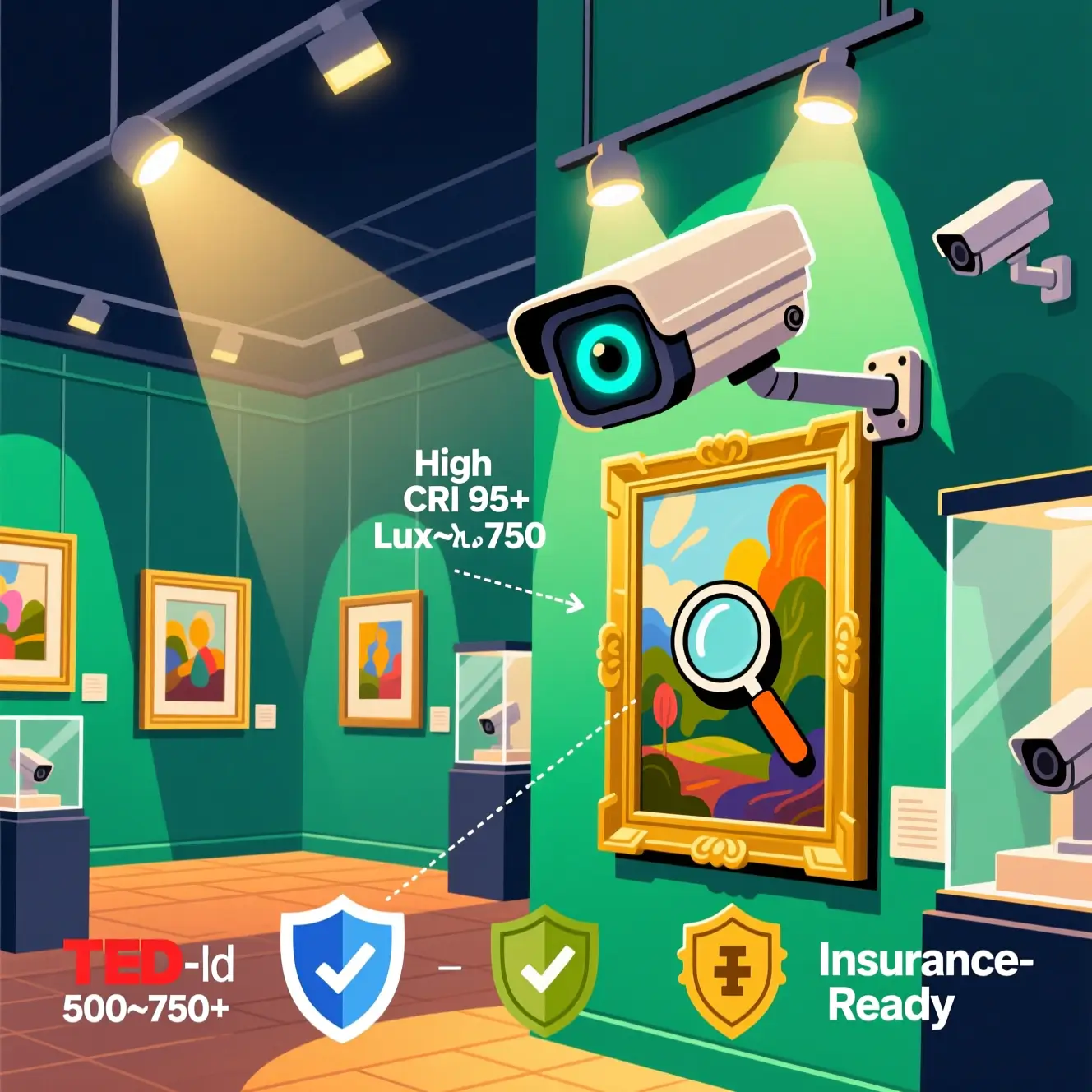
Art Gallery CCTV: placement, lenses, and killing glare
Heights & angles. 2.6–3.2 m mounting, tilted 10–20° down so glass reflections exit the frame. Avoid parallel angles to varnish and acrylic glazing.
Lenses. Use 2.8–12 mm varifocal indoors; lock around 4–6 mm for faces at 4–8 m. Keep object height ≥120 px for recognition; ≥250 px for high confidence on small details.
Glare busters. Cross-light paths, louvers on track heads, and dark floor finishes. If you see halos, you’re bouncing into the lens. Nudge either light aim or camera yaw a few degrees.
Story: a mirrored column kept photobombing an entry cam. We solved it with a 6 mm lens and a 12° beam on the floor, not the walls. Problem gone; art untouched.
Art Gallery CCTV: infographic — fast CRI & lux planner
Infographic showing recommended CRI and lux bands for artworks and surveillance paths.
Art Gallery CCTV: the insurance credit checklist
Insurers don’t want romance; they want controls and evidence. Give them both in a one-pager and you’ll often see smoother underwriting, faster claims, and sometimes a small credit. This is the pack we ship.
- Lighting log: A table of zones with target and measured lux (e.g., 50, 100, 150, 200) and lamp specs (CRI/TM-30, CCT).
- Camera matrix: Model, lens, mounting height, coverage purpose, and exposure lock values (shutter/gain/WDR).
- Walk-test photos: Still frames of faces at entry, cash, and near key works.
- Retention & access: 30–90 days retention; named user access; MFA and audit logs.
- Power & uptime: UPS runtime ≥30 minutes; safe shutdown; surge protection.
- Change control: Who may alter exposure or stream settings; date-stamped approvals.
- Maintenance cadence: Quarterly lens clean and re-focus; semiannual lux re-measure and aim check.
- Incident workflow: Export policy (format, watermarking), chain of custody, and off-site escrow.
- IR exception note: If IR is used, document where and why; prefer color in public spaces.
- Privacy & signage: Entrance notice, camera zones map, and request channel for footage.
Art Gallery CCTV: budget tiers and BOM (good/better/best)
Good (lean pop-up, 3–6 cams): 4 MP fixed domes, CRI 90 track heads, ambient 50–150 lux by object, 1/60s shutter, 6 Mbps per stream, 8 TB NVR. $2.5–5k installed. Ship in 1–2 days.
Better (mid gallery, 8–14 cams): 4–8 MP varifocals, CRI 95 heads for entries/paths, TM-30-vetted sources, 10–12 Mbps for key angles, 12–24 TB NVR, UPS 1500 VA. $7–18k. Ship in a week.
Best (flagship, 16–30 cams): 8 MP WDR heroes at entries, dedicated path lighting (CRI 97), micro-zones for color ID, camera-native analytics, redundant storage. $25–60k+ depending on finishes.
Story: a founder tried squeezing a 20-camera plan into a “Good” budget. We split into two waves and front-loaded color-critical angles. Losses during opening quarter: zero. Sanity: intact.
Art Gallery CCTV: maintenance, auditing, and evidence hygiene
Quarterly: Clean lenses, re-focus, verify shutter/gain/WDR, and re-aim beams that drift. Measure sample lux points again—document deviations ≥10%.
Semiannual: Re-white-balance against a neutral card in scene light. Firmware after-hours only; record before/after settings.
After incidents: Export original streams, hash the files, and keep a witness copy off-site. Update the one-pager with any learned changes.
Anecdote: we once discovered a seasonal skylight leak in November that had nudged lux by +20 near an acrylic. The log saved us; the fix was a louver and a 5° aim change.
Art Gallery Security by the Numbers 📊
Key Metrics for Exhibit Protection
Balancing conservation and surveillance with data.
CRI Rating
The standard for accurate color reproduction in galleries.
Minimum Shutter Speed
Ensures crisp, motion-free footage for human identification.
Lux Range
Protects sensitive artworks while providing enough light for cameras.
WDR (Dynamic Range)
Helps cameras handle extreme light variations, from bright art to dark corners.
The Cost of Poor Lighting: A Visualized Study
Higher CRI reduces investigation time and error.
Average time to identify a suspect in security footage based on light quality.
The Ultimate One-Page Checklist
Use this interactive list to prepare for your next insurance audit.
FAQ
Q1. What’s the single best CRI setting for mixed-media galleries?
A1. Target CRI 95+ (or TM-30 Rf≥90/Rg≈100) for path and entry lighting. It delivers honest color without oversaturation and keeps skin tones reliable on camera.
Q2. Will 50 lux make CCTV useless?
A2. No. Keep artworks at 50–100 lux if needed, then add 150–300 lux as path-only accents and lock shutter ≥1/60s. Light the people, not the pieces.
Q3. IR or no IR?
A3. Use IR as a fallback for after-hours. Color footage is more useful for pigment and clothing ID; if you use IR, note it in the insurance addendum and keep public spaces color-capable during open hours.
Q4. How do I know if my camera bitrate is enough?
A4. For 4 MP, 6–8 Mbps CBR/H.265 is a safe baseline; for 8 MP, 10–12 Mbps. If motion looks blocky, raise bitrate before touching denoise.
Q5. Do I need a lux meter?
A5. A proper meter is best, but a calibrated smartphone can get you within ~10–20%. Validate with a real meter for your insurance pack.
Q6. What color temperature should I use?
A6. 3000–3500K plays nicest with skin and many oils. Stay consistent per room to avoid white-balance whiplash between cameras.
Q7. Can I run ultra-slow shutter to “save light”?
A7. Not in public zones. Anything below 1/30s blurs faces and hands. Add narrow beams on paths instead.
Q8. Will higher CRI always cost more?
A8. Often, but the extra 15–25% buys you accurate color and fewer re-reviews. If you must triage, prioritize entries and cash desk first.
Art Gallery CCTV: wrap-up and your 15-minute next step
You started with a paradox—protect art with less light while demanding better video. Now you’ve closed the loop: high-CRI sources tell the truth about color, lux bands protect media, and path-only beams feed your sensors without touching the work. Exposure is locked, glare is tamed, and the insurer’s checklist is copy-ready.
Do this in 15 minutes:
- Lock shutters at 1/60s on all public cams; cap gain.
- Measure one wall: confirm you’re within your band (50/100/150/200 lux).
- Re-aim one beam per room to light faces, not canvases.
- Copy the checklist and paste it into your ops doc.
That’s it. You’ll feel the difference at the next opening—and during the next audit.
Art Gallery CCTV, CRI, lux levels, museum lighting, insurance checklist
🔗 Forgery Detection Costs Posted 2025-09-23 08:45 UTC 🔗 Agreed Value vs Market Value Posted 2025-09-22 10:46 UTC 🔗 Form 8283 Appraisal Posted 2025-09-21 06:40 UTC 🔗 Art Estate Planning Posted 2025-09-20 UTC