

What Is B2B Intent Data? A Plain-English Guide for Founders and RevOps Teams – 7 Shocking Mistakes I Made Before We Unlocked Profitable Growth
Here’s a slightly painful truth: By the time someone on your team fires off that first cold email, most of your best prospects have already chosen a vendor. Seriously. According to some recent B2B buying research (6sense, Oct 2024), a huge chunk of decisions are made quietly during the “lurking” phase—when buyers are doing anonymous research and ghosting sales reps like pros.
If you’re not using B2B intent data properly (or at all), it’s like showing up to a soccer match in the 85th minute… and expecting to win.
I learned this the slow, frustrating, borderline-expensive way. We poured months into outbound campaigns and so-called “intent-based” strategies that—on paper—looked like genius. In real life? Crickets. The pipeline was chaotic, unpredictable, and gave off strong “hope-as-a-strategy” vibes.
But once we finally figured out how to actually use intent data the right way, things flipped. The pipeline started to feel calm. Predictable. Even a bit… boring. (But like, in that beautiful “this-is-scaling” kind of way.)
So, I wrote the guide I wish someone had handed me earlier. Plain English. No jargon. Just real talk about:
- What B2B intent data actually is (and isn’t),
- The 7 sneaky mistakes that quietly sabotage growth, and
- A down-to-earth playbook you can start using right away.
If you want to skip the fluff, start with the 60-second readiness checklist below. Then jump into the sections that match where you are right now.
Let’s stop guessing—and start closing deals before your prospects go dark.
Table of Contents
What Is B2B Intent Data in Plain English?
Let’s strip away the jargon. {MAIN_KEYWORD}: B2B intent data is behavioral evidence that a company is actively researching a problem you solve, right now. It’s not a magic list of “ready to buy” accounts. It’s a stream of clues.
Those clues can come from things like:
- Spikes in research on topics closely related to your product.
- Visits to pricing, comparison, or implementation pages.
- Reading reviews of you and your competitors.
- Downloading whitepapers and playbooks around a specific pain.
Modern reports on B2B buying show that buyers spend well over half their decision time doing independent research online (Gartner, 2023-09; various 2024-2025 updates echo the same). That makes intent data one of the few ways to see what’s happening in that black box.
When we first “bought intent,” we treated it like a cheat code. In reality, it’s more like a weather forecast: it doesn’t close deals; it tells you where to send your best sales and marketing energy.
“Intent data doesn’t replace your go-to-market. It simply stops you from yelling in the wrong direction.”
- It shows which companies are researching topics linked to your solution.
- It works best when combined with a clear ICP and strong messaging.
- It prevents you from wasting cycles on truly cold accounts.
Apply in 60 seconds: Write down three buyer problems. Ask: “Which behaviors would prove someone cares about each today?” That’s your first intent map.
Why B2B Buying Now Feels So Chaotic (and Where Intent Data Fits)
If it feels like every deal involves more people, more steps, and more “checking with the team,” you’re not imagining it. Recent research shows that average buying groups commonly include 10–13 people, often from multiple departments (Forrester, 2024-12; 6sense, 2025-01). Another Gartner survey in 2025 found that 74% of buying teams show unhealthy conflict during the decision process (Gartner, 2025-05).
On top of that, a 2024 buyer experience study reported that 81% of buyers choose a preferred vendor before talking to sales (6sense, 2024-10). Pair that with a 2024 Gartner survey where over 60% of buyers said they prefer a rep-free experience and 73% avoid suppliers who send irrelevant outreach (Gartner, 2025-06), and you see the problem clearly:
- More stakeholders.
- More anonymous research.
- Less patience for generic outreach.
In one RevOps role, I remember staring at our CRM, watching deals stall in “evaluation” for 90+ days. We weren’t losing because the product was bad. We were losing because the buying group made most of their emotional decision before we even knew they existed.
B2B intent data helps you enter that decision window earlier. Not perfectly, not for everyone—but enough to change the odds on the opportunities that matter.
- Buying groups are larger and more conflicted than ever.
- Most of the decision is made during anonymous research.
- Irrelevant outreach actively hurts your brand and win rate.
Apply in 60 seconds: Look at your last 5 closed-lost deals. Ask sales, “When did they actually start researching this problem?” Notice how far ahead of your outreach that moment was.
The 3 Main Types of B2B Intent Data You’ll Actually Use
Most teams drown in terminology here. Let’s keep it simple. In practice, you’ll use three buckets of intent data:
1. First-party intent data (your own properties)
- Website analytics (pricing page visits, repeat blog visits, docs traffic).
- Product usage signals (feature adoption, seat expansion, churn risk behavior).
- Email engagement, webinar attendance, community activity.
This is the most controllable data you have. When we first wired product usage into our CRM, we suddenly saw how many “happy” customers were quietly evaluating competitors, based on docs and export behavior.
2. Third-party intent data (external networks)
Third-party providers like Bombora, ZoomInfo, 6sense, Demandbase, and others observe behavior across large content networks, review sites, and ad inventory. They aggregate page views, topic searches, and research patterns to show which companies are “surging” on certain topics (Bombora, 2025-07; various provider comparisons, 2024-10).
Think of it as a heatmap of “who is in market” beyond your own website. It’s imperfect, but when combined with your ICP, it can dramatically sharpen your focus.
3. Second-party intent data (partner ecosystems)
Less discussed but incredibly powerful, this is intent data you access through partners:
- Marketplace platforms sharing which accounts viewed or trialed adjacent tools.
- Media partners sharing content consumption on sponsored content.
- Strategic alliances where you share anonymized or account-level trends.
On one partnership project, we discovered that accounts trialing our integration partner’s tool were 4–5x more likely to buy our solution within 90 days. We didn’t need a new channel—just better timing based on shared signals.
- Start with your own data (first-party) before buying big platforms.
- Use third-party intent to discover in-market accounts you don’t see yet.
- Explore second-party data inside partner ecosystems you already use.
Apply in 60 seconds: List your top 3 tools that already contain buyer behaviors (website analytics, CRM, product analytics). That’s your starting intent stack.
How B2B Intent Data Works Under the Hood
You don’t need to be a data engineer to use intent, but understanding the basics will save you from lots of magical thinking.
Signals → Topics → Scores
Most providers follow a similar pattern:
- Collect signals: pageviews, downloads, searches, review reads, ad interactions.
- Map signals to topics: “SOC 2 compliance automation,” “B2B intent data,” “RevOps analytics,” and so on.
- Score at the account level: how much more active is this company on a topic compared to its normal baseline?
When a company shows significantly more activity on a topic than usual, the provider calls that a “surge.” Scores often update weekly.
Privacy, compliance, and reality checks
Reputable providers emphasize privacy-compliant, company-level intent data, not creepy individual tracking. Many highlight GDPR and CCPA compliance and focus on account-level decision signals rather than personal browsing history (various provider disclosures, 2024-2025).
Reality check: intent data is noisy. Bad IP mapping, shared coworking spaces, and content syndication can all introduce false positives. In one rollout, we chased a “surging” account for weeks before realizing most signals were coming from a university computer lab testing free tools.
Show me the nerdy details
Under the hood, many intent platforms use IP-to-company resolution, cookie data (where compliant), and publisher logs. They compare each company’s weekly topic counts to a historical baseline, then convert that deviation into a surge score. Some apply machine learning to filter out junk (like content farms or bots). Others enrich with firmographics and technographics so you can filter out companies that don’t match your ICP.
- Scores reflect relative interest, not guaranteed deals.
- False positives are normal; your filters and playbooks matter.
- Privacy-compliant platforms focus on account behavior, not individuals.
Apply in 60 seconds: Ask your provider or vendor, “What exactly goes into this surge score?” If they can’t explain it simply, slow down your rollout.
7 Shocking Mistakes I Made with B2B Intent Data
Here’s the part I wish weren’t autobiographical. Every one of these mistakes either cost us pipeline, wasted sales time, or skewed leadership’s expectations.
Mistake 1: Treating every surge as “ready to buy”
We once sent a “priority leads” list to sales with a subject line I still regret: “These accounts are buying this quarter.” Spoiler: they were not. Some were just early in their research; others were students or partners.
The fix was humbling: we re-labeled surging accounts as “high-intent research phase” and designed plays that assumed curiosity, not commitment—more education, less pressure.
Mistake 2: Ignoring the ideal customer profile (ICP)
At one point, our intent list included everyone from tiny consultancies to global conglomerates. It looked big and impressive on the dashboard, but less than 10% matched our actual ICP. Sales felt like they were calling random names off the internet.
We tightened the filters around ARR band, tech stack, and geography. Overnight, our list shrank by about 60%, but connect rates and response quality improved so much that sales didn’t want to go back.
Mistake 3: Flooding reps with raw data (and no plays)
My worst meeting as a RevOps lead was when a sales manager opened our new “Intent” dashboard, stared at the chart for a few seconds, and asked: “Cool… what do you actually want my team to do with this?”
We had shipped a dashboard, not a playbook.
We eventually landed on a simple rule: no new intent field without a matching, documented action—for SDRs, AEs, and marketing.
Mistake 4: Over-automating outreach
Drunk on automation, we wired surges directly into sequences. The result? We accidentally spammed a few prospects who were already mid-conversation with an AE. One replied: “Are you three different companies or just very confused?” Fair question.
We learned to route intent through ownership rules first, so existing opp owners stayed in control and sequences stayed context-aware.
Mistake 5: Forgetting customer intent (not just net-new)
For months we used intent only for new logo acquisition. Meanwhile, a few of our biggest customers were quietly researching competitors. We noticed only when churn notices arrived.
Now we maintain separate playbooks for customer intent signals: expansion, renewal, and churn risk. One CSM told me it felt like we’d given her “a sixth sense” about which accounts needed a proactive call.
Mistake 6: Measuring only meetings, not revenue
In our first quarter with intent, we celebrated a spike in meetings. Everyone felt great—until finance pointed out that closed-won revenue from those intent-driven meetings was flat.
The fix was simple but powerful: we separated volume metrics (meetings, emails) from revenue metrics (pipeline generated, win rate, deal cycle). The truth hurt—but it gave us a real path to improvement.
Mistake 7: Leaving RevOps out of the room
Early on, intent was owned entirely by marketing. Sales saw it as “just another MQL list.” RevOps wasn’t involved at all.
Once RevOps took ownership of routing, definitions, and reporting, the energy shifted. Intent became part of a shared revenue operating model, not a marketing experiment.
Short Story: (about 150 words)
I remember one Thursday evening, sitting alone in an almost-dark office, staring at a dashboard full of bright red “intent surge” icons. We’d bet a big chunk of our budget on this data, and my calendar was full of leadership meetings with titles like “Intent Program Review.” It looked impressive—lines up and to the right, charts everywhere. But when I pulled the actual pipeline numbers, my stomach sank.
The big “intent cohort” was performing no better than our regular outbound. I walked to the whiteboard and wrote one question in huge letters: “If we turned this off tomorrow, what would actually break?” The honest answer was: nothing. That night, I sketched what would eventually become our intent operating model: clear ICP filters, specific plays, RevOps ownership, and revenue-based metrics. That was the moment intent data stopped being a toy and started being a tool.
- Label surges as “research phase,” not “ready to buy.”
- Filter ruthlessly to your real ICP before routing to sales.
- Measure impact on revenue, not just meetings booked.
Apply in 60 seconds: Pick one mistake above that feels uncomfortably familiar. Write a one-sentence fix and share it with your team today.
Money Block #1: Eligibility Checklist – Are You Ready for B2B Intent Data?
Before you sign an annual contract, run this quick eligibility checklist:
- ICP defined? Yes / No – You can state clearly which segments you care about most.
- Routing rules? Yes / No – You know who owns which accounts (SDR, AE, CSM).
- Playbooks ready? Yes / No – You have at least one outreach template per core topic.
- Data owner? Yes / No – RevOps or a named person will own data quality and reports.
- Budget guardrails? Yes / No – You know your max annual spend and review cadence.
If you answered “No” to more than two, slow down. Tighten these basics first; you’ll save both money and sales goodwill.
Neutral action: Save this checklist in your RevOps workspace and confirm each item with sales, marketing, and finance before requesting quotes.

Designing an Intent-Driven Revenue Engine for Founders and RevOps
Once you’ve dodged the obvious mistakes, the fun begins: designing an intent-driven revenue engine that feels predictable instead of reactive.
Step 1: Start with one core motion, not everything
In one startup, we tried to roll out intent for SDR prospecting, AE account expansion, and CSM churn prevention—at the same time. It was chaos. We later focused on just one motion: SDR outbound into surging target accounts. Within two quarters, it became our most reliable source of new pipeline.
Step 2: Create simple “if X, then Y” rules
Your intent operating model should be understandable on a single slide. For example:
- If an ICP account surges on “B2B intent data” and has no open opp, then SDR runs a 3-touch insight sequence.
- If a customer surges on competitor topics 90 days before renewal, then CSM triggers a strategy call.
- If a target account surges on “RevOps automation” and visited your pricing page, then AE runs a one-to-one Loom walkthrough.
Step 3: Align reporting to leadership questions
Founders and RevOps leaders don’t care about clever dashboards; they care about answers:
- How much pipeline did intent-sourced accounts create this quarter?
- What’s the win rate vs. non-intent accounts?
- Do intent accounts move faster through the funnel?
We once simplified our reporting to just three charts: pipeline, win rate, and cycle time by cohort. It was enough to keep leadership confidently invested without drowning them in noise.
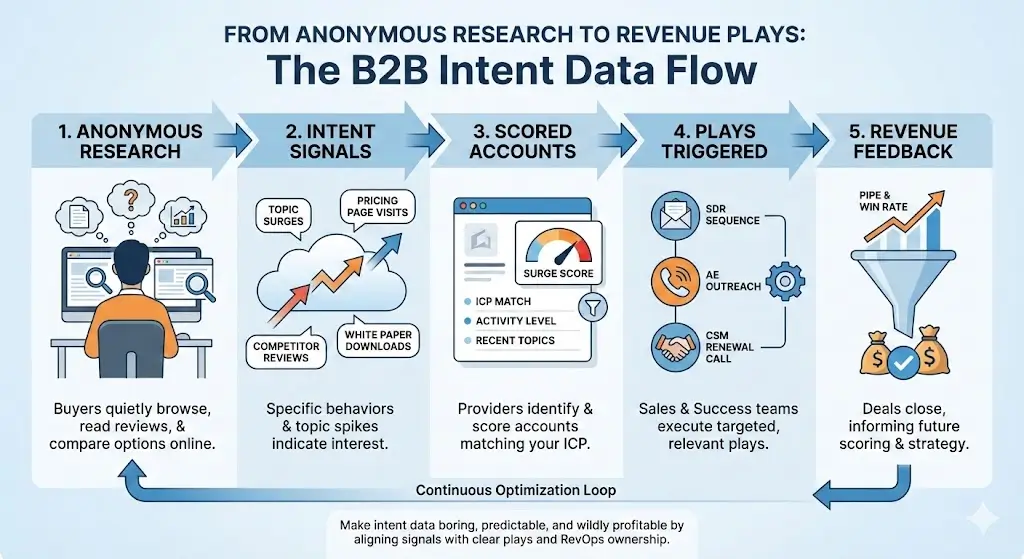
Infographic: From Anonymous Research to Revenue Plays
- Anonymous Research: Buyers read articles, reviews, and comparison pages.
- Intent Signals: Topics spike (e.g., “B2B intent data,” “RevOps analytics,” “marketing attribution”).
- Scored Accounts: Providers flag surging companies that match your ICP filters.
- Plays Triggered: SDR, AE, and CSM teams run targeted sequences and calls.
- Revenue Feedback: Win rate and deal speed update your scoring and playbooks.
Use this as a quick visual when explaining intent to non-technical stakeholders.
- Pick one motion to optimize first (usually SDR or ABM).
- Document “if X, then Y” rules that everyone understands.
- Report on pipeline, win rate, and cycle time by intent cohort.
Apply in 60 seconds: Write down one motion you’ll focus on first and one metric that will prove it’s working.
Money Block #2: Example Fee Table – 2025 B2B Intent Data Contracts (Global)
These are illustrative ranges seen in public benchmarks and vendor comparisons in 2024–2025. Always confirm the latest fee schedule.
| Buyer Stage (ARR) | Typical Annual Range (USD) | Notes (2025) |
|---|---|---|
| Early-stage SaaS (<$5M ARR) | $10,000 – $40,000 | Often one region, limited topics, basic integrations. |
| Growth stage ($5–50M ARR) | $40,000 – $120,000 | Multiple regions, ABM features, deeper CRM/MA sync. |
| Enterprise (>$50M ARR) | $120,000 – $300,000+ | Custom contracts, dedicated support, multi-brand setups. |
Data here moves relatively fast; verify 2025 pricing with each vendor’s official fee schedule or sales team.
Neutral action: Download or copy this table into your planning doc and compare it to quotes from at least two providers before signing.
Money Talk: Contracts, Pricing, and ROI Math for 2025
This is where most founders and RevOps leaders get nervous—and rightly so. Intent contracts can feel like a big leap, especially when the annual minimums look like a seed round for your first company.
Mini ROI reality check
Start with a simple, conservative model:
- Average deal size: $30,000.
- Annual intent contract: $60,000.
- Target: at least 3–4 incremental deals per year that you can reasonably attribute to intent-driven plays.
If that feels unrealistic in your segment or region, your risk is high. In Korean and broader APAC markets, for example, buying groups can be more consensus-driven and relationship-heavy. That often means longer sales cycles but also a bigger upside once you crack the pattern. In Seoul-based SaaS teams I’ve worked with, intent data worked best when paired with localized content (Korean-language explainers, local case studies) and patient, consultative outreach rather than aggressive “book a demo now” pushes.
Money Block #3: 60-Second ROI Calculator – Is Intent Worth It for You?
Use this tiny calculator to sanity-check your decision.
Neutral action: Screenshot your result and share it with your finance partner before entering any negotiation.
When to buy vs. when to wait (2025, global)
Here’s a simple decision card you can adapt:
- Buy now if your outbound or ABM motions are already functioning, but reps complain they don’t know where to focus this month.
- Wait if you don’t yet have clear ICP definitions, working sequences, or a reliable CRM.
- Experiment if you can negotiate a shorter contract or partial region (e.g., North America only) to prove value before scaling.
- Know how many incremental deals you need to justify the spend.
- Adjust expectations for your region and sales cycle reality.
- Start small where possible—region, segment, or term length.
Apply in 60 seconds: Plug your own deal size and estimated contract cost into the mini calculator and share the result in your next revenue meeting.
How to Implement B2B Intent Data in the Next 30 Days
You don’t need a six-month project plan. You need four focused weeks where founders, RevOps, sales, and marketing are aligned.
Week 1: Clarify ICP and signals
- Document your top 3–5 ICP segments (industry, size, tech stack, region).
- List 10–15 topics that reliably indicate interest in your product.
- Identify existing signals (website pages, product events, email engagement).
One team I worked with discovered that visits to a single technical blog post predicted deals 2x better than generic demo page visits. They’d been ignoring it for months.
Week 2: Choose your data sources
Decide what you’ll use in Phase 1:
- First-party only: great if you’re budget-conscious or early-stage.
- First + third-party: ideal if you have ABM or outbound motions ready.
- Partner data: powerful for ecosystems like cloud marketplaces.
Week 3: Build one simple RevOps-owned workflow
Use your CRM as the source of truth:
- Sync intent scores and topics into account records.
- Tag accounts that match ICP and hit a minimum score.
- Route them into a named view for SDRs or AEs.
RevOps should own definitions and quality here. When we handed this to RevOps instead of marketing, complaints from sales dropped sharply within a month.
Week 4: Launch, learn, and adjust
Set up a short feedback loop:
- Weekly 30-minute review: which intent accounts actually turned into meaningful conversations?
- Adjust topics, thresholds, and ICP filters accordingly.
- Capture objections from buyers (“We’re just researching”) and feed that back into messaging.
Money Block #4: Quote-Prep List – What to Gather Before You Talk to Intent Data Providers
Arrive at vendor conversations prepared, and you’ll get more precise quotes:
- Number of accounts you want tracked per month and per region.
- List of core topics (10–20) most relevant to your product and ICP.
- Primary CRM and marketing automation platforms (e.g., Salesforce, HubSpot).
- Regions needed (e.g., North America, EU, APAC, including South Korea).
- Ideal contract length and renewal process (12 vs. 24 months).
Neutral action: Save this list into your RevOps or procurement workspace and fill it out before requesting any formal quotes.
- Dedicate each week to one clear milestone.
- Anchor everything in CRM reality, not dashboards.
- Iterate based on real conversations and deals, not theory.
Apply in 60 seconds: Block four weekly 30-minute meetings on your calendar titled “Intent Data – Week 1–4” and invite RevOps plus one sales leader.
FAQ
1. What exactly is B2B intent data, and how is it different from normal lead lists?
B2B intent data is behavioral evidence that a company is actively researching a problem or solution in your space—things like topic surges, review reads, and pricing page visits. Traditional lead lists usually rely on static firmographic data (industry, size, role). Intent data tells you who is moving now, not just who fits your profile.
60-second action: Take your current lead list and highlight accounts that have shown any recent behavior (visits, replies, downloads). That’s your “proto-intent” segment.
2. How much does B2B intent data usually cost, and how do I know if it’s worth it?
Example ranges in 2025 run from roughly $10,000–$40,000 per year for early-stage teams up to $120,000+ for enterprise contracts, depending on coverage, regions, and integrations. It’s worth it only if you can realistically generate a handful of incremental deals per year that you can tie back to intent-driven plays.
60-second action: Use the mini ROI calculator above with your own deal size and a sample contract amount. Decide whether the required number of incremental deals feels achievable.
3. How long does it take to see results from an intent data rollout?
Most teams see leading indicators within 30–60 days (better conversations, higher reply rates) and clear revenue impact within 3–6 months, assuming they already have functional outbound or ABM motions. If your go-to-market is still forming, expect a longer runway.
60-second action: Set a calendar reminder three months from now labeled “Intent Data Checkpoint” and define ahead of time which metrics you’ll judge it on (pipeline, win rate, cycle time).
4. What if the signals are wrong or low-quality—can I appeal or fix them?
Yes. Reputable intent data providers will let you tune topic lists, thresholds, and filters, and some will investigate obvious anomalies (like student traffic or coworking spaces) if you flag them. You can also “appeal” internally by adjusting how much weight sales and RevOps give to certain scores until the data proves itself.
60-second action: Ask your current or prospective provider, “How do we report noisy signals, and what options do we have to improve quality over time?” Capture their answers in your RevOps documentation.
5. How do we handle privacy and compliance when using intent data?
In 2025, leading providers emphasize company-level, privacy-compliant data, often framed around GDPR and CCPA standards. You should still evaluate their documentation, data processing agreements, and any regional constraints (for example, stricter rules in the EU or specific requirements in South Korea and other APAC markets).
60-second action: Share your top two vendor options with your legal or security team and ask for a one-paragraph risk assessment before you sign anything.
6. Is B2B intent data useful for very small markets or niche industries?
It can be, but expectations need to be realistic. In narrow niches or smaller countries, signal volume will be naturally lower. In those cases, the biggest returns often come from combining first-party data (your own traffic) with modest third-party coverage, and using intent signals more for timing than for volume.
60-second action: Estimate your total addressable account list. If it’s under a few thousand, prioritize first-party and partner data first, then layer third-party intent carefully.
Conclusion: Make Intent Data Boring—and Wildly Profitable
Looking back at those early “7 shocking mistakes,” I can’t help but cringe a little. Not because they were catastrophic, but because they were so… obvious. Embarrassingly obvious. We treated intent data like it was some mystical oracle—part crystal ball, part black magic.
The big turning point? We got over the magic. We made intent data boring.
And boring was exactly what we needed.
Boring looked like this:
- Clear ICP filters everyone actually agreed on (no more “it depends…” debates in meetings).
- Straightforward, documented plays—literally “if X, then Y”—so sales and success could stop guessing.
- RevOps in charge of routing and reporting, with clear links to revenue (and no spreadsheets that require a PhD to understand).
And then something weirdly beautiful happened.
Suddenly, pipeline got… predictable.
Outbound didn’t feel like a frantic cold-calling lottery.
Leadership reviews stopped being therapy sessions about “Does this even work?” and turned into focused convos like, “Cool—how do we scale this?”
So, if you do nothing else in the next 15 minutes, do this:
- Run the mini ROI calculator—with your actual numbers, not your “slide deck” numbers.
- Pick one motion where intent data could make a clear impact—maybe your SDRs, ABM program, or churn prevention.
- Book a 30-minute working session with RevOps and a sales lead to rough out your first playbook. Doesn’t have to be pretty. Just has to exist.
You don’t need to unlock explosive growth overnight. This isn’t a heist movie.
You just need to stop treating intent data like a shiny toy you show off at conferences—and start using it like the practical, slightly boring workhorse it’s meant to be.
Last reviewed: 2025-11; sources referenced include Forrester, Gartner, 6sense, and major B2B intent data providers.
B2B intent data, buyer intent signals, RevOps playbook, go-to-market strategy, account-based marketing
🔗 B2B Intent Data Providers 2 Posted 2025-11-18 🔗 B2B SEO Consultant 2 Posted 2025-11-13 🔗 Netsuite B2B Commerce Posted 2025-11-09 🔗 B2B VerizonWireless Posted 2025-11-09 🔗 B2B SEO Consultant