
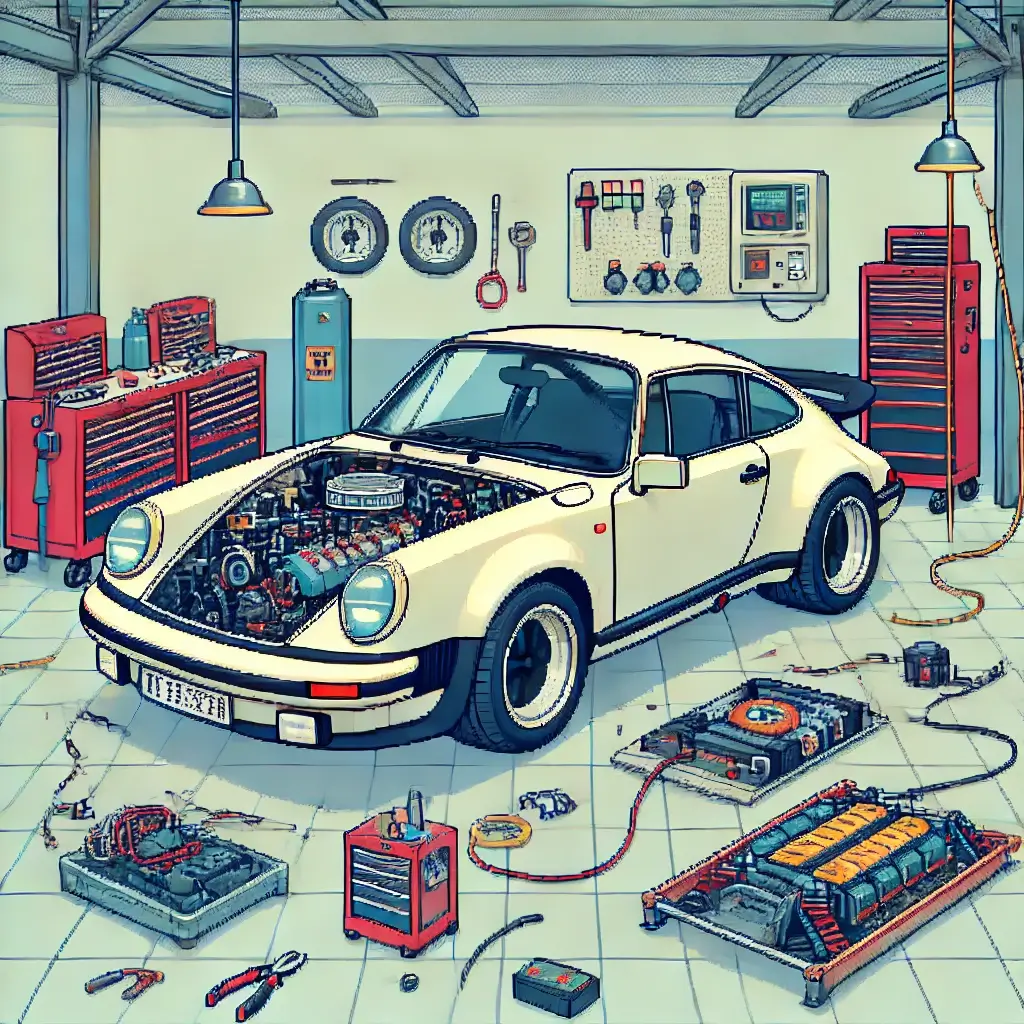
Electrifying Classics: 5 Mind-Blowing EV Conversions You Need to See!
Hey gearheads and eco-warriors! Have you ever looked at a beautifully sculpted classic car and thought, “Man, if only this thing didn’t guzzle gas like there’s no tomorrow, and maybe, just maybe, didn’t leave a cloud of exhaust in its wake?”
Well, you’re not alone! The world of classic car EV conversions is absolutely exploding, and for good reason. It’s where the timeless elegance of yesteryear meets the cutting-edge technology of tomorrow. Imagine cruising in a vintage Porsche 911, an iconic VW Bus, or even a rugged Land Rover Defender, but with instant torque, silent operation, and zero emissions. Sounds like a dream, right? Trust me, it’s very much a reality, and it’s exhilarating!
I’ve been knee-deep in this fascinating trend, watching incredible builds unfold and even getting my hands dirty on a few projects myself. It’s not just about being green; it’s about preserving automotive history while making it relevant for generations to come. Plus, let’s be honest, the performance boost from an electric powertrain in a lightweight classic can be utterly breathtaking. We’re talking about a whole new level of “sleeper” cars here!
So, buckle up! In this ultimate guide, we’re going to dive deep into the electrifying world of **classic car EV conversions**. We’ll cover everything from the initial spark of an idea to the rubber hitting the road. We’ll talk about meticulous build logs, where to source those crucial components, and share some real talk about the challenges and triumphs you’ll face. Ready to turn that classic into an electric beast? Let’s get charged!
—
Table of Contents
- 1. Why Go Electric with Your Classic? It’s More Than Just Eco-Friendly!
- 2. Picking Your Dream Machine: What Makes a Good Candidate for an EV Conversion?
- 3. The Nitty-Gritty: Planning Your EV Conversion Project Like a Pro
- 4. Component Sourcing: Where to Find the Gold for Your EV Conversion
- 5. The Build Log Unveiled: Step-by-Step Towards an Electric Classic
- 5.1. The Grand Teardown: Out with the Old, In with the New Philosophy
- 5.2. Drivetrain Mounting: Precision is Your Best Friend
- 5.3. Battery Packaging and Safety: Your Top Priority!
- 5.4. Wiring and Integration: The Spaghetti Monster Tamed
- 5.5. First Spark and Beyond: Testing, Tuning, and the Thrill of the First Drive
- 6. Common Pitfalls and How to Avoid Them: Learn From My (and Others’) Mistakes!
- 7. Is an EV Conversion Right for You? The Honest Truth.
- 8. The Future is Electric: Join the Revolution!
—
1. Why Go Electric with Your Classic? It’s More Than Just Eco-Friendly!
Let’s kick things off with the “why.” Sure, environmental concerns are a huge driver for many, and rightly so. Fewer emissions, cleaner air – it’s a win-win for Mother Earth. But honestly, that’s just the tip of the iceberg when it comes to **classic car EV conversions**.
For starters, think about performance. Traditional classic cars, bless their mechanical hearts, often come with tired old engines that might produce a respectable amount of horsepower, but torque? Not always their strong suit, especially off the line. Electric motors, on the other hand, deliver instant, mind-bending torque from 0 RPM. That classic Porsche 356 you’ve always adored? Imagine it launching with the urgency of a modern sports car. It’s a truly exhilarating experience that breathes new life into these automotive icons.
Then there’s reliability. Old gasoline engines can be finicky. Carburetor issues, leaky seals, overheating – the list goes on. An electric powertrain, while complex in its own way, typically has far fewer moving parts. This means less maintenance, fewer breakdowns, and more time enjoying your ride rather than tinkering under the hood (though a bit of tinkering is part of the fun, right?). You get modern-day reliability in a timeless package.
And let’s not forget the “cool” factor. Showing up in a meticulously restored classic that purrs silently, then silently zooms away? That turns heads like nothing else. It’s a conversation starter, a statement, and a testament to clever engineering and a forward-thinking mindset. Plus, with the increasing restrictions on internal combustion engines in urban areas, an EV-converted classic future-proofs your beloved vehicle, ensuring you can enjoy it for decades to come.
2. Picking Your Dream Machine: What Makes a Good Candidate for an EV Conversion?
So, you’re convinced. You want an electric classic. But which one? Not every classic car is an ideal candidate for an EV conversion, though with enough willpower (and cash), anything is possible!
From experience, here’s what to look for:
- Rust-Free Chassis: This is non-negotiable. You’re going to be adding significant weight with batteries, and you need a solid foundation. Don’t skimp here. A rusty chassis is a money pit, and frankly, a safety hazard. Get it thoroughly inspected!
- Good Structural Integrity: Related to rust, but also considering the overall design. Some older cars might flex more than you’d like under the new stresses. Cars with a separate body-on-frame construction (like old trucks or SUVs) can sometimes be easier to work with, as battery placement is more flexible.
- Sufficient Space for Batteries: This is the big one. Batteries are bulky, heavy, and need to be strategically placed for weight distribution and safety. Look for cars with generous engine bays, trunk space, or even under the floorboards where you can cleverly integrate battery packs. VW Buses, older Beetles (with their empty front trunks and rear engine bays), and many American muscle cars often provide good opportunities.
- Desirable Aesthetics: Let’s be real, you’re doing this because you love the car’s look. Pick something that truly resonates with you, something that will make you smile every time you look at it. The mechanicals will change, but the soul of the car (its design) remains.
- Manual Transmission (Optional but Recommended): Many converters choose to retain the manual gearbox, often locking it into second or third gear. This allows for mechanical gear reduction, which can simplify the motor selection and reduce the need for a custom gearbox adapter. Plus, for some, shifting gears is part of the classic car experience.
Some popular choices I’ve seen include classic Beetles, Porsche 911s (especially older air-cooled models), Mini Coopers, Land Rover Defenders, and even classic American pickups. Each presents its own unique set of challenges and rewards, but the common thread is a passionate owner ready to embark on an adventure.
3. The Nitty-Gritty: Planning Your EV Conversion Project Like a Pro
Alright, you’ve got your classic car, and you’re buzzing with excitement. Now comes the really fun part: planning! This isn’t just about ripping out the old engine; it’s about meticulously designing a new powertrain that works seamlessly with your vehicle. Think of yourself as an automotive architect.
This phase is critical. A well-planned project saves headaches, money, and time down the road. Trust me, I’ve seen projects stall (and even fail) due to insufficient planning. Here’s a breakdown of the key components you’ll need to consider and how to approach them:
3.1. Motor Selection: Horsepower, Torque, and Your Inner Speed Demon
This is where the magic happens! The electric motor is the heart of your **EV conversion**. You have a few main options:
- AC Induction Motors: These are robust, reliable, and often used in industrial applications. They’re a good choice for many conversions due to their efficiency and relatively simple control. Tesla motors (salvaged or purpose-built) fall into this category and are increasingly popular due to their power density.
- Permanent Magnet Synchronous Motors (PMSM): These offer higher power density and efficiency than AC induction motors, meaning more power for a given size and less energy waste. They’re often found in modern EVs and can be a great, albeit sometimes more expensive, option.
When choosing, think about your target performance. Do you want something that matches or slightly exceeds the original car’s performance, or are you aiming for supercar-level acceleration? Remember, more power often means more expensive components and potentially larger, heavier battery packs.
Crucially, you’ll need to consider how the motor connects to your drivetrain. Will you use an adapter plate to mate it to the existing transmission, or go for a direct drive (often requiring a custom differential)? This is where things get really custom, and often requires professional fabrication or specialized kits.
3.2. Battery Power: Range Anxiety vs. Real-World Driving
The batteries are your fuel tank, and they dictate your range. This is often the most expensive single component in an **electric car conversion**.
- Lithium-ion (Li-ion): This is the go-to chemistry for EVs due to its high energy density (more power per pound). You’ll typically be looking at modules from salvaged EVs (like Nissan Leaf, Tesla, or Chevy Bolt) or new purpose-built cells.
The total capacity (measured in kWh) will determine your range. A good rule of thumb for a decent daily driver conversion is at least 30-40 kWh for 100-150 miles of range, but this varies wildly depending on vehicle weight, driving style, and aerodynamics. More capacity means more batteries, which means more weight and less space for… well, anything else!
Placement is key. You need to distribute the weight evenly to maintain the car’s handling characteristics. This often means placing packs in the original engine bay, trunk, and sometimes even custom-built enclosures under the floor. Safety is paramount here; proper enclosure, cooling (if necessary), and fusing are non-negotiable.
3.3. BMS and Controller: The Brains of Your Electric Beast
These two components are the unsung heroes of your **EV conversion**:
- Battery Management System (BMS): This is your battery’s guardian angel. It monitors individual cell voltages, temperatures, and overall pack health. It balances the cells during charging and discharging, preventing overcharging or over-discharging which can severely damage or even destroy your battery pack. A robust, reliable BMS is absolutely essential for safety and longevity.
- Motor Controller (Inverter): This is the “brain” that translates your accelerator pedal input into electrical signals that control the motor’s speed and torque. It’s a highly sophisticated piece of electronics that manages power flow, regenerative braking, and often communicates with other vehicle systems. Matching the controller to your chosen motor is crucial for optimal performance.
These components often come as a matched set, especially if you’re salvaging from a modern EV, but standalone options are also available. Don’t skimp on quality here; these are complex systems that directly impact your car’s safety and performance.
3.4. Auxiliary Components: Don’t Forget the Small Stuff!
While not as glamorous, these are vital:
- DC-DC Converter: Your main battery pack operates at high voltage (often 100V+), but your car’s original 12V system (lights, wipers, radio, etc.) still needs power. The DC-DC converter steps down the high voltage to 12V.
- Vacuum Pump: Most classic cars rely on engine vacuum for power brakes. With no engine, you’ll need an electric vacuum pump to maintain braking assistance.
- Electric Heater/AC: Your old heater core used engine heat. You’ll need an electric heater for warmth and potentially an electric AC compressor for cooling.
- Charging Port: You need a way to charge your new EV! This involves selecting a standard (J1772 for North America/Japan, Type 2 for Europe, or CCS/CHAdeMO for fast charging) and integrating it cleanly into the car’s body.
- Gauges/Display: Your old fuel gauge and tachometer are now useless. You’ll want new gauges or a digital display to show battery state of charge, motor temperature, and other relevant EV metrics.
Each of these components adds to the complexity and cost, but they’re essential for a complete, functional, and safe **electric car conversion**.
4. Component Sourcing: Where to Find the Gold for Your EV Conversion
Now that you know what you need, where do you get it? This is where the hunt begins, and it’s part of the fun (and sometimes frustration) of **EV conversions**.
There are generally two main approaches:
- Salvage/Donor Cars: This is often the most cost-effective way to get a complete powertrain. A wrecked Nissan Leaf, Chevy Bolt, or Tesla can provide a motor, inverter, some battery modules, and even a DC-DC converter and charger. The challenge is ensuring the components are undamaged and understanding their specific integration requirements. Plus, you’ll need the expertise to safely extract high-voltage components.
- Purpose-Built EV Conversion Kits/Components: Several companies specialize in selling new, off-the-shelf components designed specifically for EV conversions. These include motors, controllers, battery modules, and often complete “plug-and-play” systems. While more expensive, they often come with better documentation, support, and are engineered to work together, simplifying the integration process.
Here are some reliable resources I’ve found incredibly useful. These aren’t just storefronts; they’re often hubs of knowledge, offering forums, guides, and customer support. Always do your research, read reviews, and don’t be afraid to reach out to their technical teams with your specific questions.
Electric GT – Motors & Systems
EV West – Comprehensive Kits & Parts
OpenEV – DIY Components & Resources
Remember, sourcing isn’t just about buying parts. It’s about building relationships with suppliers, understanding lead times, and ensuring compatibility. Don’t be afraid to buy a few books or subscribe to online forums dedicated to EV conversions. The collective knowledge of the community is priceless!
5. The Build Log Unveiled: Step-by-Step Towards an Electric Classic
This is where your vision truly comes to life. A **detailed build log** is more than just a diary; it’s your blueprint, your troubleshooting guide, and ultimately, a testament to your hard work. Think of this as the main event, the thrilling montage where all your planning turns into tangible progress!
Having been through this process myself, I can tell you it’s a mix of immense satisfaction and head-scratching moments. But every challenge overcome makes the final result even sweeter.
5.1. The Grand Teardown: Out with the Old, In with the New Philosophy
This is arguably the most satisfying (and messy) part for many. Get ready to strip out everything that makes your classic car run on fossil fuels. We’re talking engine, transmission, fuel tank, exhaust system, radiator, and all associated lines and wiring. Label everything! Even if you think you’ll remember, you won’t. Trust me on this one. Take pictures, lots of them, from every angle. This documentation will be invaluable when you start installing the new components.
This phase is also the perfect time for a thorough cleanup. Degrease the engine bay, inspect for any hidden rust (even if you did before, do it again!), and repair any structural issues. A clean canvas makes for a better build.
5.2. Drivetrain Mounting: Precision is Your Best Friend
Once the old powertrain is out, you’ll start fabricating or installing the motor mounts and the adapter plate to connect your electric motor to the existing transmission (if you’re retaining it) or the differential. This needs to be precise. Any misalignment can lead to vibrations, premature wear, and even catastrophic failure.
This often involves custom fabrication, which can be done by a skilled welder or a specialized shop. Measure twice (or ten times!), cut once. Mock up your components before final welding to ensure everything clears and fits perfectly.
For those keeping the manual transmission, you’ll typically “lock” it into a higher gear (like 2nd or 3rd) and remove the clutch mechanism. The electric motor will provide all the torque you need without needing to shift, though some enthusiasts retain the clutch for a more “authentic” driving feel, using it primarily for starting from a standstill.
5.3. Battery Packaging and Safety: Your Top Priority!
This is probably the most critical part of the **EV conversion** when it comes to safety. Your batteries need to be securely mounted, protected from impact, and adequately cooled (if required by your battery chemistry/application). Fabricate robust enclosures, ideally from steel or aluminum, to protect the battery modules. Ensure proper ventilation, and consider active cooling if you’re pushing serious power or live in a hot climate.
Weight distribution is key here. Try to spread the battery weight as evenly as possible to maintain the car’s original handling characteristics. This might mean placing some packs in the front, some in the rear, and possibly even some in a custom-built floor compartment. Always consider crash safety – where would the batteries go in an impact, and how can you mitigate that?
5.4. Wiring and Integration: The Spaghetti Monster Tamed
If you’re not comfortable with electrical work, this is where you call in a pro! There are two main wiring systems:
- High Voltage (HV) System: This carries the power from your battery pack to the motor controller and motor. Use appropriately sized, orange-colored (industry standard for HV) cables. All connections must be robust, insulated, and fused correctly. Safety interlocks (to automatically disconnect HV power in case of an accident or system fault) are crucial.
- Low Voltage (LV) System: This is your car’s original 12V system, powered by the DC-DC converter. You’ll need to integrate new components like the electric vacuum pump, electric heater, and new gauges into this system.
Proper wire routing, crimping, and insulation are paramount. A single loose connection in the HV system can be incredibly dangerous. Take your time, double-check everything, and follow electrical safety guidelines religiously.
5.5. First Spark and Beyond: Testing, Tuning, and the Thrill of the First Drive
Once everything is connected, it’s time for the moment of truth. But don’t just hit the “on” switch and go for a joyride! Start with static tests: check voltage levels, motor controller readings, and BMS status. Ensure all safety systems are functioning. Power up the low-voltage system and check all the ancillary components.
Once you’re confident, move to low-speed tests in a safe, controlled environment. Listen for unusual noises, check temperatures, and monitor your new gauges. Gradually increase speed and load. This is also the time for tuning – adjusting controller parameters for optimal performance, regenerative braking settings, and throttle response. Many modern motor controllers offer software interfaces for fine-tuning that can dramatically change the driving experience.
And then… the first real drive. There’s truly nothing like it. The silent acceleration, the effortless torque, the feeling of driving your beloved classic, reborn as a whisper-quiet, incredibly powerful electric machine. It’s a moment you’ll never forget.
6. Common Pitfalls and How to Avoid Them: Learn From My (and Others’) Mistakes!
No project this ambitious goes off without a hitch. Believe me, I’ve had my share of “aha!” moments that were preceded by “oh no!” moments. Here are some common pitfalls in **classic car EV conversions** and how to sidestep them:
- Underestimating Budget and Time: This is the big one. EV conversions are not cheap, and they are not quick. Components are expensive, and custom fabrication takes time. Double your initial budget and triple your estimated timeline. Seriously. It’s better to be pleasantly surprised than utterly disheartened.
- Ignoring Weight Distribution: Just slapping batteries wherever they fit is a recipe for disaster. Your car’s handling will be thrown off, making it unsafe and unpleasant to drive. Spend time calculating weight distribution and planning battery placement. Some professional conversion shops even use CAD software to model this.
- Insufficient Cooling: Electric motors, controllers, and especially batteries generate heat, especially under load. Overheating can lead to reduced performance, premature component failure, and in the case of batteries, a serious fire risk. Don’t neglect proper cooling solutions (fans, liquid cooling, etc.) as needed.
- Poor Wiring and Insulation: High voltage is no joke. Shoddy wiring, exposed terminals, or insufficient insulation are accidents waiting to happen. Invest in quality tools, proper high-voltage cables, and use heat shrink, cable glands, and proper fusing. If you’re unsure, hire a qualified automotive electrician for this part.
- Ignoring Local Regulations: Before you even start, check your local laws regarding vehicle modifications and EV conversions. Some regions have strict inspection requirements, while others might offer incentives. Don’t get 90% through the build only to find you can’t register it.
- Lack of Documentation: Remember those photos and labels from the teardown? Keep that going. Document every step, every connection, every component used. This “build log” is your best friend for troubleshooting, future maintenance, and even for showing off your masterpiece!
The key takeaway? Patience and meticulousness are your greatest allies. Don’t rush, don’t cut corners, and don’t be afraid to ask for help from the thriving EV conversion community.
7. Is an EV Conversion Right for You? The Honest Truth.
So, after reading all this, you might be thinking, “This sounds amazing! Or, “This sounds like a monumental task!” Both are correct!
An **EV conversion** is not for everyone. It requires:
- Significant Financial Investment: Even a budget build can run tens of thousands of dollars. High-end conversions can easily hit six figures.
- Technical Skill: You need a good understanding of mechanics, electrical systems, and ideally, a willingness to learn fabrication. If you’re purely a wrench-turner, be prepared to dive into electronics.
- Time and Patience: This isn’t a weekend project. It will likely take months, if not years, of dedicated effort.
- Problem-Solving Mindset: You will encounter unforeseen challenges. You need to be resourceful, persistent, and enjoy figuring things out.
- Space and Tools: A dedicated workshop space and a decent set of tools (including specialized electrical safety gear) are essential.
However, if you possess these qualities, the reward is truly immense. You get a unique vehicle that combines the best of both worlds: classic aesthetics and modern performance, reliability, and environmental friendliness. It’s a deeply personal project, a creative outlet, and a source of immense pride.
I can tell you from personal experience, driving a classic car that you’ve personally converted to electric power is an experience unlike any other. It’s quiet, powerful, and utterly unique. The looks you get, the conversations it sparks – it’s just fantastic.
8. The Future is Electric: Join the Revolution!
The world of **classic car EV conversions** is not just a niche hobby; it’s a rapidly growing movement. As battery technology improves and electric powertrains become more commonplace, the possibilities for transforming our beloved vintage vehicles will only expand. We’re on the cusp of a truly exciting era where automotive history is preserved, revitalized, and future-proofed.
Whether you’re an experienced mechanic, an electronics wizard, or just a passionate car enthusiast with a dream, I hope this detailed guide has given you a comprehensive overview and inspired you to consider embarking on your own electric adventure. It’s challenging, rewarding, and undeniably cool. So, what classic are you going to electrify first?
Get out there, get creative, and let’s electrify the future, one classic at a time!
—
Classic car EV conversions, Electric powertrain conversion, Vintage electric cars, EV conversion parts, DIY EV build