
The 1,100 Lives He Saved: Why Schindler’s List (1993) Still Haunts Us
There are some movies you simply watch, and then there are others that leave an indelible mark on your soul, reshaping the way you view history and humanity.
Steven Spielberg’s 1993 masterpiece, *Schindler’s List*, is one of the latter.
I remember the first time I saw it, probably in my early twenties, and I was completely unprepared for the emotional gut punch it delivered.
I had read about the Holocaust in school, seen grainy footage, and even visited a museum exhibit or two.
But *Schindler’s List* wasn’t just a lesson; it was an experience, a raw and unflinching look at the darkest chapter of human history, illuminated by a single, flickering candle of hope.
This isn’t just a film review; it’s a deep dive into why this movie, over 30 years later, remains one of the most important cinematic achievements of all time.
It’s a conversation about what it means to be a witness, a survivor, and ultimately, a person capable of extraordinary change.
Let’s talk about the film that taught a generation what it means to truly make a difference.
I mean, what’s a little emotional turmoil when you’re exploring the depths of human decency, right?
Stick with me, because this story is far too important to let fade away.
This is about the film, the history, and the man who, against all odds, chose to save lives.
Table of Contents
***
The Audacity of Hope: Unpacking Schindler’s List (1993)
When you sit down to watch *Schindler’s List*, you’re not just preparing for a film; you’re preparing for a cinematic event that will test your emotional limits.
I’ve had friends tell me they couldn’t get through it, and I completely understand why.
The film doesn’t shy away from the horrific realities of the Holocaust.
It places you right in the middle of it, an uncomfortable and necessary position.
Spielberg’s decision to shoot the film almost entirely in black and white wasn’t just an artistic choice; it was a way of creating a visual time capsule, a stark and somber reflection of the era.
It immediately strips away any sense of modern comfort, forcing you to confront the past head-on.
The film’s opening, with the flickering flame of a Shabbat candle, is the last burst of color we see until its final, powerful moments.
This simple yet profound choice sets the stage, telling us that color, life, and hope have been all but extinguished.
Then we’re introduced to Oskar Schindler, a suave, charismatic member of the Nazi Party who arrives in Kraków with a clear goal: to get rich off the war.
He’s a classic opportunist, a smooth talker who knows how to charm both the Nazi elite and the Jewish black marketeers.
His early scenes are almost a masterclass in how to game a system, and for a moment, you almost feel a grudging admiration for his hustle.
He uses his connections to acquire an enamelware factory and, to save money, he employs Jewish workers from the ghetto.
For Schindler, they are just cheap labor, a means to an end.
But this is where the movie begins to work its magic, subtly and slowly transforming our understanding of the man.
This transformation is the heart of the film, and it’s handled with such grace and subtlety that it feels entirely earned.
He’s not a hero from the start; he’s a flawed, self-serving individual who finds himself on an unexpected path to redemption.
I think this is why the movie is so powerful.
It doesn’t give us a perfect hero to root for.
It gives us a very real, very human man who had to *choose* to become a hero.
That choice, against the backdrop of unimaginable horror, is what makes his story so compelling and so important to remember.
It’s a powerful reminder that even in the darkest of times, an individual choice can change everything.
The film’s pacing is deliberate, almost agonizingly so, especially as it builds toward the liquidation of the Kraków Ghetto.
Spielberg uses a handheld camera in many of these scenes, giving them a raw, documentary-like feel that is deeply unsettling.
The chaos, the terror, the sheer senselessness of the violence—it’s all captured with a horrifying clarity that leaves you breathless.
It’s in these moments that the film’s unflinching honesty shines through, refusing to sanitize history for the sake of the audience’s comfort.
The sounds of screams and gunfire are contrasted with the quiet, devastating moments of loss, like a father trying to comfort his daughter as they are separated forever.
The film doesn’t just show you the big picture; it shows you the individual tragedies that make up the whole.
And that, I believe, is what makes it so emotionally resonant and, frankly, so hard to watch.
It forces you to see the people, not just the statistics.
It forces you to confront the very real human cost of prejudice and hatred.
***
From Opportunist to Hero: The Complex Character of Oskar Schindler
Liam Neeson’s portrayal of Oskar Schindler is nothing short of iconic, a masterclass in nuance and emotional depth.
When the film begins, Schindler is a charmer, a hedonist who enjoys the finer things in life: good food, expensive suits, and the company of beautiful women.
He sees the war as an opportunity for profit, and he’s not shy about it.
He’s driven by ambition and greed, a classic capitalist whose moral compass is, at best, a bit rusty.
But the seeds of his transformation are sown early on, primarily through his relationship with Itzhak Stern, his Jewish accountant, played with quiet dignity by Ben Kingsley.
Stern is the moral center of the film, a man of unwavering integrity who sees through Schindler’s flashy exterior.
He is the one who understands the true value of Schindler’s factory: it’s not a place for making money, but a place for saving lives.
He subtly manipulates the system, ensuring that Schindler’s workforce is not just made up of healthy young men, but also rabbis, teachers, and intellectuals—people who would otherwise be deemed “useless” and sent to their deaths.
Schindler’s gradual awakening is a slow burn, a process that happens almost without him realizing it.
It’s not a sudden, dramatic conversion.
Instead, it’s a series of small moments, little cracks in his selfish facade that allow a flicker of empathy to shine through.
There’s a powerful scene where he watches the liquidation of the ghetto from a hilltop, and for the first time, the reality of the situation seems to hit him.
He sees the brutality not as a distant policy, but as the murder of individuals.
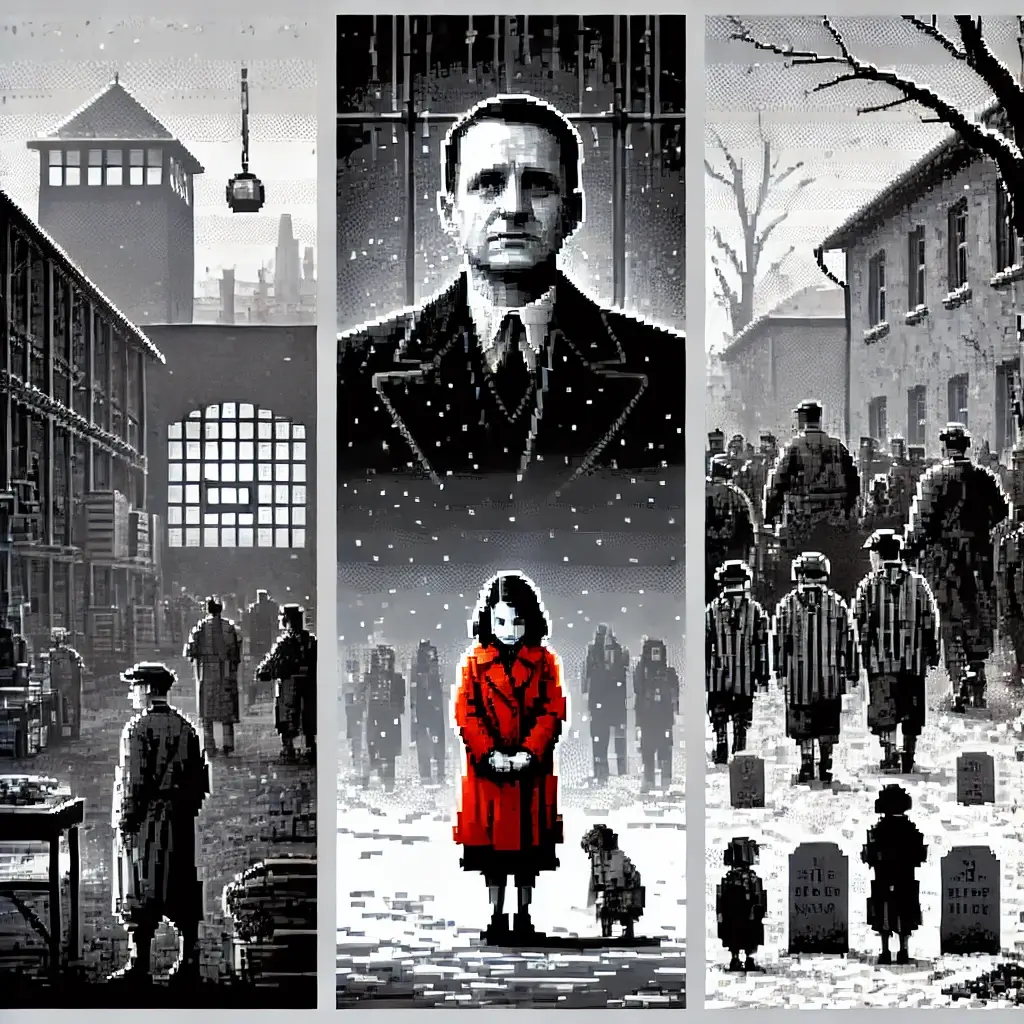
The sight of a little girl in a red coat—the single flash of color in a sea of black and white—is a visual metaphor for the innocence and humanity being extinguished.
This image, burned into his memory, becomes the catalyst for his change.
From that moment on, his focus shifts from making a fortune to saving lives.
He starts bribing officials, spending his entire fortune on protecting his workers, who he now calls “my Jews.”
He uses his charm and influence, the same qualities that once served his greed, to buy freedom for his people.
The scene where he compiles the famous list—the “Schindler’s List”—is one of the most tense and emotionally charged sequences in cinema history.
Every name added is a life saved, a victory against the overwhelming evil of the regime.
He is no longer just a man in a suit; he is a beacon of hope in the darkness.
The real Oskar Schindler was, of course, a deeply flawed person—a womanizer and a Nazi Party member—which makes his transformation all the more extraordinary and authentic.
This film doesn’t glorify him in a way that feels unearned.
It presents a portrait of a complicated man who, when faced with a moral crossroads, chose the path of righteousness.
It’s a powerful lesson that anyone, regardless of their past, has the capacity for immense good.
For more about the real history, this site is a good place to start:Explore the True Story of Oskar Schindler
***
The Chilling Face of Evil: Amon Göth and the Brutality of the Holocaust
Every hero needs a villain, and in *Schindler’s List*, that role is filled by the chillingly sadistic SS-Untersturmführer Amon Göth, played by Ralph Fiennes in a performance that is both terrifying and unforgettable.
I have to admit, there are very few characters in film that have made my skin crawl quite like Göth.
He is not a cartoonish villain; he is a man of casual, bone-deep evil.
He represents the banality of evil that Hannah Arendt wrote about, a man who murders without a second thought, for no reason other than his own amusement.
His introduction, as he stands on the balcony of his villa, casually shooting at prisoners in the Płaszów concentration camp, is one of the most stomach-turning scenes in the film.
He doesn’t do it out of anger or hatred; he does it out of boredom, as if he’s swatting flies.
This casual cruelty is far more terrifying than a raving psychopath because it shows how completely desensitized he is to human life.
Göth’s relationship with Schindler is a fascinating one, a twisted kind of friendship based on their shared love of the high life and a mutual understanding of how the world works.
The two men are, in many ways, two sides of the same coin: charming, intelligent, and ambitious.
But where Schindler ultimately chooses to value human life, Göth sees it as utterly worthless.
Their conversations are often laced with a tense subtext, as Schindler tries to manipulate Göth into showing a modicum of humanity, a request that is always met with chilling indifference.
The scene where Göth attempts to show mercy to his Jewish maid is a masterstroke of psychological horror.
He tries to be “a good man,” to show kindness, but his ingrained prejudice and sadism are too strong.
He physically cannot bring himself to act with empathy, and in the end, he resorts to what he knows best: violence.
This scene is a stark portrayal of how deeply the Nazi ideology had corrupted the souls of its followers, making compassion a foreign and impossible concept.
Fiennes’ performance is so convincing that it’s hard to believe he’s playing a role.
He gained a significant amount of weight and studied historical footage to accurately capture Göth’s physicality and mannerisms.
His eyes are cold, his smile is a grimace, and his presence is a constant threat.
He embodies the monstrous inhumanity that was at the core of the Holocaust, a reminder that evil is not always loud and theatrical, but can be disturbingly quiet and ordinary.
This portrayal is a necessary component of the film, providing the chilling backdrop against which Schindler’s heroism can shine so brightly.
Without the darkness of Göth, the light of Schindler would not be nearly as powerful or as meaningful.
***
The Power of Black and White: Spielberg’s Masterful Aesthetic Choices
As a filmmaker, Steven Spielberg is a legend, but with *Schindler’s List*, he ascended to a new level of artistry.
He chose to shoot this film in a way that completely defied his own signature style, creating something raw, personal, and deeply intimate.
The decision to shoot in black and white was, as I mentioned, more than just an aesthetic choice.
It was a statement.
It connected the film directly to the historical photographs and newsreels of the era, blurring the line between cinematic recreation and historical document.
It’s a technique that immediately gives the film a sense of authenticity and solemnity, forcing the audience to take it seriously.
The lack of color makes the rare instances of it even more impactful, most notably the little girl in the red coat.
This single splash of color is, to me, the most important visual element in the entire film.
It’s a powerful symbol of innocence, of the individual life being lost in the chaos of mass death.
For Schindler, seeing her is a moment of clarity, a realization that the people he is watching are not just numbers or “statistics,” but real children with real lives, real families, and real futures being stolen from them.
Later, when he sees her body in a pile of the deceased, the red coat is a devastating confirmation that even this tiny spark of life has been extinguished.
It’s a perfect example of visual storytelling that speaks volumes without a single line of dialogue.
Another brilliant choice was Spielberg’s use of handheld cameras, particularly in the chaotic scenes of the ghetto liquidation.
This technique gives the film a vérité style, making you feel like you are right there in the middle of the terror, a silent witness to the atrocities.
The camera is shaky, it’s frantic, and it reflects the panic and confusion of the people being herded and murdered.
It makes the horror feel immediate and personal, not something distant and removed.
And let’s not forget the score by John Williams, a longtime Spielberg collaborator.
Williams’ work here is stripped down and haunting, a world away from his soaring, heroic themes for films like *Star Wars* or *Indiana Jones*.
The main theme, featuring Itzhak Perlman on the violin, is a mournful melody that captures the immense sadness and dignity of the people whose stories are being told.
The music is not used to manipulate emotions, but to deepen them, to provide a quiet, mournful backdrop to the unspeakable events on screen.
All of these elements—the black and white, the red coat, the handheld camera, the minimalist score—come together to create a film that is not just visually stunning, but emotionally devastating in the most profound way.
It’s a film that earns its place in history not just because of its subject matter, but because of the unparalleled artistry with which it was created.
For a detailed breakdown of the film’s unique production, check out this great resource:Explore the IMDB Page for Schindler’s List
***
More Than Just a Movie: The Enduring Legacy of the 1,100
*Schindler’s List* is more than just a piece of entertainment; it’s a vital piece of living history.
The film’s incredible success and critical acclaim allowed Spielberg to establish the **USC Shoah Foundation**.
This organization has one primary goal: to record and preserve the testimonies of Holocaust survivors and witnesses.
I find this part of the story almost as moving as the film itself.
Instead of just taking the profits and moving on, Spielberg used his platform and his resources to ensure that the voices of those who experienced this horror would never be silenced.
The Shoah Foundation has collected tens of thousands of video testimonies, creating an invaluable archive for future generations.
It ensures that the phrase “never forget” is not just a slogan, but an active, ongoing effort.
The film also had a profound impact on how the Holocaust was taught in schools and discussed in popular culture.
For many young people, *Schindler’s List* was their first real exposure to the horrors of the Holocaust, a visceral and immediate way of understanding a historical event that could otherwise feel distant and abstract.
The film gave a face to the victims and a name to a savior, making the story feel personal and tangible.
The final scene of the film, where the real-life Schindlerjuden (Schindler’s Jews) and the actors who portrayed them walk hand-in-hand to place stones on Schindler’s grave, is one of the most breathtaking and emotional conclusions in all of cinema.
It’s a moment that bridges the gap between the film and reality, reminding us that these were not just characters on a screen, but real people whose lives were saved by a man who made the ultimate choice to do good.
The sight of the stones, a traditional Jewish custom to honor the deceased, is a powerful symbol of their enduring gratitude and the memory that lives on.
This scene, filmed in color, is the perfect ending, bringing back the life and vibrancy that had been so conspicuously absent throughout the rest of the film.
It’s a flicker of hope, a testament to the lives that were saved, and a powerful statement that good can, and does, triumph over evil.
The legacy of the 1,100 lives saved is a testament to the idea that one person’s actions can change the world.
Schindler’s story is a reminder that courage and humanity are not defined by grand gestures, but by the small, quiet choices we make every single day.
If you’d like to learn more about the Shoah Foundation and its incredible work, I highly recommend checking out their website:Learn More About the USC Shoah Foundation
***
Why We Can Never Forget: The Lasting Impact on My Soul
The thing about *Schindler’s List* is that it doesn’t just show you history; it makes you feel it.
I remember sitting in the theater, and when the film ended, there was a profound silence.
No one moved for a long time.
We were all just sitting there, trying to process the emotional weight of what we had just witnessed.
It’s a film that leaves you changed.
It forces you to ask difficult questions about good and evil, about complicity and courage, and about the fundamental responsibility we have to one another.
It makes you wonder, “What would I have done?”
And that’s the most important question of all.
Schindler’s story is not a fairy tale.
It’s a brutal, honest, and deeply human story about the best and worst of what we are capable of.
It shows us that even in the darkest of times, light can be found, and that a single person, driven by a flicker of conscience, can create a ripple effect that saves a thousand lives.
The film’s message is as relevant today as it was in 1993, a timeless warning against the dangers of hatred and indifference.
It reminds us that we are all witnesses to history, and that we have a moral obligation to stand up for what is right, no matter the cost.
So, if you’ve never seen it, I urge you to watch it.
If you have, I urge you to watch it again.
It’s a difficult journey, but it’s one we all need to take, to remember the past and to ensure a better future.
It is a film that will forever be a part of our collective consciousness, a powerful and necessary reminder of the strength of the human spirit.
And that, my friends, is a legacy worth celebrating and remembering for generations to come.
***
Schindler’s List, Steven Spielberg, Holocaust, Oskar Schindler, Amon Göth