
7 Jeep Off-Road Modifications That Will Absolutely Change Your Life
Hey there, fellow Jeep lover, and welcome to the deep end of the off-roading rabbit hole.
If you’re reading this, chances are you’ve already felt the itch—that undeniable urge to take your rig beyond the pavement and onto the trails.
Maybe you’ve been out once or twice and realized your stock Jeep is, well, just a little bit shy of its full potential.
Or maybe you’ve spent countless hours scrolling through Instagram, drooling over those epic builds and thinking, “How the heck do they do that?”
Don’t worry, you’re in the right place.
I’ve been there, staring at a catalog of parts with my wallet sweating bullets, trying to figure out what’s a must-have and what’s just a shiny accessory.
After years of turning wrenches, busting knuckles, and recovering my buddies (and myself) from situations I’d rather not talk about, I’ve learned a thing or two about off-road modifications.
This isn’t just a list of parts; it’s a blueprint for turning your daily driver into a trail-dominating beast.
We’re going to get our hands dirty and talk about specific modifications for two iconic Jeep models: the modern JL Wrangler and the legendary, rugged XJ Cherokee.
This guide will show you how to do it right, why certain mods are crucial, and how to avoid making costly mistakes.
So, grab a cold one, get comfortable, and let’s talk about some serious off-road modifications that will transform your Jeep.
Table of Contents
An Off-Roading Mindset: More Than Just Parts
Before we even get to the fun stuff, let’s have a quick chat about the philosophy of building a trail rig.
I’ve seen so many people get it backward.
They buy a lift kit because it looks cool, slap on the biggest tires they can afford, and then wonder why their Jeep handles like a drunken octopus on the highway and breaks down on the trail.
The best off-road modifications are not about looks; they are about purpose.
They should be chosen based on what you want to do with your Jeep, where you want to go, and what you’re willing to spend.
Are you a weekend warrior hitting fire roads and easy trails?
Or are you trying to conquer the Rubicon Trail and spend a week camping in the wilderness?
Each path requires a different set of priorities.
Start with a plan, a budget, and a realistic understanding of your skills and the capabilities of your vehicle.
Don’t be that guy who buys a brand-new winch but doesn’t know how to use it.
Knowledge is just as important as the parts themselves.
The Modern Marvel: Essential Off-Road Modifications for Your JL Wrangler
The JL Wrangler is an absolute beast right out of the box.
Jeep really did their homework with this one, giving us a solid foundation to build on.
With its more refined interior, modern engine options, and improved suspension geometry, the JL is arguably the best platform Jeep has ever given us for off-road modifications.
But “good” isn’t “great,” and that’s where we come in.
Let’s talk about how to take your JL from a capable daily driver to an unstoppable trail machine.
The Right Stance: Lifts and Suspension for the JL Wrangler
This is probably the first thing everyone thinks about when they hear “Jeep off-road modifications.”
And for good reason!
A proper lift kit is the gateway to bigger tires, better ground clearance, and an overall more aggressive stance.
But not all lifts are created equal.
You’ve got a few options, and choosing the right one is crucial.
Option 1: The Budget Boost (Leveling Kits and Spacers).
If you’re just looking to fit slightly larger tires (up to about 33 inches) and get a bit more height without breaking the bank, a leveling kit or a simple spacer lift is a great starting point.
These kits use spacers on top of your factory springs to raise the body.
They’re cheap, easy to install, and maintain the factory ride quality.
The downside?
You’re not really improving your suspension’s performance, just its height.
This is a solid choice for the beginner who wants to dip their toes into the world of Jeep off-road modifications.
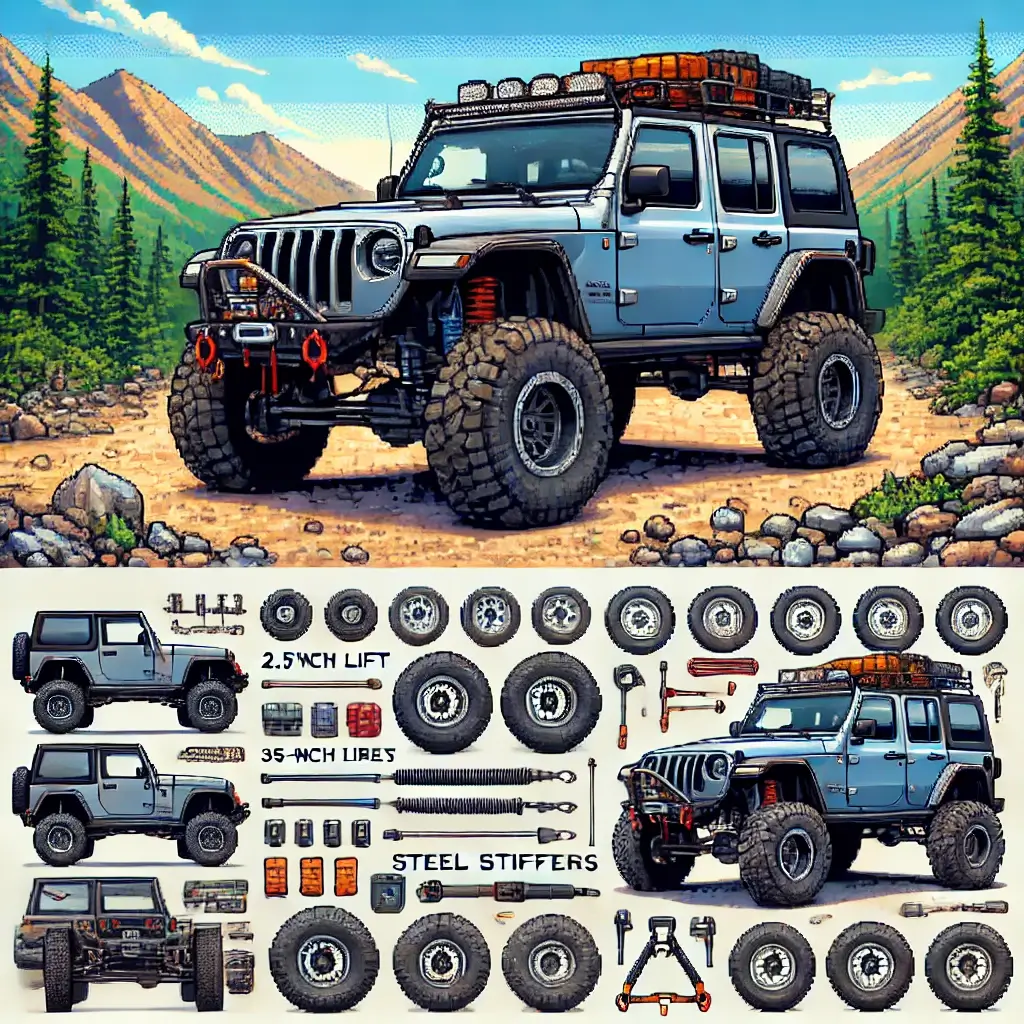
Option 2: The Mid-Range Sweet Spot (2.5-3.5 inch Full Suspension Kits).
This is where things get serious.
A full suspension kit replaces your factory springs and shocks with components designed for off-road performance.
You’ll get new coil springs that provide a better lift and shocks that can handle the abuse of a rocky trail or a bumpy washboard road.
Many of these kits also include adjustable control arms, which help correct your suspension geometry after the lift, preventing issues like “death wobble” and poor handling.
A 2.5-inch lift is the sweet spot for many JL owners, allowing you to comfortably run 35-inch tires without major modifications.
A 3.5-inch lift will let you go up to 37-inch tires, but at this point, you’ll need to start considering other supporting mods like new driveshafts and steering components to keep everything working properly.
My advice? Don’t cheap out on your suspension.
It’s the heart of your off-road performance, and a quality kit will pay for itself in comfort and capability.
Ground Control: Choosing the Best Tires for Your JL Wrangler
Tires are arguably the single most important modification you can make.
You can have the biggest lift and the fanciest shocks, but if your tires can’t grip the terrain, you’re just a glorified paperweight.
When it comes to off-road tires, you’ve got two main categories: All-Terrain (AT) and Mud-Terrain (MT).
All-Terrain (AT) Tires:
AT tires are the workhorse of the off-road world.
They’re a fantastic compromise, offering good grip on the trails while still being quiet and comfortable enough for daily driving.
Their tread pattern is designed to handle a variety of surfaces—rocks, dirt, sand, and even light mud—without wearing down too quickly on the highway.
If your Jeep spends more time on the road than the trail, or if you do a lot of long-distance driving to get to your destinations, an AT tire is probably the best choice for you.
They are a true jack-of-all-trades and a great starting point for any JL off-road modification journey.
Mud-Terrain (MT) Tires:
Now, if your weekends are spent playing in the muck, crawling over giant rocks, and generally punishing your Jeep, an MT tire is where it’s at.
These tires have an aggressive, deep tread pattern with large voids between the lugs that are designed to clean out mud and grab onto everything else.
They’re not quiet on the highway, and they wear down faster, but their performance in tough conditions is second to none.
The larger lugs and reinforced sidewalls also provide better protection against punctures from sharp rocks.
The noise is a small price to pay for the peace of mind they provide when you’re deep in the wilderness.
Most JL owners will go for a 35-inch tire with a 2.5-inch lift, but if you’re a serious crawler, don’t hesitate to jump up to a 37-inch tire, just be ready for the extra cost of supporting off-road modifications.
Battle-Ready: Armor and Protection for the JL
Your Jeep’s factory underbelly is surprisingly exposed.
Rock sliders, skid plates, and steel bumpers aren’t just for looks; they’re essential protective off-road modifications.
Think of them as insurance for your most vulnerable parts.
Rock Sliders:
These are a non-negotiable off-road modification if you plan on doing any serious rock crawling.
They protect the lower body of your Jeep from getting crunched by rocks and ledges, saving you from thousands of dollars in bodywork.
They also double as a convenient step for getting into your lifted rig.
Skid Plates:
Your oil pan, transmission, and transfer case are all sitting ducks underneath your Jeep.
A good set of steel or aluminum skid plates will shield these vital components from impact.
I’ve personally seen a single rock tear a hole in a factory oil pan, turning a fun day into an expensive nightmare.
Don’t skip this.
Steel Bumpers:
The JL’s factory bumper is great for a parking lot, but it’s not made for the trail.
Aftermarket steel bumpers provide a much stronger platform for mounting a winch, a place for recovery points, and better approach and departure angles for clearing obstacles.
They are an investment, but they will save your fenders and radiator from a nasty encounter with a tree or a rock.
Get Yourself Out of Trouble: Winches and Recovery Gear
The golden rule of off-roading is “always be prepared.”
A winch is the ultimate piece of self-recovery gear and one of the most critical off-road modifications you can make.
It’s not a matter of if you’ll get stuck, but when.
When you’re out there alone or even with a group, a winch is your lifeline.
Choose a winch with a rating of at least 1.5 times the gross vehicle weight of your Jeep.
For a JL Wrangler, that usually means a 10,000 to 12,000-pound winch is a safe bet.
Don’t forget the supporting gear: a recovery strap (not a tow strap), some D-shackles, and a tree saver strap are all essential items to have in your recovery bag.
And for heaven’s sake, learn how to use them before you’re in a bad situation.
The Old School King: Off-Road Modifications for the Unkillable XJ Cherokee
Alright, let’s shift gears and talk about a true legend.
The XJ Cherokee isn’t just a vehicle; it’s a cult classic, a legend in its own right.
With its solid axles, legendary 4.0L inline-six engine, and unibody construction, the XJ is a testament to simple, rugged design.
While the JL is a modern marvel, the XJ is a blank canvas, a true hot rod for the trails.
It’s tougher, grittier, and requires a different approach to off-road modifications.
Building Up a Legend: Lift Kits for the XJ Cherokee
Lifting an XJ is a bit different from a JL.
Because the XJ uses leaf springs in the rear, your options are a bit more varied, and you have to be careful to avoid common mistakes.
Budget Lifts (2-3 inches):
For a mild lift, you can use a coil spacer in the front and an Add-A-Leaf (AAL) kit in the back.
This is a cheap way to get a little extra height to clear 30 or 31-inch tires.
But be warned: an AAL will stiffen your rear suspension and can lead to a rougher ride.
A better option for a budget build is a full leaf spring pack replacement, which will give you a much better ride and more articulation.
Serious Lifts (4-6.5+ inches):
This is where the XJ truly comes alive.
A 4.5-inch lift is the most common and versatile choice, allowing you to run 33-inch tires with some fender trimming.
These kits usually come with new full leaf springs, coil springs, new control arms, and a drop pitman arm to correct steering geometry.
Going taller, say 6.5 inches or more, will let you run 35-inch tires or larger, but it also introduces a host of other challenges.
You’ll need a Slip Yoke Eliminator (SYE) kit and a new CV driveshaft to fix driveline vibrations, as well as a more robust steering system to handle the larger tires.
It’s a whole domino effect of off-road modifications.
Fortifying the Foundation: Unibody Stiffeners and Reinforcements for the XJ
Here’s the thing about XJs: they don’t have a traditional frame.
The entire chassis is a unibody, and with the added stress of a lift and bigger tires, that chassis can start to flex and crack over time.
If you’re serious about your XJ off-road modifications, you need to reinforce the chassis.
Unibody stiffeners are weld-on plates that reinforce the weak points of the chassis, particularly in the rocker panel and subframe areas.
Think of it as giving your XJ a skeleton of its own.
Installing them is a major undertaking, often requiring a welder and a lot of patience, but it’s an essential step if you want your rig to last.
Guts and Glory: Drivetrain and Axle Upgrades for the XJ
With bigger tires and a lift, you’re putting a lot more stress on your factory axles and gearing.
The stock Dana 35 rear axle that came on many XJs is notoriously weak.
It’s what we in the community affectionately call a “paperweight.”
Many XJ owners swap it out for a Ford 8.8 rear axle from an Explorer, which is a significant upgrade in strength and reliability.
This is a big job, but one of the most rewarding off-road modifications for an XJ.
Beyond the axles, upgrading your gearing is a game-changer.
When you put on larger tires, you change the final drive ratio, and your engine has to work much harder to turn those big, heavy tires.
The solution is to re-gear your axles with a lower numerical ratio (e.g., going from 3.55 to 4.56 or 4.88).
This brings your engine’s power band back to where it needs to be, restoring lost power and making your rig feel alive again.
It’s not a cheap mod, but it’s one of the most important off-road modifications for an XJ that will make it perform like it should.
Your Journey Begins Now: Final Thoughts on Off-Road Modifications
Whether you’re building a brand-new JL or breathing new life into a classic XJ, the journey of off-road modifications is one of the most rewarding things you can do.
It’s not just about the parts you buy; it’s about the skills you learn, the friends you make, and the incredible places your Jeep will take you.
Don’t be afraid to start small.
A good set of tires and a winch can take you a lot farther than you think.
Learn your rig, understand what it needs, and build it for your purpose.
And remember, the most important rule of all: always have fun out there.
Now get out there and get your hands dirty.
Happy wheeling!
For more inspiration and to find the parts you need, check out these trusted resources:
Quadratec for JL Wrangler Mods
4 Wheel Parts for XJ Cherokee Lifts
RockAuto for Jeep XJ Drivetrain Parts
Jeep, Wrangler, Cherokee, Off-roading, Modifications