
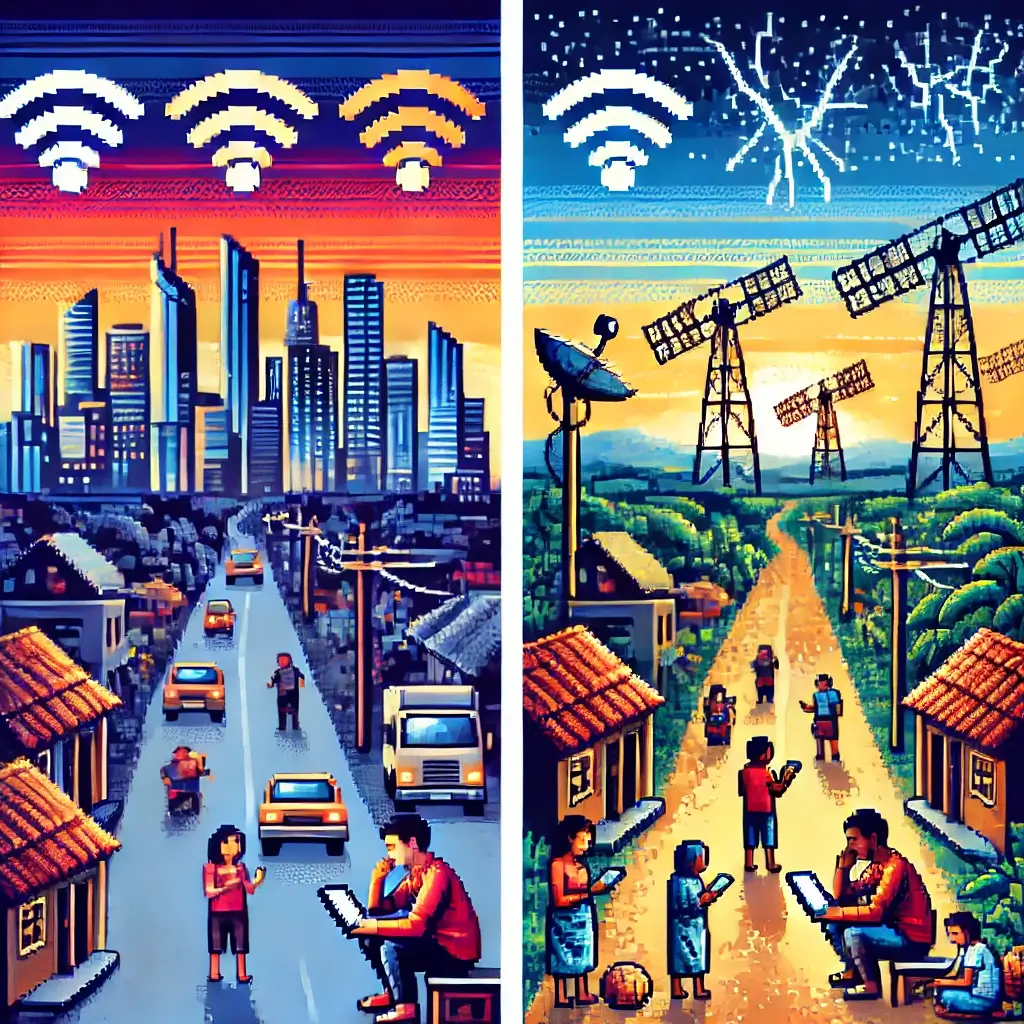
The Shocking 35% Gap: Why Rural Internet Penetration Is Still a Global Crisis!
Hey there, fellow digital citizens!
Let’s chat about something that truly gets my goat: the persistent and frankly, alarming, disparity in global **internet penetration in rural areas**.
You’d think in 2025, with all our fancy gadgets and interconnected lives, everyone would have a fair shot at getting online, right?
Well, think again.
The truth is, while urban centers are practically swimming in high-speed connectivity, a significant chunk of the world’s rural population is still stuck on the digital sidelines.
We’re talking about a whopping 35% gap between urban and rural internet use – a gap that represents billions of people being left behind.
And let me tell you, it’s not just an inconvenience; it’s a fundamental issue of equity, opportunity, and human potential.
So, buckle up, because we’re about to dive deep into this issue, explore why it’s happening, what the consequences are, and what we can actually do about it.
This isn’t just data; it’s about lives, livelihoods, and the future of our global community.
Table of Contents
What’s the Big Deal About Rural Internet? It’s Everything!
You might be wondering, “Why should I care about whether someone in a remote village has internet?”
Fair question.
But let me paint a picture for you.
Imagine your daily life without the internet.
No quick searches for information, no online banking, no connecting with loved ones across the globe, no streaming your favorite shows, and certainly no remote work or online education.
Pretty restrictive, right?
Now, magnify that by a thousand for communities where the internet isn’t just a convenience but a lifeline.
For rural populations, **internet penetration** isn’t just about entertainment; it’s about access to vital services.
Think about it:
Education: Online learning platforms, digital libraries, and virtual classrooms can revolutionize education in areas where physical schools are sparse or under-resourced.
Without reliable internet, rural students are at a significant disadvantage, unable to compete with their urban counterparts in an increasingly digital world.
It’s like trying to run a marathon with one shoe – you’re just not set up for success.
Healthcare: Telemedicine allows patients in remote areas to consult with specialists without traveling hundreds of miles, saving time, money, and potentially lives.
Doctors can access critical information, share medical records securely, and even provide remote diagnoses.
Imagine the relief for someone in a sparsely populated region who no longer has to undertake an arduous journey for a specialist appointment.
Economic Opportunity: The internet opens up a world of possibilities for small businesses, farmers, and entrepreneurs in rural areas.
They can reach wider markets, sell their products online, access agricultural data, and find new revenue streams.
Farmers can monitor weather patterns, market prices, and even livestock remotely, leading to more efficient and profitable operations.
It’s no exaggeration to say that connectivity can literally transform stagnant economies into thriving hubs of innovation.
Social Inclusion: Being connected means staying in touch with family and friends, accessing government services, and participating in the broader societal conversation.
It combats isolation and gives rural voices a platform.
During global crises, like the recent pandemic, the internet became a critical tool for disseminating information and maintaining social connections.
Those without it were truly cut off.
So, when we talk about **internet penetration in rural areas**, we’re not just discussing a technical issue.
We’re talking about fundamental human rights, economic development, and social justice.
It’s about leveling the playing field and ensuring that no one is left behind in the digital age.
The Stark Reality: Unpacking the Numbers on Internet Penetration in Rural Areas
Alright, let’s get down to brass tacks and look at some hard numbers.
Because while anecdotes are powerful, data really drives the point home.
The International Telecommunication Union (ITU), a specialized agency of the United Nations, provides some of the most comprehensive data on global connectivity.
And their findings? Not exactly cheering.
According to their latest reports, about 67% of the world’s population is now online.
That sounds pretty good on the surface, right?
But when you dig a little deeper, the picture gets much gloomier, especially for those living outside bustling cities.
Globally, the gap in internet use between urban and rural areas stands at approximately 35%.
That means for every 100 people in an urban area who are online, only 65 people in a rural area are. Think about that for a second.
It’s like we’re playing a game of digital musical chairs, and a third of the rural population never gets a seat.
In the least developed countries (LDCs), the situation is even more dire.
Only about 27% of the population is online, and the rural-urban gap widens even further.
In some LDCs, the difference in internet penetration between urban and rural areas can exceed 50 percentage points.
Yes, you read that right – over half!
Consider regions like Sub-Saharan Africa, where vast rural populations often lack even basic electricity, let alone internet infrastructure.
While mobile broadband penetration is increasing, the quality and affordability of service in rural areas often lag far behind urban centers.
It’s not just about having a signal; it’s about having a signal strong enough, stable enough, and cheap enough to actually use for meaningful purposes.
Even in developed countries, rural areas often struggle with connectivity.
Take the United States, for example.
While overall internet penetration is high, millions of rural Americans still lack access to broadband speeds defined by the FCC (25 Mbps download / 3 Mbps upload).
The digital divide isn’t just an “over there” problem; it’s a “right here” problem too, impacting communities that are just a few hours’ drive from major metropolitan areas.
These numbers aren’t just statistics on a spreadsheet; they represent real people, real families, and real communities being excluded from the opportunities of the digital age.
It’s a stark reminder that while progress has been made, the race for universal **internet penetration in rural areas** is far from over.
Why the Digital Divide Persists: More Than Just Wires and Towers
So, why is this stubborn **digital divide** between urban and rural areas so hard to close?
It’s not just a single problem with a single solution.
It’s a complex tapestry of economic, geographical, and social challenges.
Let’s break down some of the biggest culprits:
1. The Economics of Density (or Lack Thereof):
This is probably the biggest hurdle.
Internet service providers (ISPs) are businesses, and businesses need to make a profit.
Laying fiber optic cables or building cell towers in densely populated urban areas is economically viable because there are many potential customers per square mile.
But in rural areas, homes are spread out, and the customer base is much smaller.
The cost per customer to deploy infrastructure becomes significantly higher, making it a less attractive investment for private companies.
It’s like trying to sell ice cream in the Sahara – the demand might be there, but the logistics and costs make it a tough business model.
2. Geographical Hurdles:
Think mountains, vast forests, deserts, and remote islands.
Nature, while beautiful, doesn’t always play nice with internet infrastructure.
Building and maintaining networks in challenging terrains can be incredibly expensive and technically difficult.
Imagine trying to lay fiber through a national park or across a major mountain range – it’s a monumental task.
3. The “Last Mile” Problem:
Even if a fiber backbone runs through a rural region, getting that connection the “last mile” to individual homes can be a nightmare.
This is where wireless technologies like fixed wireless or satellite come in, but they often come with their own limitations in terms of speed, latency, and data caps.
It’s the difference between having a superhighway nearby and actually having a paved road leading right to your driveway.
4. Affordability:
Even where infrastructure exists, the cost of internet service can be prohibitive for many rural households.
Rural areas often have lower average incomes, and what might seem like an affordable monthly fee in a city could be a significant burden for a rural family.
Plus, the equipment needed to get online (computers, smartphones) also represents a significant investment.
5. Lack of Digital Literacy and Awareness:
In some cases, people in rural areas might not fully understand the benefits of being online or how to use the technology.
There can be a lack of digital skills, trust in online services, or simply a perceived lack of relevance.
It’s not enough to build the roads; you also need to teach people how to drive on them and convince them that the journey is worthwhile.
6. Policy and Regulatory Gaps:
Inadequate government policies, lack of incentives for ISPs to serve rural areas, and complex regulatory frameworks can also hinder progress.
Sometimes, well-intentioned regulations can inadvertently create barriers to deployment.
It’s a complex puzzle where all these pieces interact, making the challenge of achieving universal **internet penetration in rural areas** incredibly multifaceted.
Beyond the Bytes: The Real-World Impact of Limited Rural Internet Penetration
It’s easy to talk about “digital divides” in abstract terms, but let’s get real about what limited **internet penetration in rural areas** truly means for people’s lives.
It’s not just about missing out on cat videos or the latest TikTok trends.
It’s about fundamental disadvantages that compound over time, creating a cycle of exclusion.
1. Educational Disparity:
This one breaks my heart.
During the pandemic, when schools shifted to remote learning, students in rural areas without reliable internet were simply cut off.
They couldn’t attend virtual classes, access online assignments, or collaborate with peers.
Many had to rely on printed handouts, drive to public Wi-Fi hotspots (if available), or just fall behind.
This creates an “achievement gap” that can last a lifetime, impacting college opportunities and future careers.
Imagine being a bright kid with dreams, only to be held back because your home can’t connect to the world’s knowledge.
It’s a cruel irony in an age of abundant information.
2. Economic Stagnation and Brain Drain:
Without internet, rural businesses struggle to compete.
They can’t easily market their products online, process digital payments, or access global supply chains.
Remote work opportunities, which are a lifeline for many rural economies, become impossible.
This leads to economic stagnation, fewer job opportunities, and eventually, a “brain drain” as young, educated individuals leave rural areas for urban centers where opportunities are more abundant.
It’s a vicious cycle where a lack of connectivity leads to a lack of prosperity, driving away the very talent that could revitalize these communities.
3. Healthcare Deserts:
We touched on this, but it bears repeating.
Rural areas often face a shortage of medical professionals and specialized care.
Telemedicine could fill this gap, allowing patients to consult with doctors hundreds of miles away, reducing travel time and costs, and providing access to specialists who might otherwise be unavailable.
Without it, preventable illnesses go untreated, chronic conditions are poorly managed, and emergency care is delayed.
In some instances, the lack of timely medical advice due to poor connectivity can literally be a matter of life and death.
4. Social Isolation and Limited Civic Participation:
The internet is a powerful tool for social connection and civic engagement.
It allows people to stay informed, participate in local and national dialogues, and connect with communities of interest.
For rural residents without internet, this means increased social isolation, limited access to government services, and a reduced ability to make their voices heard on important issues.
They are effectively shut out of a significant part of modern public life.
The impact of limited **internet penetration in rural areas** is profound and far-reaching, affecting everything from individual well-being to community resilience.
It’s a barrier to progress that we simply cannot afford to ignore.
Bridging the Gap: Innovative Solutions for Enhancing Rural Internet Penetration
Alright, so we’ve established that the problem of limited **internet penetration in rural areas** is real, complex, and impactful.
Now for the good news: people are working on solutions, and some of them are pretty ingenious!
There’s no silver bullet, but a combination of approaches holds the key.
1. Government Subsidies and Funding Programs:
Since the economics don’t always favor private ISPs in rural areas, government intervention is often crucial.
Programs that offer grants, subsidies, or tax incentives to providers willing to build infrastructure in underserved regions are vital.
The goal is to make these projects financially attractive, even if the immediate return on investment is lower than in urban areas.
Think of it as the government chipping in to build a road to a remote town – it might not be profitable for a private company, but it’s essential for the community.
2. Innovative Technologies:
This is where things get really exciting!
- Fixed Wireless Access (FWA): Instead of laying expensive fiber all the way to every home, FWA uses wireless signals from a central tower to connect homes and businesses. It’s often quicker and cheaper to deploy, making it a great option for less dense areas. Think of it like a souped-up Wi-Fi network that covers miles, not just a few rooms.
- Low-Earth Orbit (LEO) Satellites: Companies like Starlink (from SpaceX) are launching thousands of small satellites into low orbit, providing high-speed, low-latency internet to virtually anywhere on Earth, including extremely remote locations. This is a game-changer for areas where traditional ground infrastructure is impossible or prohibitively expensive. It’s like having your own personal internet dish that talks directly to space!
- TV White Spaces (TVWS): This technology utilizes unused broadcast television frequencies to deliver broadband internet. These signals can travel long distances and penetrate obstacles, making them ideal for rural environments. It’s like finding a hidden lane on a busy highway that only you can use.
3. Public-Private Partnerships (PPPs) and Community Networks:
Sometimes, the best solution involves collaboration.
Local governments, community organizations, and private companies can team up to build and manage internet infrastructure.
Community-owned networks, where residents collectively invest in and manage their own broadband, are also gaining traction.
These initiatives empower local communities to take control of their connectivity destiny.
4. Focus on Digital Literacy and Affordability:
Building the infrastructure is only half the battle.
We also need programs that educate rural residents on how to use the internet effectively and initiatives that make service and devices more affordable.
This includes digital literacy training, device subsidies, and low-cost internet plans for eligible households.
It’s about ensuring that once the highway is built, everyone has a car, knows how to drive it, and can afford the gas.
While the challenges are significant, the combination of targeted funding, innovative technology, collaborative partnerships, and a focus on accessibility and education offers a powerful roadmap for dramatically improving **internet penetration in rural areas** globally.
A Glimpse into the Future: What’s Next for Rural Connectivity?
Looking ahead, the landscape for **internet penetration in rural areas** is poised for some exciting developments.
It’s not going to be a quick fix, but the momentum is building.
1. Continued Growth of LEO Satellites:
Starlink isn’t the only player in the LEO satellite game.
Companies like OneWeb and Amazon’s Project Kuiper are also deploying their constellations.
This increasing competition and deployment will likely drive down costs and improve service quality, making satellite internet an even more viable option for the most remote parts of the world.
Imagine a future where a remote shepherd in Mongolia has access to reliable, high-speed internet – that’s the promise of LEOs.
2. 5G and Beyond:
While 5G is currently largely an urban phenomenon, its capabilities for fixed wireless access will be transformative for rural areas.
As 5G networks expand, they will offer fiber-like speeds wirelessly, reducing the need for extensive cable deployment.
Future iterations of wireless technology (6G and beyond) promise even greater speeds and lower latency, further closing the gap.
It’s not just about mobile phones; it’s about providing high-speed home internet wirelessly.
3. Smarter Infrastructure and AI-Driven Optimization:
Expect to see more intelligent network planning and deployment.
AI and machine learning can help identify optimal locations for towers, predict demand, and even manage network traffic more efficiently, especially in rural environments where resources are constrained.
This means getting more bang for our buck and making every dollar spent on infrastructure go further.
4. Increased Policy Focus and Global Collaboration:
The pandemic highlighted the critical importance of universal internet access, leading to renewed political will and increased funding commitments from governments and international organizations.
Expect more coordinated efforts, knowledge sharing, and financial aid to bridge the digital divide, particularly in developing nations.
The conversation is shifting from “if” to “how,” and that’s a huge step forward.
The journey to universal **internet penetration in rural areas** is long and complex, but with technological advancements and a growing global commitment, the future looks brighter than ever before.
My Personal Take: Why This Matters to All of Us
As someone who’s spent a fair bit of time online (probably too much, if my screen time report is anything to go by!), I honestly can’t imagine life without the internet.
It’s not just a tool; it’s an extension of our lives, a gateway to knowledge, connection, and opportunity.
That’s why the persistent lack of **internet penetration in rural areas** doesn’t just annoy me; it genuinely worries me.
It’s a stark reminder that despite all our technological marvels, we still have fundamental inequalities that need addressing.
When millions of people are cut off from information, education, healthcare, and economic avenues simply because of where they live, it’s not just their loss; it’s a loss for all of humanity.
Think about the untapped potential, the brilliant minds that could be solving our biggest global challenges if only they had access to the tools of the modern world.
It’s like having a library full of books but keeping the doors locked for half the population.
What kind of world are we building if we leave so many behind?
This isn’t charity; it’s an investment.
An investment in human capital, in global economic growth, and in a more equitable and interconnected future.
So, next time you effortlessly stream a movie or video call a friend across the globe, take a moment to consider those who can’t.
And then, perhaps, consider how you can contribute, even in a small way, to closing this vital **digital divide**.
Whether it’s supporting policies that prioritize rural broadband, advocating for digital literacy programs, or simply spreading awareness, every little bit helps.
Because universal **internet penetration in rural areas** isn’t just a lofty goal; it’s a necessary step towards a truly inclusive and prosperous world for everyone.
Let’s make sure no one is left offline.
Useful Resources:
Explore ITU Global Connectivity Data US Rural Broadband Statistics Learn About Starlink Satellite Internet Pew Research: Digital Divide in the US
Global Internet Penetration, Rural Connectivity, Digital Divide, Broadband Access, Satellite Internet
🔧 Read: Industrial Style Revolution! 🏠 Explore: Must-Have HomeKit Integrations 🏡 Learn: Housing Voucher Secrets